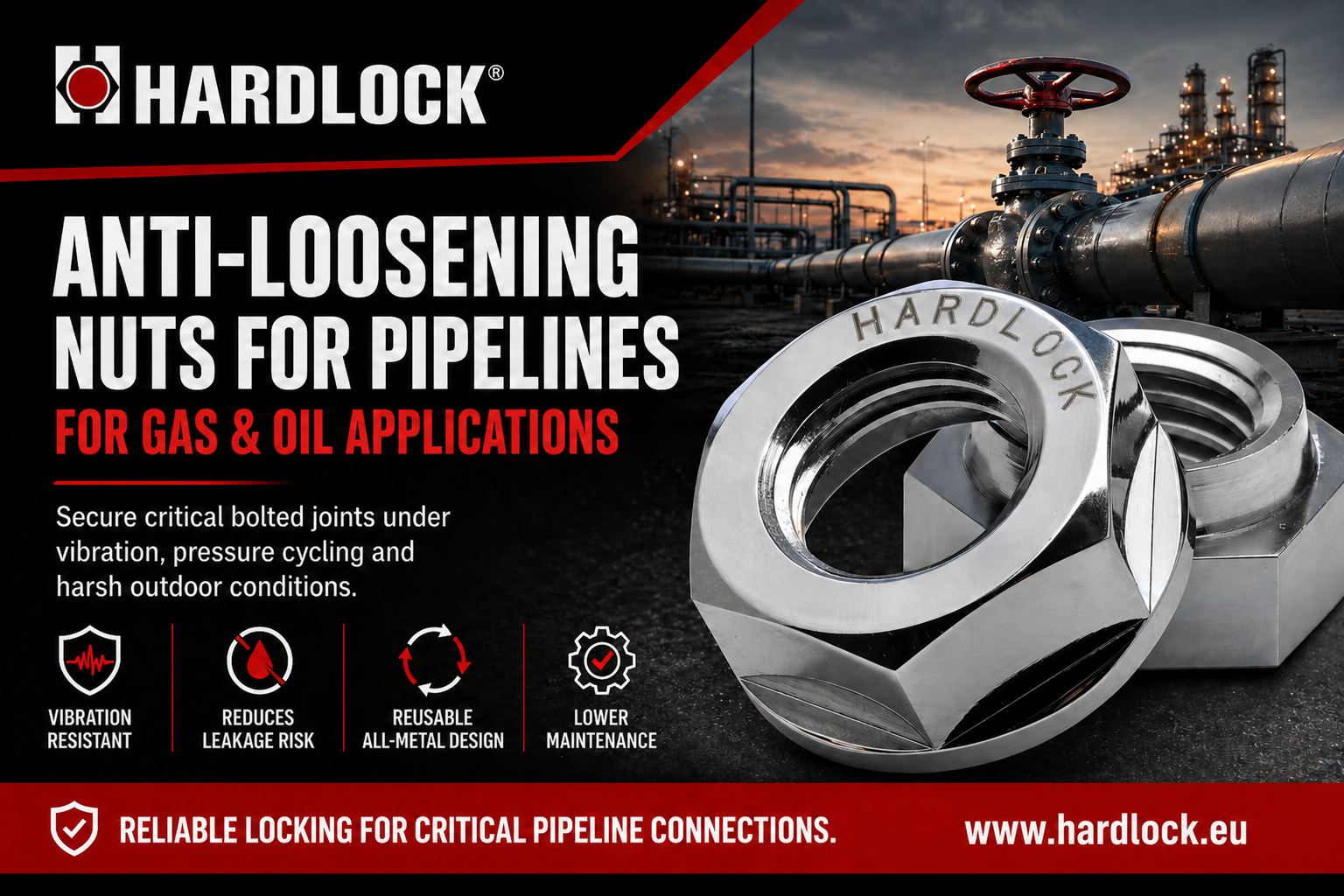
Anti-Loosening Nuts for Gas & Oil Pipelines: HARDLOCK® Solution for Safer Pipeline Connections
Anti-loosening nuts for pipelines are essential for gas and oil systems exposed to vibration, pressure changes, and harsh outdoor conditions. In these critical applications, bolted joints must remain secure for many years without unexpected loosening.
In pipeline systems, even small bolt loosening can create serious risks. It may reduce sealing performance, increase leakage risk, and lead to costly maintenance or shutdowns.
Therefore, choosing the right anti-loosening nut is essential.
The HARDLOCK® Nut provides a mechanical locking solution for critical pipeline connections. It helps maintain joint stability even in harsh oil and gas environments.
Why Anti-Loosening Nuts for Pipelines Matter
Pipeline systems are not static.
During operation, they are affected by many forces. These include:
- Flow-induced vibration
- Compressor and pump vibration
- Pressure cycling
- Thermal expansion and contraction
- Ground movement
- External shock and impact
- Outdoor corrosion and weather exposure
Over time, these forces can reduce bolt preload.
When preload decreases, the joint becomes less stable. Small movements between the bolt and nut can then increase loosening. As a result, flange connections, support structures, valve assemblies, and equipment mounts may require repeated inspection and retightening.
For general safety guidance in gas transmission and pipeline systems, operators often refer to international standards and industry bodies such as ASME and API. Pipeline integrity and safety are also discussed by organizations such as the Pipeline and Hazardous Materials Safety Administration.
You can learn more about the root cause here:
Why Bolts Loosen And How HARDLOCK® Nuts Prevent It
Why Pipeline Bolted Joints Can Loosen
Standard hex nuts are simple and widely used. However, they rely mainly on friction and proper tightening.
In pipeline applications, this may not be enough.
Vibration, pressure changes, and long-term stress can gradually reduce clamping force. Once the initial preload is lost, the connection can begin to loosen.
Traditional solutions such as lock washers, double nuts, or adhesives may also have limitations. Some solutions lose effectiveness under vibration. Others are difficult to inspect, remove, or reuse during maintenance.
For this reason, engineers often look for a more reliable anti-loosening fastening method.
Compare different solutions here:
HARDLOCK® Nuts vs Locking Nuts & Washers
The HARDLOCK® Nut Solution
The HARDLOCK® Nut uses a unique mechanical wedge-locking principle.
It consists of two specially designed nuts. When installed together, they create a strong locking effect. This removes thread clearance and prevents the nut from rotating loose.
Unlike conventional locking systems, the locking force is mechanical. Therefore, it does not depend only on friction, adhesives, or plastic inserts.
As a result, the connection remains secure under vibration and dynamic loads.
Learn more about the product here:
HARDLOCK® Nut
Real Use of Anti-Loosening Nuts in Gas and Oil Pipelines
In real pipeline projects, anti-loosening nuts for pipelines are often selected for flange joints, valve assemblies, pipe supports, and equipment exposed to continuous vibration. HARDLOCK® nuts can be used in many pipeline-related applications.
Typical examples include:
- Pipeline flange connections
- Valve and actuator assemblies
- Compressor stations
- Pump stations
- Pipe support structures
- Skid-mounted equipment
- Pressure vessel connections
- Metering stations
- Refinery pipeline systems
- Offshore and onshore pipeline facilities
In these locations, loosening prevention is critical.
A pipeline connection must remain stable during continuous operation. It must also support inspection and maintenance without unnecessary downtime.
Because HARDLOCK® nuts are all-metal and reusable, they are suitable for applications where long service life and maintainability are important.
Related article:
Anti Loosening Nuts for Flange Connections: Oil & Gas Safety Solution
Key Benefits for Pipeline Operators
When standard nuts are replaced with HARDLOCK® nuts, pipeline operators can improve fastening reliability.
Main benefits include:
- Strong resistance to vibration-induced loosening
- Stable clamping force under dynamic loads
- Reduced need for retightening
- Improved safety in critical bolted joints
- Lower maintenance frequency
- Reusable all-metal design
- Easy installation with standard tools
- Suitable for harsh outdoor and industrial environments
In addition, HARDLOCK® nuts support long-term reliability. This is especially important for pipeline networks where access may be difficult and downtime can be expensive.
Explore the main benefits here:
HARDLOCK® Nut: Main Benefits and How It Prevents Loosening
Pipeline Flange Connections
Flange joints are among the most important bolted connections in pipeline systems.
They must maintain sealing performance under pressure, vibration, and temperature changes. If bolts loosen, sealing force may decrease. This can increase the risk of leakage.
Therefore, anti-loosening performance is essential.
HARDLOCK® nuts help maintain the connection by preventing nut rotation. As a result, the flange joint remains more stable over time.
This makes them suitable for:
- Gas transmission pipelines
- Oil pipelines
- Refinery piping
- Chemical process piping
- Offshore pipeline systems
- High-pressure flange joints
For oil and gas flange applications, read also:
Anti Loosening Nuts for Flange Connections: Oil & Gas Safety Solution
Compressor and Pump Stations
Compressor and pump stations generate continuous vibration.
This vibration can affect base frames, pipe supports, coupling guards, equipment mounts, and nearby flange joints. Over time, standard fasteners may loosen and require repeated maintenance.
HARDLOCK® nuts help reduce this risk.
The mechanical wedge-locking principle keeps the nut secure even when exposed to vibration. Therefore, they are suitable for rotating equipment areas where stable fastening is required.
Typical use areas include:
- Compressor skids
- Pump bases
- Motor mounts
- Pipe supports
- Equipment frames
- Valve actuator brackets
As a result, maintenance teams can reduce retightening work and improve equipment reliability.
Outdoor and Harsh Environment Performance
Pipelines are often exposed to outdoor conditions.
They may face rain, dust, temperature changes, coastal air, freezing conditions, and sunlight. In some oil and gas facilities, fasteners may also be exposed to high temperatures or corrosive atmospheres.
For these reasons, the fastening system must be selected carefully.
HARDLOCK® nuts are available in different materials and surface treatments depending on application requirements. Therefore, they can be adapted to many industrial environments.
For demanding thermal conditions, see:
HARDLOCK® Nuts in High Temperature Applications
For offshore and onshore environments, read:
Offshore & Onshore Applications of HARDLOCK® Nuts: Engineering Reliability in Extreme Environments
Reduced Maintenance and Lifecycle Cost
Pipeline maintenance is expensive.
Many pipeline assets are located in remote or hard-to-access areas. In addition, shutdowns can create production losses and safety risks.
Loose fasteners increase inspection and retightening work. They can also create unplanned maintenance.
By preventing loosening, HARDLOCK® nuts help reduce these problems.
They support:
- Longer inspection intervals
- Less retightening work
- Lower risk of unexpected loosening
- Improved reliability of critical joints
- Better lifecycle cost performance
Therefore, HARDLOCK® nuts are not only a fastening component. They are a reliability improvement for pipeline operations.
When to Choose HARDLOCK® Nuts for Pipelines
Consider HARDLOCK® nuts when your pipeline application includes:
- High vibration
- Pressure cycling
- Safety-critical flange joints
- Difficult access for maintenance
- Outdoor exposure
- Long service life requirements
- Repeated loosening problems
- High downtime costs
They are especially valuable where standard nuts, lock washers, or adhesives do not provide enough long-term reliability.
You can also explore wider industrial use cases here:
Where Is HARDLOCK® Nut Used? Key Applications Across Industries
Conclusion
For gas and oil infrastructure, anti-loosening nuts for pipelines provide a practical way to improve safety, reduce maintenance, and protect critical bolted joints.
Vibration, pressure changes, temperature fluctuations, and outdoor conditions can all reduce preload and cause loosening. In critical pipeline systems, this can lead to leakage, downtime, and safety risks.
The HARDLOCK® Nut provides a mechanical anti-loosening solution for pipeline connections.
By using the wedge-locking principle, it helps maintain joint stability under real operating conditions. As a result, pipeline operators can improve safety, reduce maintenance, and increase long-term reliability.
For pipeline flange connections, compressor stations, pump stations, and other oil and gas applications, HARDLOCK® nuts offer a strong and proven fastening solution.
Learn more about the technology:
HARDLOCK® Nut – The World’s Strongest Self-locking Nut
Need a reliable anti-loosening solution for pipeline joints?
Contact HARDLOCK Europe