Introduction
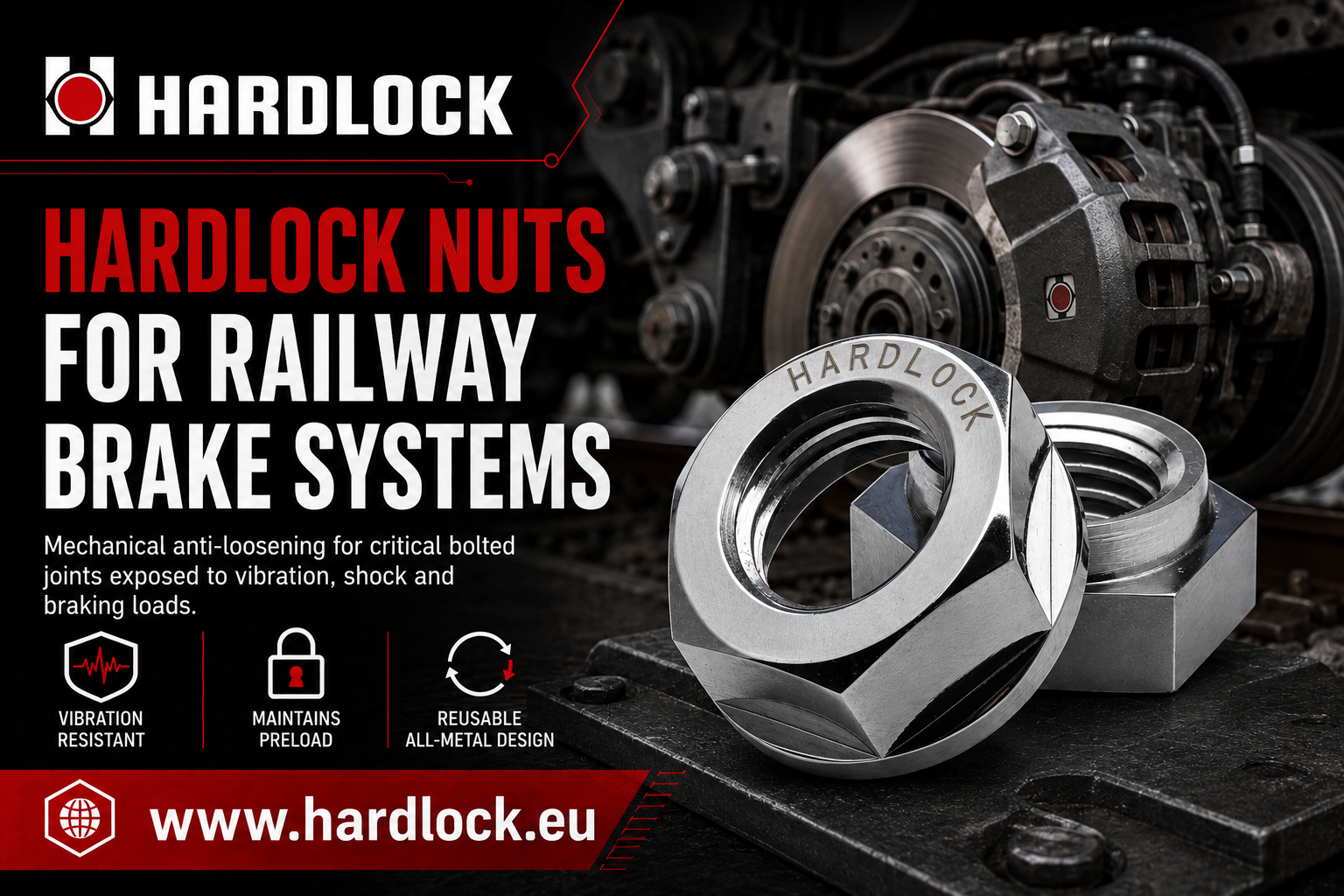
Railway locking nuts are essential for brake systems exposed to vibration, braking loads, thermal cycling, and repeated maintenance.
In rolling stock, brake-related fasteners must remain secure during long service intervals. Even minor bolt loosening can reduce clamping force, increase component movement, and create additional inspection or re-tightening work.
HARDLOCK® nuts provide a mechanical anti-loosening solution for railway brake systems where conventional nuts, washers, or adhesives may not provide sufficient long-term vibration resistance.
Railway brake assemblies are exposed to:
- wheel–rail vibration
- repeated braking cycles
- thermal expansion and contraction
- bogie shock loads
- safety-critical maintenance requirements
For related railway applications, see HARDLOCK® Nuts in Rolling Stock.
Technical Context for Railway Brake Applications
Railway brake systems operate in a highly regulated environment where safety, reliability, and long-term performance are critical.
For European railway projects, rolling stock requirements are connected with the Technical Specifications for Interoperability published by the European Union Agency for Railways. These TSIs cover rolling stock and other railway subsystems.
Brake system engineering is also addressed in railway standards and guidance. RSSB’s braking system requirements define principles of operation and performance requirements for braking systems on multiple units, supporting safe operation and interoperability.
Real-world railway safety investigations also highlight the importance of train braking system integrity. The UK Rail Accident Investigation Branch provides safety learning related to train braking systems and operational risk control.
For rolling stock disc brake components, EN 15328 covers requirements for brake pads used in disc brakes of railway rolling stock.
This technical environment makes fastening reliability especially important in brake-related assemblies, where vibration, thermal cycling, and repeated maintenance can contribute to bolt loosening.
Why Railway Locking Nuts Matter in Brake Systems
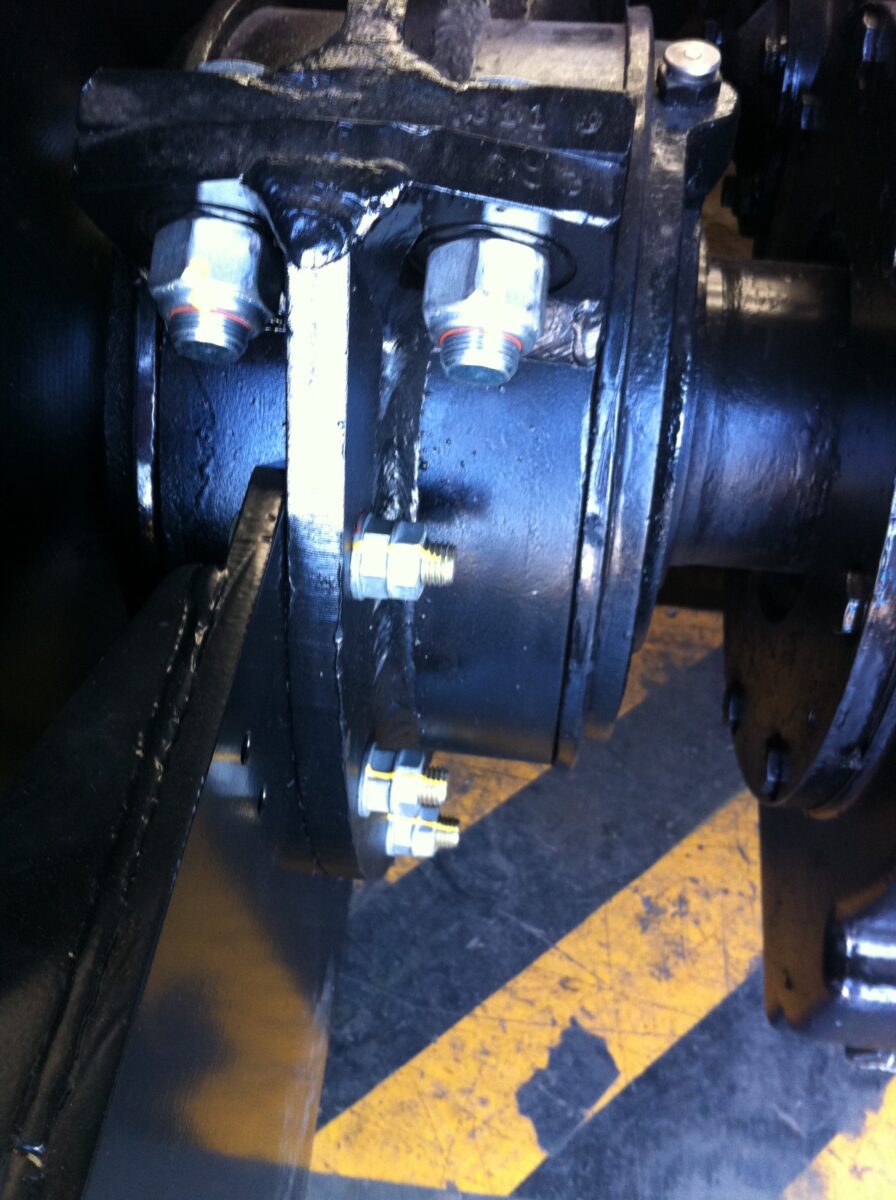
Railway brake systems are exposed to repeated mechanical and thermal stress.
During operation, bolted joints may experience:
- dynamic braking loads
- vibration from bogies and wheelsets
- temperature changes from braking cycles
- impact forces during service
- repeated maintenance handling
These factors can reduce bolt preload over time.
Once preload decreases, small movements can occur between connected parts. This can lead to progressive loosening, wear, noise, and increased maintenance work.
Detailed explanation:
Why Bolts Loosen (And How HARDLOCK® Nuts Prevent It)
Railway Locking Nuts in Real Brake System Application
1. Railway Locking Nuts for Disc Brake Mounting Areas
Disc brake assemblies are safety-critical components in rolling stock.
These areas are exposed to:
- repeated braking force
- vibration from wheelset operation
- thermal expansion
- high-frequency service cycles
Using anti-loosening nuts for railway brake systems helps maintain stable fastening in areas where looseness must be avoided.
Related application:
Railway (Rolling Stock)
2. Anti-Loosening Nuts for Brake Calipers and Brake Units
Brake calipers and brake units require accurate positioning and stable clamping.
Fastener loosening can create:
- reduced component stability
- increased vibration
- uneven wear
- additional maintenance checks
HARDLOCK® nuts provide a mechanical locking solution for assemblies exposed to vibration and dynamic loads.
Related article:
HARDLOCK® Nuts in Rolling Stock
3. Railway Locking Nuts for Bogie-Mounted Brake Equipment
Brake components mounted on bogies are exposed to some of the most severe vibration conditions on a railway vehicle.
Bogie environments include:
- wheel–rail vibration
- lateral forces in curves
- shock loads from track irregularities
- dynamic loads during acceleration and braking
Anti-loosening nuts for railway brake systems help reduce the risk of loosening where maintenance access may be limited and reliability is critical.
Similar railway vibration application:
HARDLOCK® Nuts in Rail Track Systems
4. Brake Actuator and Linkage Mounting
Brake actuators, brackets, and linkage systems must remain securely fastened during repeated operating cycles.
Common challenges include:
- cyclic movement
- vibration-induced preload loss
- mechanical shock
- alignment sensitivity
If fasteners loosen, movement can increase and component reliability may decrease.
HARDLOCK® nuts help maintain joint stability by preventing rotational loosening under vibration.
Technical comparison:
HARDLOCK® Nuts vs Locking Nuts & Washers: Which Solution Performs Best Under Vibration?
5. Brake Piping, Cable, and Support Brackets
Brake systems also include support structures such as:
- piping brackets
- cable clamps
- sensor brackets
- protective covers
- mounting frames
These parts may not carry the same braking force as primary brake components, but loosening can still cause vibration, noise, wear, and maintenance issues.
For railway vehicles, even auxiliary fastening points must remain stable over long service intervals.
Related railway equipment article:
HARDLOCK® Nuts in Auxiliary Railway Equipment
Why Conventional Fastening Methods Can Fail
Many conventional locking methods depend on friction, deformation, or installation conditions.
Common solutions include:
- standard hex nuts
- nylon insert nuts
- spring washers
- double nuts
- thread-locking adhesives
In railway brake systems, these solutions may face limitations.
Spring Washers
Spring washers may lose effectiveness under vibration and repeated loading.
Nylon Insert Nuts
Nylon insert nuts depend on polymer friction and may not be suitable for high-temperature or repeated maintenance environments.
Adhesives
Adhesives require clean surfaces, correct curing conditions, and may complicate inspection or disassembly.
Double Nut Systems
Double nut systems depend heavily on correct installation technique.
For safety-critical rolling stock applications, engineers need a locking solution that addresses the root cause of loosening: rotational movement caused by thread clearance.
Detailed overview:
Bolt Locking Methods Explained: How to Prevent Loosening and Maintain Preload
How HARDLOCK® Nuts Prevent Loosening in Brake Applications
HARDLOCK® Nuts use a mechanical wedge-locking principle.
The system consists of two specially designed nuts:
- a convex nut
- a concave nut
When tightened together, the wedge effect generates radial force on the bolt threads.
This creates:
- elimination of thread clearance
- prevention of rotational movement
- stable locking under vibration
- reliable performance without adhesives
Unlike friction-based solutions, HARDLOCK® does not rely only on surface friction.
This makes it suitable for railway brake systems where vibration, thermal cycles, safety, and maintenance reliability are critical.
Product information:
HARDLOCK Nut
Technical Benefits of Railway Locking Nuts for Brake Systems
✔ Resistance to Vibration
Brake system fasteners must withstand continuous vibration and shock loads.
HARDLOCK® nuts are designed to prevent loosening under vibration by using a mechanical wedge-locking system.
✔ Stable Fastening During Braking Cycles
Repeated braking creates cyclic forces and thermal changes.
A secure bolted joint helps maintain stable component positioning during long-term operation.
✔ Reduced Maintenance Requirements
Loose fasteners require inspection, re-tightening, and replacement work.
Using anti-loosening nuts for railway brake systems can help reduce:
- re-tightening cycles
- maintenance workload
- unplanned service interventions
- downtime risk
✔ Suitable for Safety-Critical Assemblies
Railway braking systems require high reliability.
Fastening solutions must support:
- safe operation
- long service life
- predictable maintenance
- stable clamping force
✔ Reusable Mechanical Locking
HARDLOCK® nuts are fully metallic and reusable.
This is important for railway maintenance environments where components may need to be inspected, removed, and reassembled.
Comparison: HARDLOCK® vs Conventional Fastening Methods
| Feature | Standard Nut | Nylon Insert Nut | Adhesive | Spring Washer | HARDLOCK® Nut |
|---|---|---|---|---|---|
| Vibration resistance | Low | Medium | Medium | Low | Very High |
| Suitable for brake vibration | Low | Medium | Medium | Low | Excellent |
| Maintenance reduction | Low | Medium | Medium | Low | High |
| Reusability | High | Low | Low | Medium | High |
| Mechanical locking | No | No | No | No | Yes |
| Dependence on friction | High | High | Medium | High | Low |
When to Specify HARDLOCK® Nuts for Railway Brake Systems
Consider HARDLOCK® nuts if your application involves:
- repeated brake vibration
- high safety requirements
- thermal expansion and contraction
- critical bolted joints
- difficult maintenance access
- frequent re-tightening work
- failure risk from preload loss
- long service life expectations
Typical stakeholders include:
- rolling stock manufacturers
- brake system suppliers
- railway operators
- maintenance teams
- overhaul workshops
- engineering departments
- procurement teams evaluating lifecycle cost
Related HARDLOCK® Railway Articles
Continue reading related HARDLOCK® railway and vibration-resistance articles:
- HARDLOCK® Nuts in Rolling Stock
- HARDLOCK® Nuts in Rail Track Systems
- HARDLOCK® Nuts in Auxiliary Railway Equipment
- Anti-Loosening Nuts for Pantographs: HARDLOCK® Solution
- Why Bolts Loosen And How HARDLOCK® Nuts Prevent It
- Junker Test Lock Nut: HARDLOCK® Vibration Proof Nut
- HARDLOCK® Nuts vs Locking Nuts & Washers
Conclusion: Reliable Fastening for Railway Brake Safety
Railway brake systems require fastening solutions that remain secure under vibration, thermal cycling, braking loads, and long-term service conditions.
Conventional nuts, washers, and adhesives may not provide reliable anti-loosening performance in vibration-critical railway applications.
HARDLOCK® nuts provide a mechanical locking solution that helps prevent bolt loosening at the root cause.
For rolling stock brake systems, this means:
- improved fastening reliability
- reduced maintenance work
- better long-term joint stability
- support for safety-critical operation
- lower lifecycle risk
HARDLOCK® — mechanical anti-loosening performance for railway brake systems.
Need a Proven Anti-Loosening Solution for Railway Brake Systems?
Working on rolling stock brake equipment, bogie-mounted components, disc brake assemblies, or maintenance-critical railway systems?
Contact HARDLOCK® experts for:
- engineering consultation
- application-specific recommendations
- product selection support
- railway fastening experience
- technical information for your project
FAQ
What are anti-loosening nuts for railway brake systems?
Anti-loosening nuts for railway brake systems are locking fasteners designed to prevent bolt loosening caused by vibration, braking cycles, thermal expansion, and dynamic loads in rolling stock brake assemblies.
Why do bolts loosen in railway brake systems?
Bolts can loosen because railway brake systems are exposed to vibration, cyclic braking loads, shock, thermal changes, and repeated maintenance conditions. These factors can reduce preload and allow rotational movement.
Are HARDLOCK® nuts suitable for railway brake applications?
Yes. HARDLOCK® nuts are designed for vibration-critical applications and are used in railway rolling stock environments where stable fastening and reduced maintenance are important.
How do HARDLOCK® nuts prevent loosening?
HARDLOCK® nuts use a mechanical wedge-locking principle. A convex and concave nut are tightened together, creating radial locking force on the bolt threads and preventing rotational loosening.
Do HARDLOCK® nuts require adhesives?
No. HARDLOCK® nuts provide mechanical locking without thread-locking adhesives.
Can HARDLOCK® nuts reduce railway maintenance work?
Yes. By preventing loosening under vibration, HARDLOCK® nuts can help reduce re-tightening work, inspection frequency, and maintenance caused by loose fasteners.