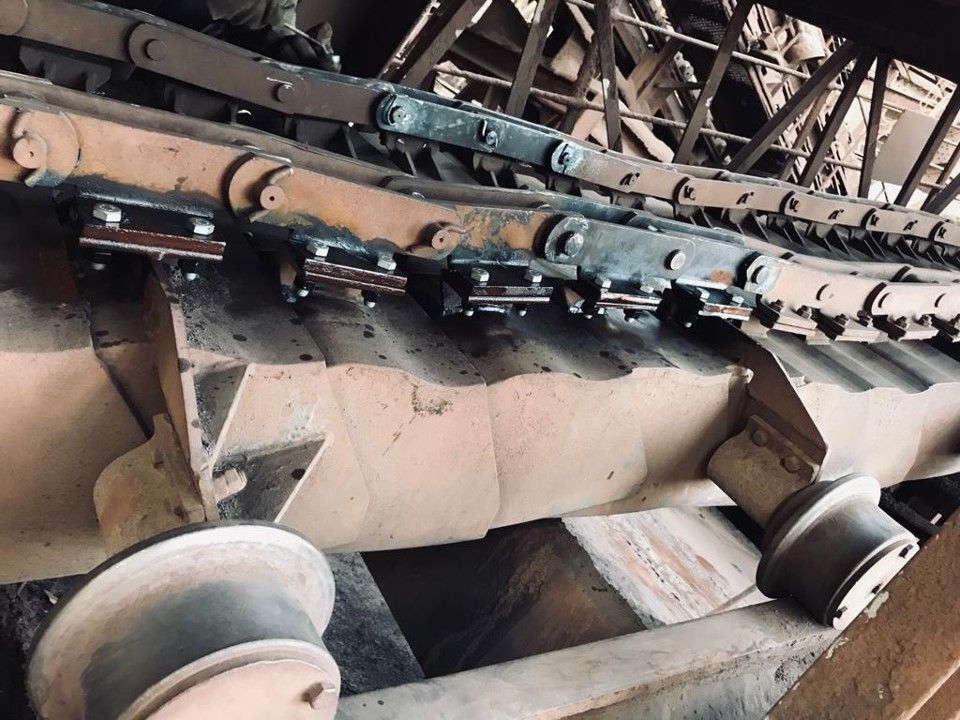
Bolted joints in sintering plant cooling conveyors loosen due to both rotational loosening from operational loads and non-rotational loosening caused by extreme temperature fluctuations. After sintering, materials can reach temperatures just below their melting points—often exceeding 1000°C for both steel and ceramics. As these materials pass through the cooling conveyor, they cool down to safe handling temperatures, typically below 200°C.
Most fasteners—including self-locking types—rely on bolt preload to maintain clamping force, with friction at the threads, bearing surfaces, and joint interface preserving this force. When preload is lost due to non-rotational loosening, friction drops, increasing the risk of rotational loosening. In this application, conventional locknuts with spring washers failed to prevent loosening and bolt breakage.
The HARDLOCK® nut’s design incorporates interlocking nuts that generate two distinct loads on the bolt: the Convex Nut applies preload, while the Concave Nut engages a wedge interface, generating a strong transverse locking load across the bolt shaft. Even if preload is reduced due to non-rotational loosening, the transverse locking load remains unaffected, mechanically preventing further rotational loosening. This drastically reduced joint failures and unplanned downtime, improving overall plant efficiency.