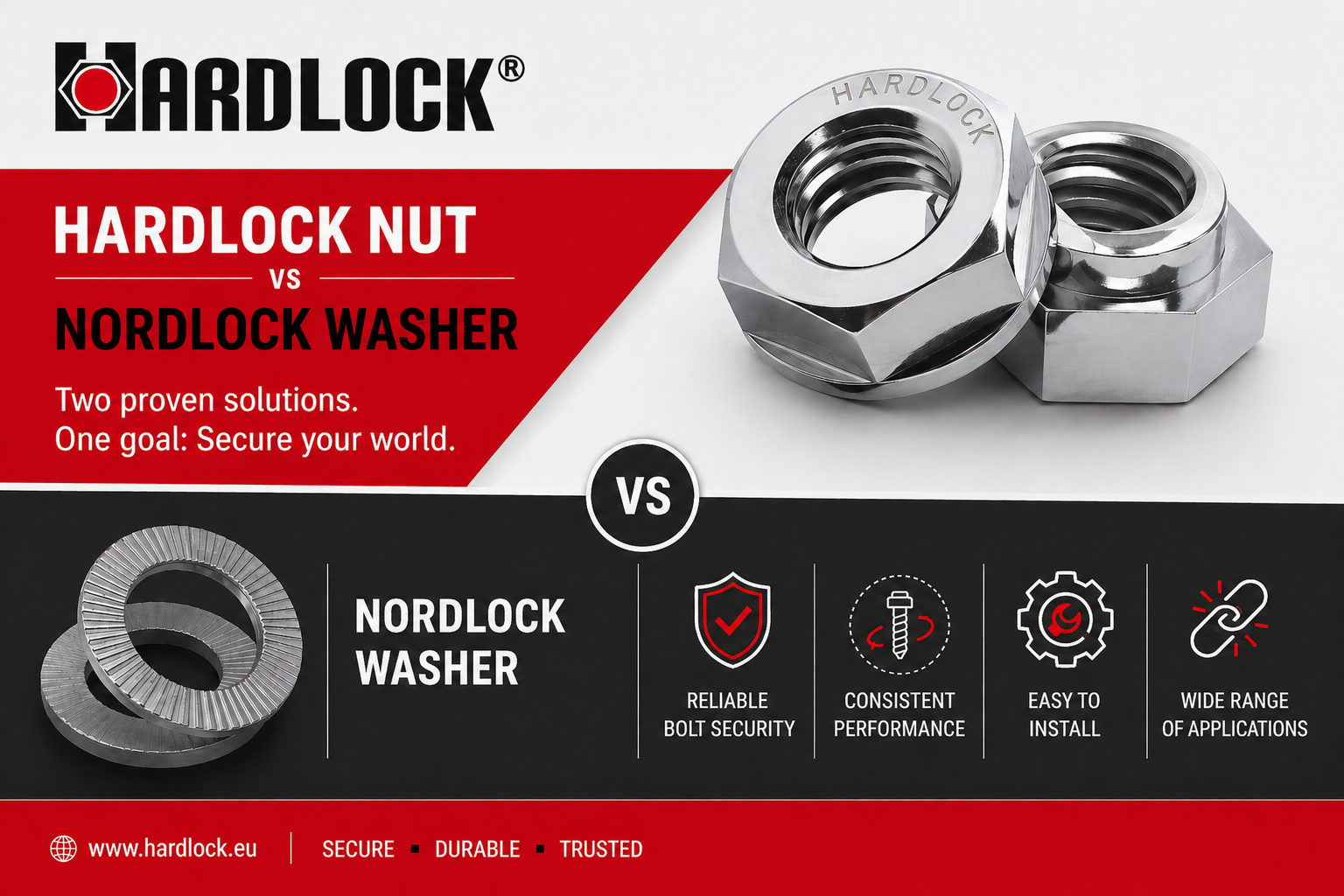
In applications exposed to vibration, dynamic loads, or temperature changes, preventing bolt loosening is essential for safety and reliability.
Two widely used solutions are HARDLOCK® Nut and Nord-Lock® wedge-locking washers. Both are designed to improve joint security—but they use different mechanical principles.
This article provides a clear, technical comparison to help you choose the right solution for your application.
Why Preventing Bolt Loosening Matters
Bolt loosening can lead to:
- Loss of preload
- Equipment malfunction
- Increased maintenance costs
- Safety risks in critical systems
This is especially important in industries such as:
- Transportation and railway systems
- Energy and power generation
- Construction and infrastructure
- Heavy machinery and manufacturing
Overview of the Two Solutions
HARDLOCK® Nut
HARDLOCK® Nut is a mechanical locking system consisting of two nuts working together.
Key concept:
- The top nut has an off-center (eccentric) thread
- Tightening creates a radial locking force
- This force helps prevent rotation of the nut
Nord-Lock® Washer
Nord-Lock® washers are wedge-locking washers used in pairs.
Key concept:
- Two washers with cam faces are installed together
- When tightened, they create a wedge effect
- The system is designed so that loosening requires more movement than tightening
Comparison of Locking Principles
| Feature | HARDLOCK® Nut | Nord-Lock® Washer |
|---|---|---|
| Type of solution | Nut-based system | Washer-based system |
| Locking principle | Radial mechanical locking (eccentric thread) | Wedge-locking via cam surfaces |
| Components required | Two-part nut system | Pair of washers + standard nut/bolt |
| Installation | Similar to standard nut tightening | Requires correct washer orientation |
| Reusability | Designed for repeated use | Typically reusable depending on condition |
| Application flexibility | Replaces standard nut | Used in combination with standard fasteners |
Performance Considerations
Both solutions are designed to improve resistance to loosening. The choice depends on the specific application and design requirements.
Vibration and Dynamic Loads
- Both systems are engineered for environments with vibration
- Performance may vary depending on installation, joint design, and load conditions
Installation and Assembly
- HARDLOCK® Nut integrates directly into the fastening system
- Nord-Lock® washers require correct pairing and positioning during installation
In both cases, proper installation is essential for optimal performance.
Space and Design Constraints
- HARDLOCK® Nut replaces a standard nut, which may simplify assembly in some designs
- Washer-based systems may require additional space depending on configuration
Maintenance and Inspection
- Both systems are used in applications aiming to reduce maintenance
- Inspection practices depend on industry standards and operating conditions
Typical Applications
Both HARDLOCK® Nut and Nord-Lock® washers are used in demanding environments, including:
- Railway and transportation systems
- Construction and structural engineering
- Energy and power generation
- Industrial machinery
The selection often depends on design preferences, standards, and engineering requirements.
Choosing the Right Solution
When selecting a locking system, consider:
- Type and intensity of vibration
- Available installation space
- Assembly process and accessibility
- Maintenance strategy
- Industry-specific standards or requirements
Each solution offers a different approach to achieving joint security.
Key Takeaway
Both HARDLOCK® Nut and Nord-Lock® washers are designed to enhance the reliability of bolted joints.
The main difference lies in their mechanical design and integration into the assembly:
- HARDLOCK® Nut integrates the locking mechanism within the nut itself
- Nord-Lock® washers provide a locking function through paired washer geometry
Understanding these differences helps engineers select the most suitable solution for their specific application.
Frequently Asked Questions
What is the difference between a locking nut and a wedge-locking washer?
A locking nut integrates the locking mechanism into the nut, while a wedge-locking washer uses paired washers to create resistance to loosening.
Are both solutions suitable for vibration environments?
Yes, both are designed for applications where vibration is a concern, provided they are correctly installed.
How do I choose between them?
The choice depends on design constraints, installation preferences, and application requirements.
Need Help Selecting the Right Fastening Solution?
Choosing the right anti-loosening system is essential for safety, reliability, and long-term performance.
👉 Contact us to discuss the best solution for your application.