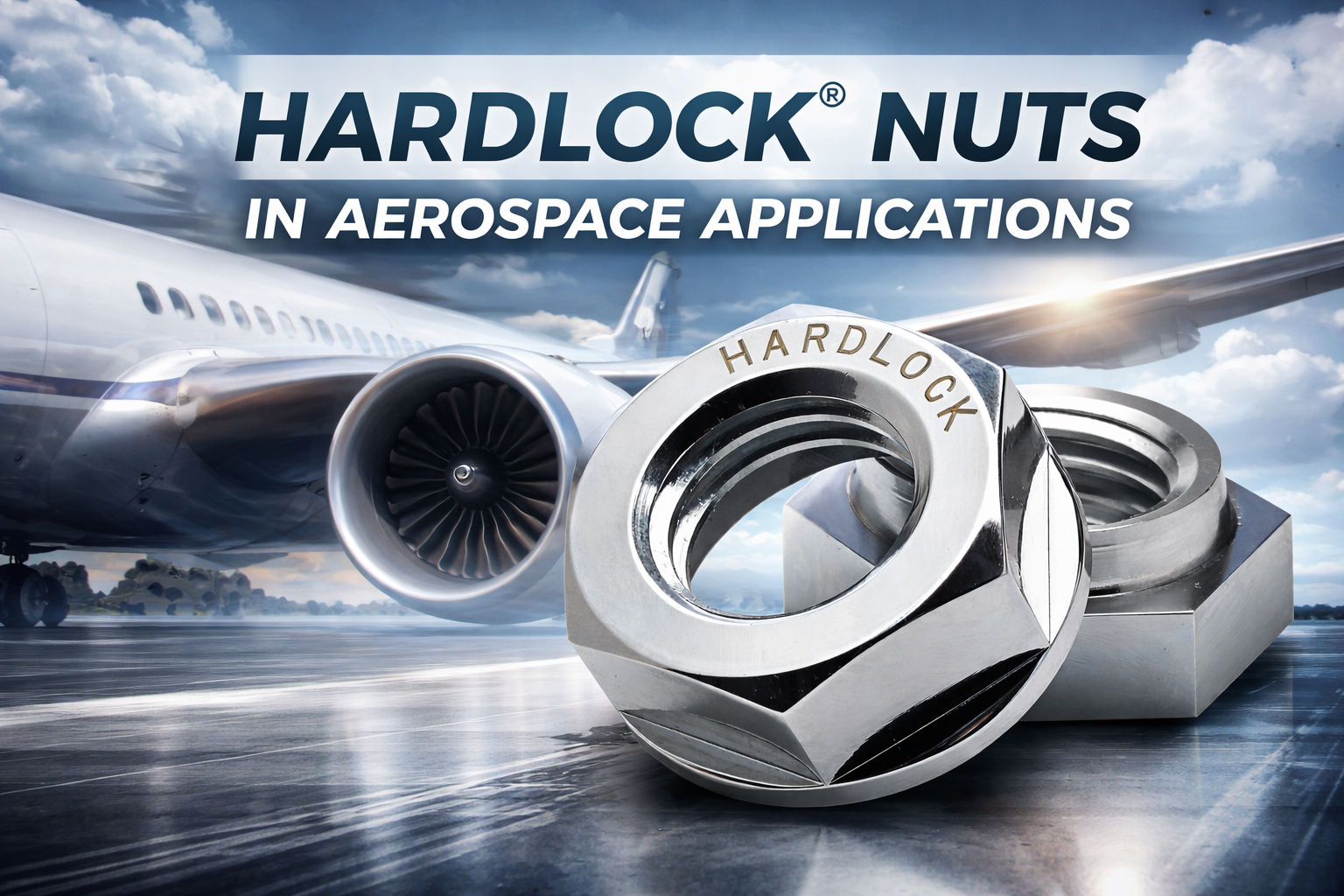
The Challenge: Fastener Failure in Aerospace Environments
In the aerospace industry, fastening reliability is not optional — it is critical to safety, performance, and compliance.
Aircraft components are continuously exposed to:
- High-frequency vibration
- Thermal expansion and contraction
- Dynamic loads and cyclic stress
- Pressure fluctuations
Under these conditions, conventional fastening methods often fail due to loss of preload, leading to:
- Bolt loosening
- Structural instability
- Increased maintenance intervals
- Safety risks
As explained in our article:
👉 https://www.hardlock.eu/blog/why-bolts-loosen-under-vibration/
Even properly tightened bolts can loosen when subjected to vibration.
Why Conventional Locking Methods Are Not Enough
Traditional solutions such as:
- Spring washers
- Nylon insert nuts
- Double nut systems
rely primarily on friction to maintain locking force.
However, under vibration:
- Friction decreases
- Micro-movements occur
- Preload is gradually lost
This mechanism is described in detail here:
👉 https://www.hardlock.eu/blog/how-to-prevent-bolt-loosening/
In aerospace applications, this is unacceptable.
The HARDLOCK® Solution: Mechanical Wedge Locking
HARDLOCK® Nuts use a unique wedge-locking principle that eliminates reliance on friction.
The system consists of:
- A convex (top) nut
- A concave (bottom) nut
When tightened:
- The wedge effect creates a constant axial force
- Thread clearance is eliminated
- Loosening is mechanically prevented
Learn more about the principle and advantages:
👉 https://www.hardlock.eu/hardlock-nut-main-benefits/
Proven Performance: Tested Under NAS Standards
Reliability in aerospace requires validated testing.
HARDLOCK® Nuts have been tested according to NAS (National Aerospace Standard) vibration test methods, confirming their performance under extreme vibration conditions.
📖 Detailed test methodology:
👉 https://hardlock-nut.com/technical-info/data/bolt-vibration-test-methods/
📊 NAS vibration test results:
👉 https://hardlock-nut.com/technical-info/data/nas-test/
These tests demonstrate:
- No loosening under severe vibration
- Stable preload retention
- Superior performance compared to conventional locking methods
Real-World Aerospace Use Cases
HARDLOCK® Nuts are suitable for a wide range of aerospace applications, including:
✈️ Aircraft Structures
- Airframe connections
- Structural joints exposed to cyclic loads
🛠 Engine and Auxiliary Systems
- Components subjected to high vibration and thermal stress
🚁 Rotorcraft Systems
- Critical joints in helicopters where vibration is extreme
🛰 Ground Support & Aerospace Infrastructure
- Equipment requiring long-term reliability with minimal maintenance
Case Insight: Lessons from High-Vibration Industries
Applications such as vibration screens in heavy industry show similar challenges to aerospace environments.
👉 https://www.hardlock.eu/hardlock-nut-on-vibration-screens/
In these cases:
- Conventional fasteners fail rapidly
- Maintenance costs increase
- Downtime becomes critical
HARDLOCK® eliminates these issues through mechanical locking rather than friction-based resistance.
Key Benefits for Aerospace Engineers
Using HARDLOCK® Nuts provides:
✔ Guaranteed anti-loosening performance
✔ Stable preload under vibration
✔ Reduced maintenance and inspection intervals
✔ Increased safety and reliability
✔ Long-term cost efficiency
Why This Matters
In aerospace engineering, failure is not an option.
The difference between:
- A friction-based locking system
- A mechanically secured joint
can determine the reliability of an entire system.
Conclusion: Engineering Reliability Beyond Friction
HARDLOCK® Nuts provide a proven, tested, and reliable solution for preventing bolt loosening in aerospace applications.
By eliminating dependence on friction and ensuring mechanical locking, they meet the demands of even the most extreme environments.
📩 Get in Touch
Looking for a reliable fastening solution for aerospace applications?
👉 Contact our technical team to discuss your specific requirements and testing conditions.