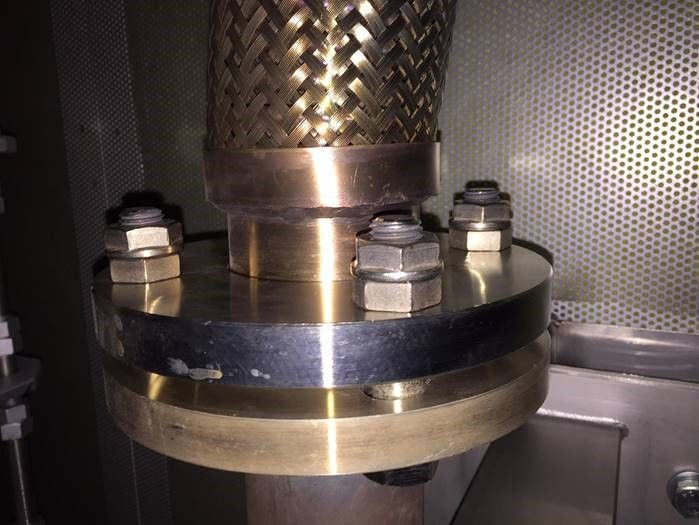
Introduction
High temperature environments represent one of the most demanding conditions for bolted joints. Whether in power generation, naval engineering, or steel production, elevated temperatures accelerate loosening, reduce preload, and compromise safety.
HARDLOCK® nuts provide a mechanical locking solution that maintains integrity even at temperatures reaching up to 800 °C, as demonstrated in real-world applications across multiple industries.
This article presents verified use cases, materials, and operating conditions based on actual deployments, reinforcing both engineering credibility and B2B decision confidence.
Why High Temperature Fastening Is a Critical Risk
At temperatures above 300 °C, conventional fastening systems begin to fail due to:
- Loss of friction coefficient
- Relaxation and creep of materials
- Thermal expansion mismatch
- Degradation of locking elements (e.g., nylon, adhesives)
In critical systems such as turbines or furnaces, even minor loosening can lead to:
- Equipment failure
- Costly downtime
- Safety hazards
For a deeper understanding of loosening mechanisms, see related article:
→ How HARDLOCK® Nuts Prevent Loosening (internal link)
HARDLOCK® Solution: Mechanical Locking Independent of Temperature
Unlike friction-based systems, HARDLOCK® nuts rely on a wedge-locking principle that:
- Does not depend on surface friction
- Is unaffected by thermal cycling
- Maintains preload under vibration and expansion
Because the system is entirely metallic, it eliminates temperature-sensitive components, making it suitable for extreme heat environments.
Verified Use Cases in High Temperature Applications
The following real-world applications demonstrate the performance of HARDLOCK® nuts across industries and temperature ranges:
1. Gas Turbine Systems (Naval Engineering)
- Application: Exhaust pipe of gas turbine engine (destroyer ship)
- Sizes: M10, M12–M22, M24
- Materials: S45C, SUS304
- Surface Treatments: Aluminum coating, manganese phosphate, unplated
- Operating Temperature: 300 °C – 600 °C
These systems experience extreme thermal cycling and vibration, where maintaining preload is critical for operational safety.
2. Thermal Power Plants
Steam Turbine Systems
- Application: Bypass strainer (Kuwait thermal plant)
- Size: M56×3.0
- Material: SNB16
- Surface Treatment: Aluminum coating
- Operating Temperature: 543 °C
Desulfurization Equipment
- Application: Duct flange connections
- Sizes: M16–M24
- Materials:
- Hastelloy C-276 / C-22
- SUS316
- Operating Temperature: up to 500 °C
These applications require corrosion resistance + thermal stability, making alloy selection critical.
3. Steel Industry (Extreme Heat Conditions)
- Application: Electric heater in furnace
- Size: M8
- Material: SUS310S
- Surface Treatment: Unplated
- Operating Temperature: up to 800 °C
This represents one of the most extreme verified conditions, where conventional locking methods are not viable.
4. Exhaust and Piping Support Systems
- Application: Exhaust pipe supports (gas turbine systems)
- Size: M20
- Material: SUS304
- Surface Treatment: Aluminum coating
- Operating Temperature: 300–600 °C
- Application: Intake piping support (desulfurization systems)
- Size: M16
- Material: Titanium TB340
These applications combine mechanical stress, vibration, and thermal expansion, requiring consistent locking performance.
Material Selection for High Temperature Performance
Real-world applications show that HARDLOCK® nuts are compatible with a wide range of materials depending on temperature and environment:
- Carbon steel (S45C) → up to ~600 °C with coating
- Stainless steels (SUS304, SUS316, SUS310S) → corrosion + heat resistance
- High-performance alloys (Hastelloy C-276 / C-22) → aggressive chemical environments
- Nickel alloy steels (SNB7, SNB16) → high strength at elevated temperatures
- Titanium alloys (TB340) → lightweight + corrosion resistance
Surface treatments such as aluminum coating further enhance oxidation resistance at high temperatures.
Engineering Benefits for B2B Applications
Based on these deployments, HARDLOCK® nuts provide measurable advantages:
1. Proven Performance up to 800 °C
Validated across industries including steel production and power generation.
2. Reduced Maintenance Intervals
Stable preload reduces the need for retightening in high-risk environments.
3. Compatibility with Advanced Materials
Supports a wide range of alloys used in modern industrial systems.
4. Increased Operational Safety
Prevents loosening in critical infrastructure such as turbines and exhaust systems.
Related Technical Insights
To further support your engineering decisions, explore:
- Vibration Testing and Performance Results
- Applications in Heavy Industry
- Comparison with Conventional Locking Methods
Conclusion
Real-world data confirms that HARDLOCK® nuts deliver reliable locking performance across extreme temperature ranges—from 300 °C to 800 °C.
From naval gas turbines to steel furnaces and thermal power plants, they provide:
- Mechanical reliability independent of temperature
- Long-term preload stability
- Reduced operational risk and maintenance costs
For engineers and procurement specialists, HARDLOCK® represents a proven, field-tested solution for high temperature fastening challenges.
Contact HARDLOCK® Experts
Looking for a solution tailored to your high temperature application?
Our engineering team can recommend the optimal material, coating, and configuration based on your operating conditions.
→ Visit www.hardlock.eu or contact us directly for technical consultation.