Introduction
In both onshore and offshore industries, fastening reliability is not just a technical requirement—it is a critical safety and operational factor. From wind turbines and oil platforms to power plants and heavy infrastructure, bolted joints are continuously exposed to vibration, dynamic loads, and environmental stress.
Even minor loosening can result in equipment failure, downtime, or safety risks.
This is where HARDLOCK Nuts provide a proven engineering solution.
👉 Related reading:
- Why do bolts loosen? → https://www.hardlock.eu/why-do-bolts-nuts-come-loose-factors-influencing-bolt-preload-loss/
The Challenge: Fastening in Onshore vs Offshore Environments
Onshore Applications
Typical onshore environments include:
- Power plants
- Railway infrastructure
- Civil engineering structures
- Industrial machinery
These systems are exposed to:
- Continuous vibration (rotating equipment, traffic, machinery)
- Thermal expansion and contraction
- Cyclic mechanical stress
For example, in power generation systems, vibration and temperature cycles can lead to progressive preload loss, increasing fatigue and failure risks .
Offshore Applications
Offshore environments add another layer of complexity:
- Saltwater corrosion
- Extreme weather conditions
- Wave-induced dynamic loads
- Difficult maintenance access
Typical offshore structures include:
- Oil & gas platforms
- Offshore wind turbines
- Subsea installations
- Marine infrastructure
In these conditions, fastener failure is not just costly—it is often critical, as maintenance access is limited and downtime is extremely expensive.
Why Conventional Fasteners Fail
Traditional locking methods (spring washers, nylon nuts, adhesives) rely heavily on friction-based locking.
However:
- Vibration reduces friction over time
- Thermal cycling causes relaxation
- Repeated loads create micro-movements
As a result:
- Preload is lost
- Loosening accelerates
- Maintenance frequency increases
👉 Learn more:
- Hardlock vs conventional fasteners → https://hardlocknut.com/articles/hardlock-nut-vs-conventional-fasteners-whats-the-difference/
HARDLOCK Nut Technology: Mechanical Locking That Works
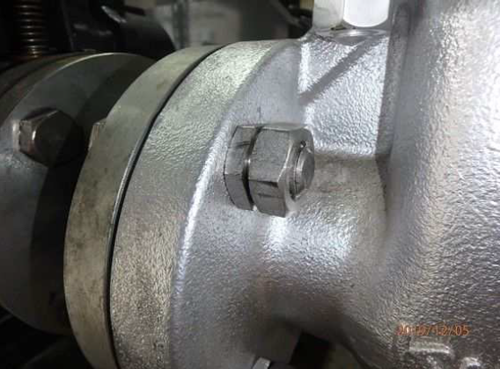
Unlike conventional systems, the HARDLOCK Nut uses a mechanical wedge-locking principle.
How It Works
- Two-part system: convex + concave nut
- Eccentric geometry creates radial locking force
- Eliminates thread clearance (main cause of loosening)
This results in:
- Stable preload under vibration
- Resistance to shock and dynamic loads
- Long-term reliability without retightening
The locking force is mechanical—not friction-based—making it highly reliable even in extreme environments .
Key Benefits for Offshore & Onshore Projects
1. Absolute Anti-Loosening Performance
HARDLOCK Nuts maintain clamping force even under:
- Continuous vibration
- Repeated shock loads
- Dynamic structural movement
This makes them ideal for safety-critical applications.
2. Reduced Maintenance & Operational Costs
Because the system:
- Does not require retightening
- Maintains preload long-term
- Is reusable
Operators benefit from:
- Lower maintenance intervals
- Reduced labor costs
- Minimal downtime
👉 Example use case:
- HARDLOCK Nut in power plants → https://www.hardlock.eu/hardlock-nut-in-power-plants/
3. Reliability in Harsh Environments
HARDLOCK Nuts are fully metallic and available in various materials and coatings, making them suitable for:
- Corrosive offshore environments
- High-temperature onshore systems
- Heavy industrial applications
4. Proven Performance Across Industries
HARDLOCK solutions are widely used in:
- Oil & gas
- Wind energy (onshore & offshore)
- Civil engineering
- Railways
- Mining and heavy industry
Typical Applications
Offshore
- Wind turbine tower connections
- Subsea structural joints
- Platform equipment fastening
- Pipeline support systems
Onshore
- Power plant piping supports
- Structural steel connections
- Rotating machinery (pumps, turbines)
- Railway and infrastructure systems
In all these applications, maintaining preload is essential to prevent fatigue, misalignment, and structural failure.
Engineering Perspective: Why Preload Stability Matters
Loss of preload leads to:
- Joint movement
- Increased stress concentration
- Accelerated fatigue
- Potential catastrophic failure
HARDLOCK Nuts eliminate this risk by:
- Locking the bolt and nut as a single system
- Preventing rotational loosening entirely
- Maintaining consistent clamping force over time
Conclusion: A Reliable Standard for Critical Infrastructure
For engineers and decision-makers in offshore and onshore industries, the choice of fastening solution directly impacts:
- Safety
- Operational reliability
- Maintenance costs
- Total lifecycle performance
HARDLOCK Nuts provide a mechanically proven, maintenance-free solution for environments where failure is not an option.
Looking for a Reliable Anti-Loosening Solution?
Explore more technical insights and real-world applications:
- https://www.hardlock.eu/blog/
- https://www.hardlock.eu/hardlock-nut-in-power-plants/
- https://www.hardlock.eu/why-do-bolts-nuts-come-loose-factors-influencing-bolt-preload-loss/
Or contact our experts for a tailored engineering consultation.