Serrated Washers vs HARDLOCK® Nuts: Preload Reliability When Reusing Bolted Joints
In vibration-critical applications, preventing loosening does not start after the machine begins operating. It starts during assembly — when the correct bolt preload is created.
Serrated washers, toothed washers and other washer-based locking systems are commonly used to increase resistance at the bearing surface. They can be practical in many applications when the mating material, surface hardness, coating, installation torque and inspection process are correctly controlled.
However, engineers and maintenance teams should consider one important question:
Can the same bolted joint achieve the same preload after repeated tightening using the original bolt, washer, nut and bearing surfaces?
In many real-world applications, the answer is: only if the friction conditions and contact surfaces remain controlled and verified.
During the first tightening operation, serrations may create surface indentations in the mating surface. Contact areas can flatten. Coatings may be affected. The friction under the nut, bolt head or washer can change. If the same tightening torque is used again, the achieved preload may not be identical.
This article compares serrated washers and HARDLOCK® Nuts from an engineering perspective, focusing on preload repeatability, repeated assembly, surface hardness and maintenance reliability.
Learn more about preload loss:
Why Bolts Loosen (And How HARDLOCK® Nuts Prevent It)
Why Preload Repeatability Matters
A bolted joint is designed to create clamping force. This clamping force, also called preload, keeps the connected parts together and helps prevent movement between them.
If preload is too low, the joint may experience:
- sliding between connected parts
- fatigue of the bolt
- vibration-induced loosening
- increased maintenance requirements
- safety and reliability risks
If preload is too high, the joint may suffer from:
- bolt overstress
- thread damage
- excessive bearing stress
- deformation of the connected material
This is why tightening torque alone is not the final performance parameter. Torque is only the assembly input. The real engineering target is preload.
In practice, preload depends on:
- bolt and nut material
- thread condition
- lubrication
- coating
- bearing surface friction
- washer geometry
- mating surface hardness
- repeated tightening history
- installation procedure
For critical joints, maintenance teams should not assume that the same torque always produces the same preload — especially after disassembly and reuse.
Related reading:
Bolt Locking Methods Explained: How to Prevent Loosening and Maintain Preload
How Serrated and Toothed Washers Work
Serrated washers are designed to interact with the bearing surface. Their teeth or serrations increase resistance by gripping into the mating material.
This makes surface condition very important.
For washer-based systems that rely on tooth engagement, the following factors must be considered:
- the washer must be suitable for the mating material
- the mating surface must allow proper grip
- the washer hardness must be higher than the contact surface hardness where required by the design
- coatings must not prevent the intended engagement
- the washer must be installed according to the manufacturer’s instructions
When the washer teeth engage with the material, they may leave permanent serration marks or local surface indentations. In some applications, this is acceptable. In others, it may create additional preload uncertainty during reuse.
The Hidden Issue: Surface Indentations After First Tightening
During the first tightening operation, a serrated washer may create bearing surface indentations in the contact surface. These indentations can change the joint in several ways:
- the original surface roughness is altered
- the coating or surface layer may be locally affected
- the bearing contact area may become larger or irregular
- local plastic deformation may occur
- the washer may seat differently during the next tightening cycle
When the same washer or a new washer is tightened again on the same surface, it may not behave as it did during the first installation.
It may:
- settle into previous bearing surface indentations
- create new serration marks beside the original ones
- experience different friction
- generate different embedment behavior
- produce a different preload at the same torque
This does not mean serrated washers are unsuitable in all applications. It means that their performance depends strongly on surface condition, material hardness and installation control.
For safety-critical or maintenance-sensitive applications, this should be verified rather than assumed.
Reusing Original Fasteners: Why Same Torque May Not Mean Same Preload
Maintenance teams often reuse the original fasteners during service work:
- same bolt
- same nut
- same washer
- same mating surfaces
- same torque value
This can appear efficient, but it may not reproduce the original joint condition.
After first tightening and disassembly, the joint may have changed due to:
- thread wear
- flattening of contact areas
- changed lubrication condition
- coating damage
- corrosion or contamination
- washer-related surface indentations
- altered bearing friction
Because tightening torque is strongly affected by friction, a change in friction can change the preload.
In practical terms:
The same torque value can lead to a different clamp load during reuse.
For a bolted joint with the same technical properties — preload, friction, tightening torque relationship and locking performance — the safest engineering approach is often to use new or verified fastening components and controlled bearing surfaces.
This is especially important when:
- preload is critical
- vibration is continuous
- the joint is safety-related
- downtime is expensive
- retightening access is limited
- the surface has visible bearing surface indentations, coating damage or wear
HARDLOCK® Nuts: A Different Locking Principle
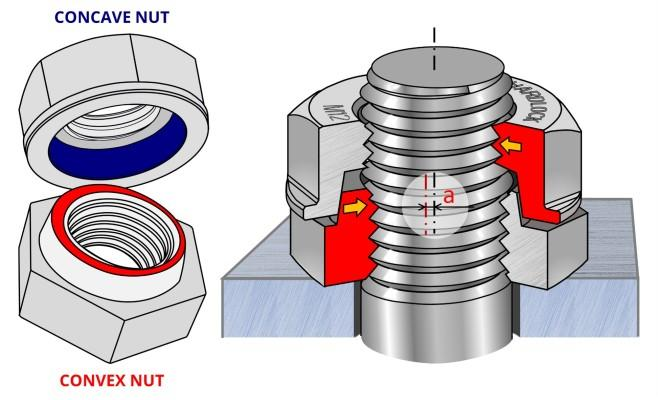
HARDLOCK® Nuts use a mechanical locking principle inside the nut system.
The system consists of two nut components:
- a concave lower nut
- a convex upper nut
When tightened together, the upper nut creates a wedge effect against the lower nut. This generates radial force on the bolt thread and helps eliminate thread clearance.
The result is a mechanical locking effect that resists rotational loosening.
Unlike serrated washer systems, HARDLOCK® Nuts do not depend on washer teeth gripping into the connected material to create the anti-loosening function. The locking principle is integrated into the nut assembly itself.
This can be important in applications where:
- surface indentations are undesirable
- mating surface hardness is difficult to control
- repeated maintenance is expected
- preload reliability is critical
- the assembly is exposed to vibration or shock
Technical explanation:
Best Locking Nut for Vibration: HARDLOCK® Nut Technology Explained
Important Engineering Note: HARDLOCK® Does Not Replace Correct Preload Design
HARDLOCK® Nuts are designed to prevent rotational loosening. However, every bolted joint still requires correct engineering design and installation.
Engineers must still consider:
- required preload
- bolt strength class
- thread engagement
- mating surface condition
- lubrication
- tightening method
- embedment
- thermal expansion
- operating load
- inspection requirements
HARDLOCK® helps address rotational loosening, but preload must still be created correctly during assembly.
For critical applications, torque-tension validation, preload measurement or a documented tightening procedure may be required.
Direct Comparison: Serrated Washers vs HARDLOCK® Nuts
| Criteria | Serrated / Toothed Washers | HARDLOCK® Nuts |
|---|---|---|
| Locking principle | Surface grip at the bearing interface | Mechanical locking inside the nut system |
| Dependence on mating surface | High — surface hardness, coating and grip matter | Lower for locking function, although preload still depends on joint friction |
| Surface condition sensitivity | Serrations may create surface indentations or serration marks | No serrated washer bite into the mating surface required |
| Reuse sensitivity | Bearing surface indentations and washer condition should be inspected | Nut and thread condition should be inspected |
| Same torque after reuse | Must be verified because friction may change | Must still be verified, but locking principle is not based on washer tooth engagement |
| Suitability for hard mating surfaces | Depends on washer hardness and manufacturer instructions | Often easier to specify where surface bite is not preferred |
| Maintenance focus | Washer wear, tooth engagement, coating damage, surface indentations | Thread condition, nut condition, preload procedure |
| Typical use | Controlled applications with suitable surfaces | Vibration-critical and maintenance-sensitive bolted joints |
When Serrated Washers Can Be Suitable
Serrated washers can be a practical option when:
- the mating surface is suitable for serration grip
- surface indentations are acceptable
- the washer hardness is appropriate
- installation is controlled
- the washer is replaced when required
- the joint is easy to inspect
- preload variation is acceptable within the design margin
They may be less suitable when:
- the mating surface is too hard
- surface coating must remain intact
- serration marks are not acceptable
- repeated tightening is expected
- preload repeatability is critical
- the joint is difficult to inspect
When to Consider HARDLOCK® Nuts
HARDLOCK® Nuts should be considered when a joint requires long-term resistance to loosening under demanding conditions.
Typical reasons to specify HARDLOCK® include:
- continuous vibration
- shock loading
- safety-critical assemblies
- high maintenance cost
- difficult access after installation
- repeated service intervals
- need to reduce retightening work
- requirement for a fully metallic solution
- need to avoid reliance on bearing-surface tooth grip
Explore related applications:
- HARDLOCK® Nuts in Rail Track Systems
- HARDLOCK® Nuts in Wind Power Turbines
- Anti-Loosening Nuts for Highways: How HARDLOCK® Improves Safety and Reduces Maintenance
- Anti Loosening Nuts for Civil Infrastructure: HARDLOCK® Solution
Maintenance Checklist: Reused Bolted Joints
Before reusing a bolted joint with washer-based locking components, engineers and maintenance teams should check:
1. Bearing Surface Condition
Look for:
- bearing surface indentations
- serration marks
- coating damage
- corrosion
- local deformation
- surface contamination
- uneven seating areas
2. Washer Condition
Check whether:
- serrations are worn
- washer surfaces are damaged
- washer pair orientation is correct, where applicable
- washer hardness is suitable for the application
- replacement is required by the manufacturer or internal procedure
3. Bolt and Nut Condition
Inspect:
- thread damage
- galling
- corrosion
- permanent elongation
- damaged coatings
- signs of overload
4. Friction and Lubrication
Confirm:
- lubrication condition
- coating compatibility
- cleanliness
- torque-tension assumptions
- whether the original torque value is still valid
5. Preload Verification
For critical joints, consider:
- torque-tension testing
- load-indicating methods
- angle-controlled tightening
- ultrasonic preload measurement
- validated assembly procedures
Cost vs Risk: Why New Fasteners May Be the Better Choice
In many industrial applications, the cost of a new fastener set is small compared with the cost of joint failure.
A reused joint with uncertain preload can lead to:
- repeated loosening
- unplanned shutdowns
- secondary component damage
- safety risks
- warranty claims
- difficult root-cause analysis
Using new or verified fastening components can help restore controlled friction conditions and reduce uncertainty.
For OEMs, railway operators, wind energy companies, steel plants and infrastructure owners, this can support:
- better reliability
- fewer maintenance interventions
- improved safety margins
- lower lifecycle cost
Related article:
HARDLOCK® Nut: Main Benefits and How It Prevents Loosening
Use Cases Where Preload Repeatability Matters Most
Railway Infrastructure
Railway systems are exposed to vibration, impact loads and environmental stress. Reused bolted joints with uncertain preload can increase maintenance requirements.
Recommended reading:
HARDLOCK® Nuts in Rail Track Systems
Wind Power
Wind turbines operate under cyclic loading, vibration, temperature changes and difficult maintenance access. Stable preload and reliable anti-loosening performance are essential.
Recommended reading:
HARDLOCK® Nuts in Wind Power Turbines
Highways and Civil Infrastructure
Bolted joints in barriers, signs, bridges and structural systems must withstand weather, vibration and long service life requirements.
Recommended reading:
Anti-Loosening Nuts for Highways: How HARDLOCK® Improves Safety and Reduces Maintenance
Heavy Industry and Steel Plants
Conveyors, hoppers, vibration screens and production equipment are exposed to continuous vibration and impact. Fastener reliability can directly affect downtime.
Recommended reading:
Vibration Resistant Nuts Steel Plant: Conveyor & Hopper Failures Solved
Frequently Asked Questions
Are serrated washers reusable?
It depends on the washer type, condition, manufacturer instructions and application. If the washer teeth are worn or the mating surface has visible surface indentations, reuse may change the locking performance and preload behavior. For critical joints, replacement or verification is recommended.
Do serrated washers require a softer mating surface?
For washer systems that rely on tooth engagement, the washer must be able to grip the mating surface. In many designs, the washer hardness must be higher than the contact surface hardness to achieve the intended mechanical function.
Can I use the same tightening torque after disassembly?
Not automatically. Reuse can change friction in the threads and bearing surfaces. Bearing surface indentations, coating damage and lubrication changes can affect the torque-preload relationship.
Do HARDLOCK® Nuts eliminate the need for correct tightening?
No. HARDLOCK® Nuts help prevent rotational loosening, but the joint must still be designed and tightened correctly to achieve the required preload.
When should I replace fasteners instead of reusing them?
Replacement should be considered when preload is critical, the joint is safety-related, surface indentations are visible, corrosion is present, lubrication is uncertain, or the original friction conditions cannot be verified.
Related Articles
Explore more HARDLOCK® technical articles:
- Why Bolts Loosen (And How HARDLOCK® Nuts Prevent It)
- Anti Loosening Nut: Why Bolts and Nuts Come Loose & How to Prevent It
- Bolt Locking Methods Explained: How to Prevent Loosening and Maintain Preload
- Junker Test Lock Nut: HARDLOCK® Vibration Proof Nut
- HARDLOCK® Nuts vs Locking Nuts & Washers: Which Solution Performs Best Under Vibration?
- HARDLOCK® Nut: Main Benefits and How It Prevents Loosening
Conclusion: Reliable Preload Starts With Controlled Assembly
Serrated washers and HARDLOCK® Nuts use different engineering principles.
Serrated washers depend on interaction with the mating surface. Their performance can be affected by surface hardness, coating, tooth engagement and bearing surface indentations after repeated tightening.
HARDLOCK® Nuts use a mechanical locking principle inside the nut assembly. This reduces dependence on washer tooth grip and provides a strong option for vibration-critical, maintenance-sensitive and safety-related joints.
For engineers, the key message is simple:
If the same preload, torque relationship and friction conditions must be achieved after maintenance, the original joint condition must be reproduced or verified.
In many critical applications, that means using new or inspected fastening components, controlled lubrication, clean bearing surfaces and a validated tightening process.
Looking to Improve Preload Reliability in Your Application?
If your equipment is exposed to vibration, repeated maintenance or preload loss, HARDLOCK® specialists can help you evaluate the right anti-loosening solution.
Contact HARDLOCK® for:
- technical consultation
- application-specific recommendations
- fastening reliability review
- testing data and documentation
- support for OEM and maintenance projects
HARDLOCK® — Reliable fastening for critical bolted joints.
Disclaimer
This article is intended for general technical information only. It does not evaluate or make claims about any specific third-party manufacturer or product. Fastener performance depends on joint design, material hardness, surface condition, coating, lubrication, installation procedure, operating environment and inspection practice. Always follow applicable standards, manufacturer instructions and project-specific engineering requirements.