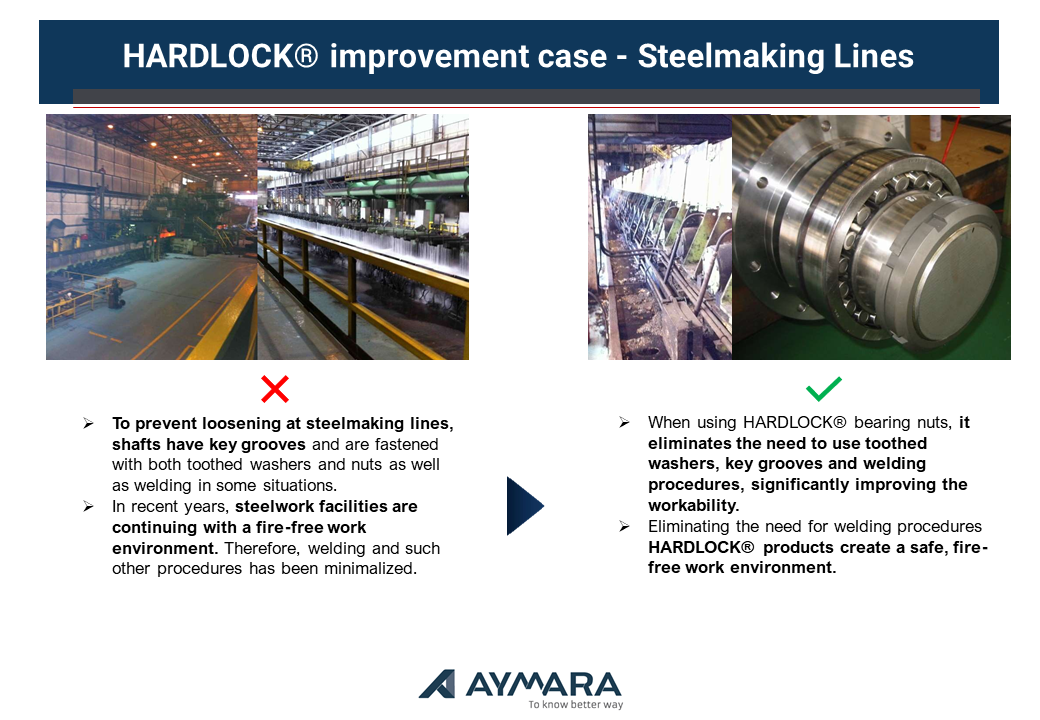
Anti-Loosening Bearing Nut for Steel Industry Applications
In steel-making environments, fasteners are exposed to extreme vibration, heat, and heavy loads. In such environments, the precise positioning and secure fixation of bearings on rotating shafts are critical for maintaining equipment performance and reliability. An anti-loosening bearing nut is essential to maintain safety and prevent costly failures.
HARDLOCK® Bearing Nut is used in steel making lines to provide secure, anti-loosening fixation of bearings, even under demanding operating conditions.
Why Bearing Fixation Matters in Steel Production
Steel production equipment—such as rolling mills, conveyors, and processing lines—relies on rotating shafts supported by bearings.
Bearing nuts are used to:
- Fix bearings in precise axial positions
- Maintain proper preload
- Ensure stable shaft operation
These functions are essential for:
- Smooth rotation
- Load distribution
- Equipment longevity
The Challenge: Extreme Operating Conditions
Steel making lines present a unique combination of mechanical and environmental challenges.
High Loads and Continuous Operation
Equipment operates under:
- Heavy radial and axial loads
- Continuous production cycles
- High torque transmission
This places significant stress on bearing assemblies.
Vibration and Dynamic Forces
During operation:
- Rolling processes generate vibration
- Material handling introduces dynamic loads
- Rotating shafts experience cyclic stress
These factors can lead to loosening of conventional bearing nuts.
Thermal Expansion and Temperature Variation
Steel production involves:
- High process temperatures
- Heat transfer to surrounding components
- Expansion and contraction of shafts and nuts
Thermal effects can reduce clamping force over time.
Precision Requirements
Accurate bearing positioning is critical for:
- Shaft alignment
- Load distribution
- Minimizing wear and vibration
Any loss of preload can affect system performance.
Maintenance and Downtime Impact
Unplanned downtime in steel production can result in:
- Significant production losses
- High repair costs
- Operational disruptions
👉 Learn more about preload loss:
https://www.hardlock.eu/why-do-bolts-nuts-come-loose-factors-influencing-bolt-preload-loss/
Why Preload Stability Is Critical for Bearing Nuts
Maintaining preload ensures:
- Stable axial positioning of bearings
- Proper load transfer
- Reduced vibration and wear
Loss of preload can lead to:
- Bearing misalignment
- Increased wear and failure
- Reduced equipment efficiency
HARDLOCK® Bearing Nut: Mechanical Locking for Shaft Stability
HARDLOCK® Bearing Nut uses a mechanical wedge-locking principle that maintains preload without relying solely on friction.
How it works:
- A specially designed locking mechanism creates radial force
- This force prevents rotational loosening
- The nut maintains consistent axial positioning under load
This design ensures reliable performance even under:
- Heavy loads
- Continuous vibration
- Thermal cycling
👉 Full technical explanation:
https://www.hardlock.eu/why-the-hardlock-nut-does-not-loosen/
Where HARDLOCK® Bearing Nut Is Used in Steel Making Lines
Typical applications include:
- Rolling mill shafts
- Conveyor systems
- Processing line equipment
- High-load rotating machinery
In these applications, precise bearing fixation is essential for performance and durability.
Key Benefits for Steel Industry Applications
✔ Maintains Accurate Bearing Positioning
Ensures stable axial fixation of bearings, supporting smooth and reliable shaft operation.
✔ Prevents Loosening Under Vibration and Load
Maintains clamping force even under heavy loads and dynamic conditions.
✔ Reduces Maintenance and Downtime
Reliable fastening can:
- Minimize retightening
- Reduce unexpected failures
- Improve production continuity
✔ Extends Bearing and Equipment Life
Stable positioning helps:
- Reduce wear
- Improve load distribution
- Extend service intervals
✔ Suitable for High-Temperature Environments
Maintains performance even under thermal expansion and harsh conditions.
Comparison with Conventional Bearing Locking Methods
Traditional solutions (lock washers, set screws, standard nuts) rely on friction or deformation.
Limitations:
- Loosening under vibration
- Reduced effectiveness under thermal cycling
- Frequent maintenance requirements
HARDLOCK® Bearing Nut provides a mechanical anti-loosening solution, ensuring stable and long-term performance.
Engineering Perspective: Cost of Failure in Steel Production
In steel making lines, fastening reliability directly impacts:
- Production uptime
- Maintenance costs
- Equipment lifespan
Failure of bearing fixation can result in:
- Shaft misalignment
- Bearing damage
- Unplanned downtime
Reliable fastening solutions help minimize these risks.
👉 Learn more about benefits:
https://www.hardlock.eu/hardlock-nut-main-benefits/
Related Applications in Heavy Industry
Similar challenges exist in:
- Pumps → https://www.hardlock.eu/hardlock-bearing-nut-in-pumps/
- High Temperature Applications: Proven Performance up to 800°C in Critical Industries → https://www.hardlock.eu/hardlock-nuts-in-high-temperature-applications-proven-performance-up-to-800-c-in-critical-industries/
- Ball and rod mills → https://www.hardlock.eu/hardlock-nut-in-ball-and-rod-mills/
- Sintering Plants → https://www.hardlock.eu/hardlock-nut-in-sintering-plants/
- Power Plants → https://www.hardlock.eu/hardlock-nut-in-power-plants/
- Nut in Oil & Gas Flange Connections → https://www.hardlock.eu/hardlock-nut-in-oil-gas-flange-connections/
- Rustproof and Vibration-Resistant Fastening Solution → https://www.hardlock.eu/hardlock-nut-rustproof-and-vibration-resistant-product/
- Offshore & Onshore Applications of HARDLOCK Nuts: Engineering Reliability in Extreme Environments → https://www.hardlock.eu/offshore-onshore-applications-of-hardlock-nuts-engineering-reliability-in-extreme-environments/
👉 Explore full application range:
https://www.hardlock.eu/where-is-hardlock-nut-often-used/
When to Use HARDLOCK® Bearing Nut in Steel Making Lines
Consider this solution if your application involves:
- High-load rotating shafts
- Vibration and dynamic forces
- Thermal expansion effects
- High cost of downtime
Conclusion
Steel making lines require fastening solutions that ensure precise bearing positioning and long-term reliability under extreme conditions.
By maintaining preload and preventing loosening, HARDLOCK® Bearing Nut provides a mechanical solution for secure shaft fixation in heavy industrial operations.
Looking to Improve Reliability in Steel Production?
Choosing the right fastening system can reduce downtime, extend equipment life, and improve operational efficiency.
👉 Start with the fundamentals:
https://www.hardlock.eu/why-do-bolts-nuts-come-loose-factors-influencing-bolt-preload-loss/