An anti loosening nut for cranes is essential for maintaining structural safety in environments exposed to constant vibration and dynamic loads. Crane components are subject to repeated stress, which can cause conventional fasteners to loosen over time, leading to serious safety risks. Cranes are critical machines used in construction, manufacturing, ports, and heavy industry for lifting and transporting loads.
These systems operate under dynamic loads, vibration, and environmental forces, placing significant stress on bolted joints. Ensuring that fasteners remain secure is essential for operational safety, reliability, and efficiency.
HARDLOCK® Nut is used on cranes to provide reliable anti-loosening performance in critical structural and moving components, even under demanding operating conditions.
Why Fastening Matters in Crane Applications
Cranes rely on bolted connections across multiple key systems:
- Structural frames and load-bearing joints
- Rail and runway connections
- Trolley and hoist assemblies
- Mechanical and drive components
These connections must ensure:
- Safe lifting operations
- Structural integrity
- Precise load handling
The Challenge: Dynamic Loads, Vibration, and Environment
Cranes operate in conditions that make fastening particularly challenging.
Continuous Dynamic Loads
Cranes are subject to:
- Repeated lifting and lowering cycles
- Load shifts and impact forces
- Start-stop motion during operation
These cyclic loads can reduce preload over time.
Vibration from Movement and Machinery
During operation:
- Motors and drive systems generate vibration
- Movement along rails creates additional dynamic stress
- Repetitive motion leads to fatigue in bolted joints
This is a primary cause of loosening in conventional fasteners. ()
Wind and Environmental Forces
Especially in outdoor and port cranes:
- Wind pressure acts continuously on the structure
- Environmental exposure accelerates wear
- Corrosion and surface changes affect friction
Wind and vibration together can gradually loosen standard nuts. ()
Maintenance Challenges at Height
Many fastening points are:
- Located at significant heights
- Difficult and costly to access
- Time-consuming to inspect and retighten
Frequent maintenance increases downtime and safety risks.
👉 Learn more about preload loss:
https://www.hardlock.eu/why-do-bolts-nuts-come-loose-factors-influencing-bolt-preload-loss/
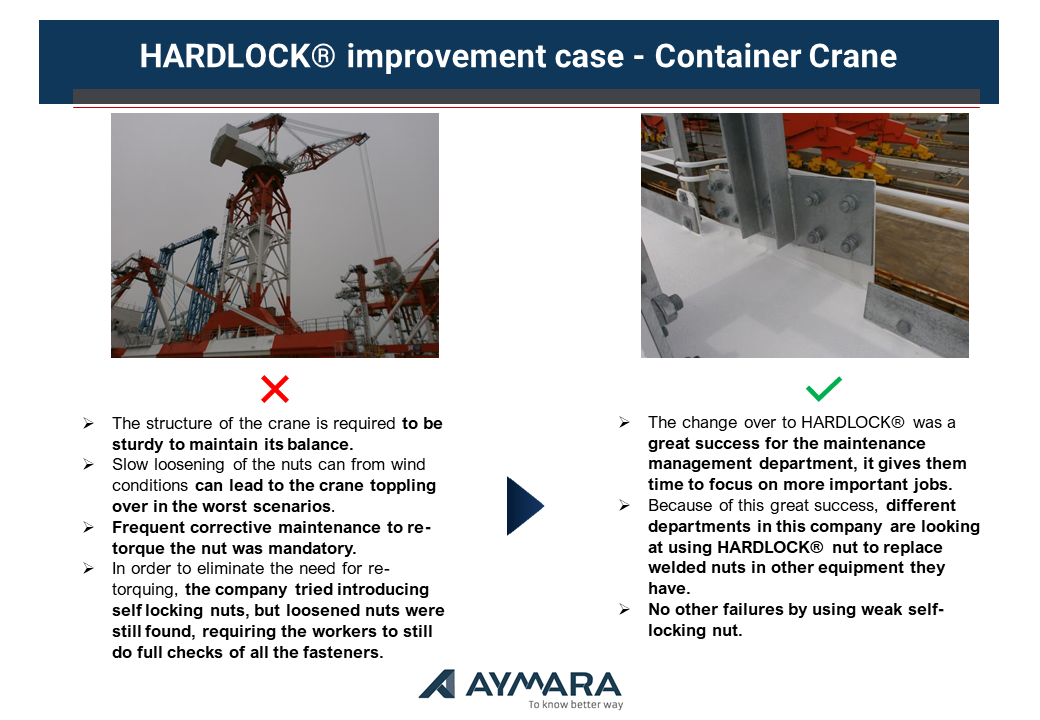
Real-World Use Case: Preventing Loosening in Crane Structures
In real crane applications, operators have experienced:
- Frequent loosening of nuts due to vibration and wind
- Increased maintenance workload for retightening
- Reduced operational efficiency
Traditional prevailing torque nuts were tested but showed limitations in harsh environments and required higher installation effort. ()
By switching to HARDLOCK® Nut:
- Loosening issues were eliminated
- Maintenance frequency was reduced
- Operational stability improved
In overhead cranes, implementation of HARDLOCK® nuts in rail and frame connections resulted in longer service intervals and reduced downtime, while improving worker safety by minimizing work at height. ()
Why Preload Stability Is Critical in Cranes
Maintaining preload ensures:
- Structural stability of the crane
- Safe load handling
- Accurate positioning of moving components
Loss of preload can lead to:
- Misalignment of rails or structures
- Increased vibration and wear
- Potential safety risks
HARDLOCK® Nut: Mechanical Locking for Lifting Equipment
HARDLOCK® Nut uses a mechanical wedge-locking principle that prevents loosening even under vibration and dynamic loads.
How it works:
- Two nuts (convex + concave) create a locking system
- An eccentric thread generates radial locking force
- This force eliminates thread clearance and prevents rotation
This ensures reliable fastening even under:
- Cyclic loading
- Continuous vibration
- Environmental stress
👉 Full explanation:
https://www.hardlock.eu/why-the-hardlock-nut-does-not-loosen/
Where HARDLOCK® Nut Is Used on Cranes
Typical applications include:
- Rail and runway fastening systems
- Structural frame connections
- Hoisting and trolley mechanisms
- High-load bolted joints exposed to vibration
These locations are critical for safe and efficient crane operation.
Key Benefits for Crane Applications
✔ Prevents Loosening Under Dynamic Loads
Maintains clamping force during lifting cycles and movement.
✔ Improves Operational Safety
Reliable fastening reduces the risk of:
- Structural instability
- Component failure
- Safety incidents
✔ Reduces Maintenance at Height
HARDLOCK® Nut helps:
- Eliminate frequent retightening
- Reduce work in hazardous locations
- Improve worker safety
✔ Extends Service Intervals and Reduces Downtime
Stable fastening leads to:
- Longer maintenance cycles
- Increased crane availability
- Lower operational costs
✔ Suitable for Harsh Outdoor Environments
Performs reliably under:
- Wind exposure
- Temperature changes
- Industrial conditions
Comparison with Conventional Fastening Methods
Traditional fastening systems rely on friction or deformation.
Limitations:
- Loosening under vibration and cyclic loads
- Increased maintenance requirements
- Reduced effectiveness over time
HARDLOCK® Nut provides a mechanical anti-loosening solution independent of friction, ensuring consistent long-term performance.
👉 Compare fastening technologies:
https://www.hardlock.eu/hardlock-nut-vs-prevailing-torque-type-nut/
Engineering Perspective: Cost of Failure in Crane Operations
In crane systems, fastening reliability directly impacts:
- Operational safety
- Equipment uptime
- Maintenance costs
Loose fasteners can result in:
- Unplanned downtime
- Increased inspection requirements
- Potential safety hazards
Reliable fastening solutions help minimize these risks.
👉 Learn more about benefits:
https://www.hardlock.eu/hardlock-nut-main-benefits/
Related Applications in Lifting and Structural Equipment
Similar challenges exist in:
- Elevators → https://www.hardlock.eu/hardlock-nut-on-elevator-applications/
- Cranes → https://www.hardlock.eu/hardlock-nut-on-cranes-2/
- Steel structures → https://www.hardlock.eu/hardlock-nut-on-steel-structures/
- Aluminum Beam Trusses → https://www.hardlock.eu/hardlock-nut-on-aluminum-beam-trusses/
- Foundation Bolts → https://www.hardlock.eu/hardlock-nut-on-foundation-bolts/
- Ventilation Fans → https://www.hardlock.eu/hardlock-nut-on-ventilation-fans/
- Communication & Transmission Towers → https://www.hardlock.eu/hardlock-nuts-in-communication-transmission-towers/
👉 Explore full application range:
https://www.hardlock.eu/where-is-hardlock-nut-often-used/
When to Use HARDLOCK® Nut in Crane Applications
Consider this solution if your application involves:
- Dynamic lifting loads
- Continuous vibration
- Difficult maintenance access
- Safety-critical structures
Conclusion
Cranes require fastening solutions that ensure safety, reliability, and long-term performance under dynamic conditions.
By maintaining preload and preventing loosening, HARDLOCK® Nut provides a mechanical solution for secure and reliable fastening in lifting and material handling systems.
Looking to Improve Crane Safety and Reliability?
Choosing the right fastening system can reduce maintenance, improve safety, and increase operational efficiency.
👉 Start with the fundamentals:
https://www.hardlock.eu/why-do-bolts-nuts-come-loose-factors-influencing-bolt-preload-loss/