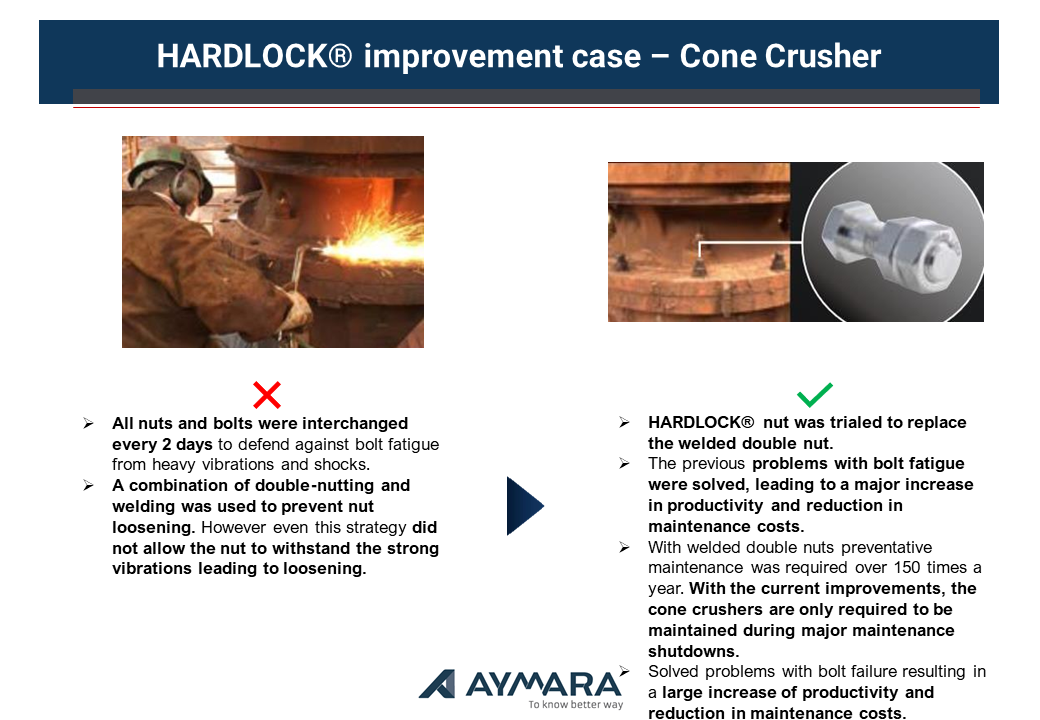
Anti-Loosening Nut for Cone Crushers
The anti-loosening nut is essential for ensuring the safe and stable operation of cone crushers. These machines operate with high vibration, impact forces, and eccentric motion, placing significant stress on bolted joints. In such environments, maintaining stable preload and preventing loosening is critical for safe and efficient operation. The HARDLOCK nut is a proven heavy-duty solution designed to prevent bolt loosening under extreme vibration and load conditions typical in mining and aggregate industries.
HARDLOCK® Nut is used on cone crushers to help ensure secure fastening of critical components, even under the most demanding conditions.
Why Fastening Matters in Cone Crushers
Cone crushers rely on bolted joints in key areas such as:
- Mantle and concave (liner) fixation
- Bowl and adjustment ring connections
- Structural and support components
These connections must ensure:
- Secure positioning of wear parts
- Proper crushing geometry
- Continuous machine operation
The Challenge: Extreme Mechanical Stress
Cone crushers create one of the most aggressive environments for fastening systems.
High Impact Loads
During crushing:
- Material is compressed and fractured
- Shock loads are transmitted through the structure
- Liner bolts are subjected to repeated impact
These forces can quickly loosen conventional fasteners.
Eccentric Motion and Vibration
Cone crushers operate using:
- Eccentric rotation mechanisms
- Continuous vibration
- Cyclic loading of components
This leads to progressive loss of preload in standard nuts.
Wear and Component Deformation
Crusher environments involve:
- Abrasive materials
- Wear of liners and contact surfaces
- Potential deformation of bolted interfaces
This reduces friction and increases the risk of loosening.
Maintenance and Downtime Constraints
Crusher maintenance involves:
- High labor intensity
- Production downtime
- Frequent liner replacement
Loose fasteners can significantly increase maintenance frequency.
👉 Learn more about preload loss:
https://www.hardlock.eu/why-do-bolts-nuts-come-loose-factors-influencing-bolt-preload-loss/
Why Preload Stability Is Critical in Crushers
Maintaining preload ensures:
- Secure fixation of liners and wear parts
- Consistent crushing performance
- Protection of structural components
Loss of preload can lead to:
- Liner movement or detachment
- Increased wear and damage
- Reduced throughput and efficiency
HARDLOCK® Nut: Mechanical Locking for Extreme Conditions
HARDLOCK® Nut uses a mechanical wedge-locking principle that maintains preload even under severe vibration and impact.
How it works:
- Two nuts (convex + concave) form a locking system
- An eccentric thread generates radial locking force
- This force prevents rotational loosening
This design provides reliable fastening even in:
- High-impact environments
- Continuous vibration
- Harsh mining conditions
👉 Full technical explanation:
https://www.hardlock.eu/why-the-hardlock-nut-does-not-loosen/
Where HARDLOCK® Nut Is Used in Cone Crushers
HARDLOCK® Nut is applied in critical locations such as:
- Mantle and concave liner bolts
- Bowl and adjustment ring connections
- High-load structural joints
These applications require secure fastening to maintain performance and safety.
Key Benefits for Cone Crusher Applications
✔ Prevents Loosening Under Extreme Impact
Maintains clamping force even under repeated crushing loads.
✔ Extends Liner and Component Life
Stable fastening helps:
- Prevent liner movement
- Reduce wear and damage
- Extend service intervals
✔ Reduces Maintenance and Downtime
Reliable fastening can:
- Decrease retightening requirements
- Reduce unexpected shutdowns
- Improve overall productivity
✔ Protects Equipment Integrity
Secure bolted joints help:
- Maintain structural stability
- Prevent damage to critical components
- Ensure safe operation
✔ Improves Crushing Efficiency
Stable liner positioning contributes to:
- Consistent crushing performance
- Optimized material processing
- Higher throughput
Comparison with Conventional Fastening Methods
Traditional fastening solutions rely on friction or auxiliary locking elements.
Limitations:
- Loosening under vibration and impact
- Reduced effectiveness over time
- Increased maintenance needs
HARDLOCK® Nut provides a mechanical anti-loosening solution independent of friction, making it suitable for extreme mining applications.
👉 Compare fastening technologies:
https://www.hardlock.eu/hardlock-nut-vs-prevailing-torque-type-nut/
Engineering Perspective: Cost of Failure in Crushing Operations
In mining and aggregate production, fastening reliability directly impacts:
- Equipment uptime
- Maintenance costs
- Production output
Failure of bolted joints can result in:
- Unplanned downtime
- Increased repair costs
- Reduced operational efficiency
Reliable fastening solutions help minimize these risks.
👉 Learn more about benefits:
https://www.hardlock.eu/hardlock-nut-main-benefits/
Related Applications in Mining and Heavy Equipment
Similar challenges exist in:
- Rustproof and Vibration-Resistant Fastening Solution → https://www.hardlock.eu/hardlock-nut-rustproof-and-vibration-resistant-product/
- Ball and rod mills → https://www.hardlock.eu/hardlock-nut-in-ball-and-rod-mills/
- Tunnel boring machines → https://www.hardlock.eu/hardlock-nut-on-tunnel-boring-machines/
- Food & Beverage Applications → https://www.hardlock.eu/hardlock-nuts-in-food-beverage-applications/
- Offshore & Onshore Applications of HARDLOCK Nuts: Engineering Reliability in Extreme Environments → https://www.hardlock.eu/offshore-onshore-applications-of-hardlock-nuts-engineering-reliability-in-extreme-environments/
- Aerospace Applications: Preventing Bolt Loosening Under Extreme Conditions → https://www.hardlock.eu/hardlock-nuts-in-aerospace-applications-preventing-bolt-loosening-under-extreme-conditions/
- Agricultural Machinery → https://www.hardlock.eu/hardlock-nuts-in-agricultural-machinery/
- Military Vehicles → https://www.hardlock.eu/hardlock-nuts-in-military-vehicles/
- Sintering Plants → https://www.hardlock.eu/hardlock-nut-in-sintering-plants/
- Ball and Rod Mills → https://www.hardlock.eu/hardlock-nut-in-ball-and-rod-mills/
- Vibration Screens → https://www.hardlock.eu/hardlock-nut-on-vibration-screens/?preview_id=5113&preview_nonce=50bbb8fe5c&preview=true&_thumbnail_id=5114
- Steel Making Lines → https://www.hardlock.eu/hardlock-bearing-nut-in-steel-making-lines/
- Hydraulic Breakers → https://www.hardlock.eu/hardlock-nut-on-hydraulic-breakers/
👉 Explore full application range:
https://www.hardlock.eu/where-is-hardlock-nut-often-used/
When to Use HARDLOCK® Nut in Cone Crushers
Consider this solution if your application involves:
- High impact and vibration
- Frequent loosening of liner bolts
- High cost of downtime
- Heavy-duty mining equipment
Conclusion
Cone crushers require fastening solutions capable of withstanding extreme mechanical stress and continuous operation.
By maintaining preload and preventing loosening, HARDLOCK® Nut provides a mechanical solution for secure and reliable fastening in high-impact crushing equipment.
Looking to Improve Crusher Reliability?
Choosing the right fastening system can reduce downtime, extend component life, and improve productivity.
👉 Start with the fundamentals:
https://www.hardlock.eu/why-do-bolts-nuts-come-loose-factors-influencing-bolt-preload-loss/