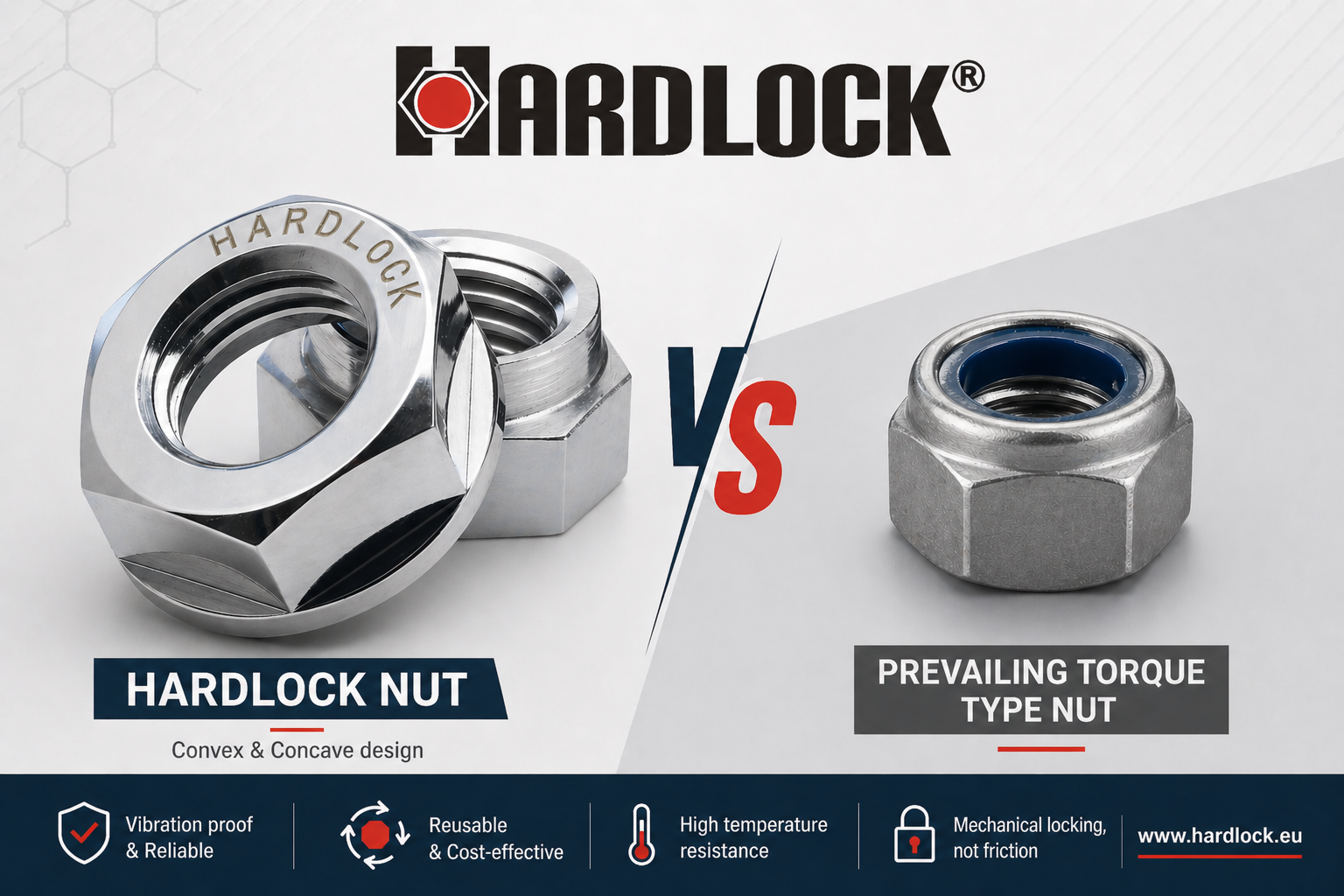
In high-vibration and safety-critical applications, choosing the right locking nut is essential.
Two commonly used solutions are HARDLOCK® Nut and prevailing torque type nuts (such as nyloc nuts or all-metal lock nuts). But how do they compare in real-world conditions?
This article explains the key differences—and helps you choose the right solution for your application.
What Is a Prevailing Torque Type Nut?
A prevailing torque nut prevents loosening by creating friction within the threads.
This is typically achieved by:
- Nylon inserts (e.g., nyloc nuts)
- Deformed threads (all-metal lock nuts)
How it works:
The nut resists rotation by increasing friction between mating threads.
Limitations of Prevailing Torque Nuts
While widely used, prevailing torque nuts have several limitations—especially in demanding environments.
❌ Performance Depends on Friction
Friction decreases under:
- Vibration
- Load cycles
- Surface wear
❌ Reduced Effectiveness Over Time
Repeated use or environmental exposure reduces locking capability.
❌ Temperature Sensitivity
- Nylon inserts degrade at high temperatures
- Metal deformation can relax over time
❌ Not Ideal for High-Vibration Applications
In extreme conditions, loosening can still occur.
What Makes HARDLOCK® Nut Different?
HARDLOCK® Nut uses a mechanical wedge-locking principle, not friction.
How it works:
- Two nuts are combined into one system
- The top nut has an eccentric thread
- Tightening creates a radial locking force
- This force physically prevents rotation
Result:
The nut does not loosen—even under extreme vibration.
Direct Comparison: HARDLOCK® vs. Prevailing Torque Nuts
| Feature | HARDLOCK® Nut | Prevailing Torque Nut |
|---|---|---|
| Locking principle | Mechanical (wedge) | Friction |
| Resistance to vibration | ✔ Excellent | ⚠️ Limited |
| Reusability | ✔ High | ⚠️ Reduced over time |
| Performance at high temperature | ✔ Stable | ❌ Limited (nylon fails) |
| Maintenance requirements | ✔ Low | ⚠️ Moderate |
| Long-term reliability | ✔ High | ⚠️ Variable |
Performance in Real Applications
High-Vibration Environments
- Railway systems
- Heavy machinery
- Industrial equipment
👉 HARDLOCK® maintains preload
👉 Prevailing torque nuts may loosen over time
High-Temperature Applications
- Power plants
- Manufacturing processes
👉 HARDLOCK® performs reliably
👉 Nylon-based solutions degrade
Safety-Critical Systems
- Infrastructure
- Transportation
- Energy
👉 HARDLOCK® provides maximum safety
👉 Friction-based systems introduce risk
Why the Locking Principle Matters
The key difference is simple:
- Prevailing torque nuts rely on friction
- HARDLOCK® Nut uses mechanical locking
Friction can decrease.
Mechanical locking does not.
This is why HARDLOCK® Nut delivers consistent, long-term performance.
When Should You Choose HARDLOCK® Nut?
HARDLOCK® is the preferred solution when:
- Vibration is present
- Safety is critical
- Maintenance access is limited
- Long service life is required
If your application cannot tolerate loosening, a mechanical locking system is essential.
Conclusion
Prevailing torque type nuts are suitable for standard applications—but they have limitations in demanding environments.
HARDLOCK® Nut provides a more advanced solution by eliminating the root cause of loosening.
By using a mechanical wedge-locking principle, it ensures reliability where it matters most.
Frequently Asked Questions
What is a prevailing torque nut?
A nut that resists loosening by increasing friction in the threads.
Are prevailing torque nuts reusable?
They can be reused, but their locking performance decreases over time.
What is the main advantage of HARDLOCK® Nut?
It prevents loosening using a mechanical locking principle, not friction.
Need Help Choosing the Right Locking Solution?
Selecting the right fastener can significantly impact safety, maintenance costs, and system reliability.
👉 Contact us to find the best solution for your application.