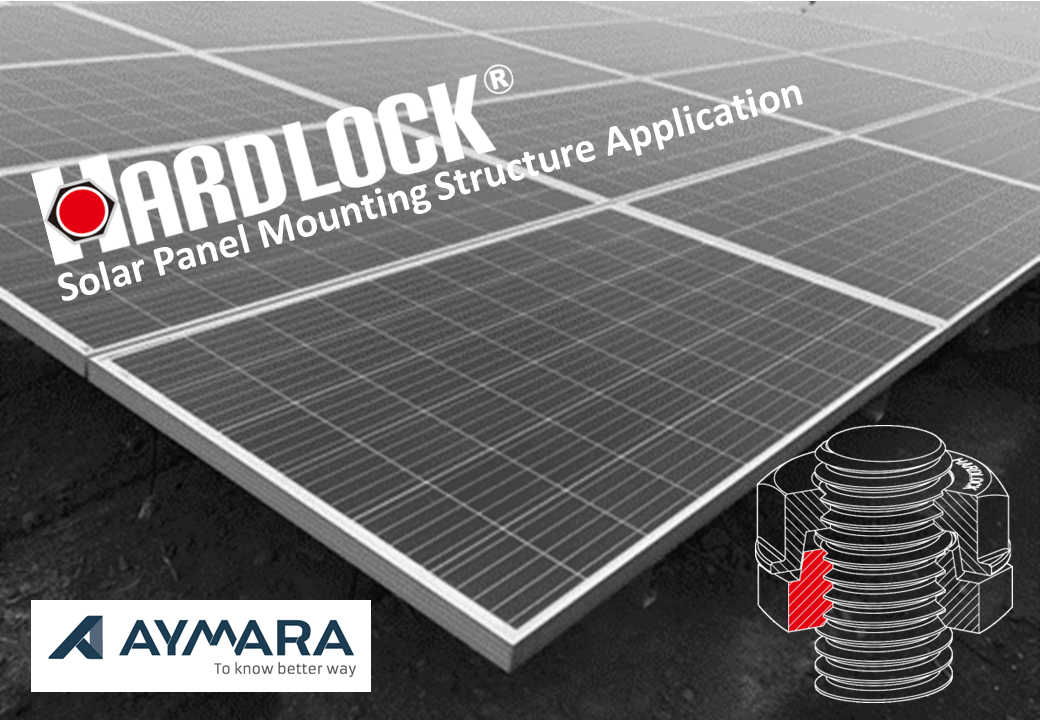
Solar panel installations are designed for long-term operation, often exceeding 20–30 years of continuous exposure to environmental conditions.
To ensure stable energy production, every component—including bolted joints—must maintain reliability, structural integrity, and minimal maintenance requirements.
HARDLOCK® Nut is used in solar panel mounting systems to help maintain secure fastening and stable preload, even under challenging environmental conditions.
Why Fastening Matters in Solar Panel Systems
Solar panel systems rely on bolted joints in:
- Mounting structures (rooftop and ground-mounted systems)
- Support frames and rails
- Structural connections exposed to environmental loads
These joints must ensure:
- Long-term structural stability
- Consistent panel alignment
- Reliable energy production
The Challenge: Loosening in Solar Installations
Although solar systems appear static, they are exposed to multiple factors that can lead to loosening.
Wind-Induced Vibration
Solar panels are continuously exposed to:
- Wind loads
- Micro-vibrations
- Dynamic forces on mounting systems
Even small vibrations can reduce friction in threaded joints and initiate loosening ()
Thermal Expansion and Temperature Cycling
Solar installations experience significant temperature differences between:
- Day and night
- Seasonal changes
This causes:
- Expansion and contraction of materials
- Loss of preload over time
Temperature fluctuations are a key driver of loosening in outdoor installations ()
Long-Term Outdoor Exposure
Solar systems must withstand:
- UV radiation
- Moisture and corrosion
- Weather extremes over decades
Maintenance Constraints
Large-scale solar farms require:
- Minimal maintenance
- Reduced inspection frequency
- High system uptime
👉 Learn more about preload loss:
https://www.hardlock.eu/why-do-bolts-nuts-come-loose-factors-influencing-bolt-preload-loss/
Why Preload Stability Is Critical in Solar Systems
Maintaining preload ensures:
- Secure panel mounting
- Resistance to wind uplift
- Stable structural performance
Loss of preload can lead to:
- Movement of panels
- Reduced structural integrity
- Increased maintenance requirements
HARDLOCK® Nut: Mechanical Locking for Renewable Energy Applications
HARDLOCK® Nut uses a mechanical wedge-locking principle designed to maintain preload under real operating conditions.
How it works:
- Two nuts form a single locking system
- The top nut has an eccentric (off-center) thread
- Tightening creates a radial locking force
- This force prevents rotation and loosening
👉 Full explanation:
https://www.hardlock.eu/why-the-hardlock-nut-does-not-loosen/
Where HARDLOCK® Nut Is Used in Solar Installations
HARDLOCK® Nut is applied in critical fastening points such as:
- Solar panel mounting rails
- Structural support connections
- Rooftop and ground-mounted systems
In these locations, stable fastening directly affects system reliability and safety.
Key Benefits for Solar Panel Applications
✔ Prevents Loosening Under Wind and Vibration
HARDLOCK® Nut helps maintain joint stability even under continuous environmental loads.
✔ Maintains Preload Under Temperature Cycling
The mechanical locking principle supports consistent clamping force despite thermal expansion and contraction.
✔ Reduces Maintenance and O&M Costs
Reliable fastening can help:
- Eliminate retightening
- Reduce inspection frequency
- Lower operational costs over the system lifecycle
✔ Supports Long-Term Energy Production
Stable mounting systems contribute to:
- Consistent panel alignment
- Reduced mechanical stress
- Improved system efficiency
✔ Reliable Performance in Outdoor Environments
Designed to perform in:
- Harsh weather conditions
- Long-term outdoor exposure
- Renewable energy installations
Comparison with Conventional Fastening Methods
Traditional fastening solutions often rely on friction or additional locking elements.
Limitations:
- Loosening under vibration
- Sensitivity to temperature changes
- Increased maintenance requirements
👉 Compare fastening technologies:
https://www.hardlock.eu/hardlock-nut-vs-prevailing-torque-type-nut/
Engineering Perspective: Lifecycle Cost in Solar Projects
In solar installations, fastening reliability directly impacts:
- System uptime
- Maintenance costs (O&M)
- Return on investment (ROI)
Even small fastening issues can lead to:
- Increased service visits
- Reduced system performance
- Higher long-term costs
Using a reliable fastening solution helps ensure predictable performance.
👉 Learn more about benefits:
https://www.hardlock.eu/hardlock-nut-main-benefits/
Related Applications in Renewable Energy
Similar challenges exist in other energy systems:
- Wind Power Turbines → https://www.hardlock.eu/hardlock-nuts-in-wind-power-turbines/
- Solar Panels → https://www.hardlock.eu/hardlock-nut-on-solar-panels/
- Solar Moduls → https://www.hardlock.eu/hardlock-nut-on-solar-moduls/
- Distribution Boards → https://www.hardlock.eu/hardlock-nut-on-distribution-boards/
- Electrical Applications: Reliable Anti-Loosening for Critical Infrastructure → https://www.hardlock.eu/hardlock-nut-in-electrical-applications/
👉 Explore full application range:
https://www.hardlock.eu/where-is-hardlock-nut-often-used/
When to Use HARDLOCK® Nut in Solar Projects
Consider this solution if your application involves:
- Wind-exposed installations
- Large temperature variations
- Long service life requirements (20+ years)
- High cost of maintenance or downtime
Conclusion
Solar panel systems require fastening solutions that deliver long-term reliability under environmental stress.
By maintaining preload and resisting loosening, HARDLOCK® Nut provides a mechanical solution for secure and stable connections in renewable energy applications.
Looking to Improve Solar System Reliability?
Choosing the right fastening system can reduce maintenance costs, improve uptime, and support long-term energy production.
👉 Start with the fundamentals:
https://www.hardlock.eu/why-do-bolts-nuts-come-loose-factors-influencing-bolt-preload-loss/