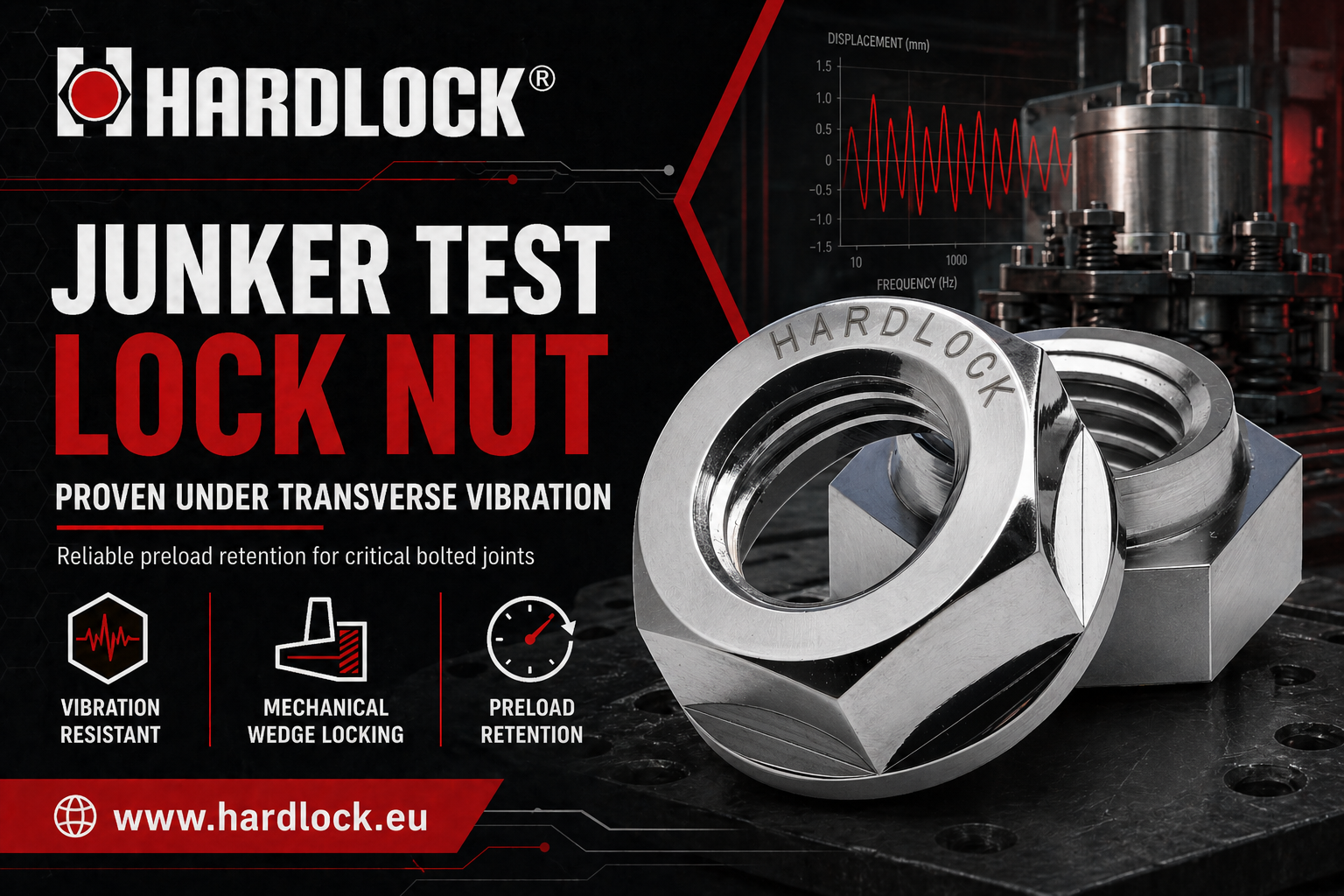
Junker Test for Lock Nuts: HARDLOCK® Performance Under Transverse Vibration
A Junker Test lock nut must prove that it can maintain preload under severe transverse vibration. For engineers working in railway, steel plants, wind power, automotive, bridges and heavy machinery, this test is one of the clearest ways to compare anti-loosening fasteners and select a reliable solution for safety-critical bolted joints.
That is why engineers often ask one key question:
How can we verify whether a locking nut really prevents loosening under vibration?
One of the most widely used methods is the Junker Test — a transverse vibration test designed to evaluate how fasteners behave when exposed to side-to-side movement.
For industries such as railway, steel production, wind power, automotive, bridges, mining and heavy machinery, this test provides valuable insight into whether a fastening solution can maintain preload under real operating conditions.
What Is the Junker Test?
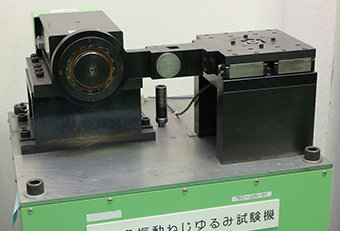
A Junker Test lock nut is evaluated by measuring how well the fastener maintains clamping force while transverse vibration is applied.
Unlike simple axial loading, the Junker Test applies vibration transverse to the bolt axis. This is important because transverse movement is one of the most severe causes of rotational loosening in bolted connections.
During the test:
- a bolt and nut assembly is clamped between a fixed plate and a moving plate
- the moving plate is displaced sideways
- transverse vibration is applied to the joint
- the remaining preload is measured over time
If the nut loosens, preload drops rapidly. If the locking system is effective, preload remains stable.
The Junker Test is commonly associated with DIN 65151 and ISO 16130. HARDLOCK® also provides technical test data and information about its testing apparatus for engineers evaluating vibration-resistant fasteners.
Why the Junker Test Matters for Lock Nut Performance
Bolted joints are designed to maintain clamping force. However, when vibration acts sideways across the joint, micro-slips can occur between the threads and bearing surfaces.
This can lead to:
- reduction of friction between threads
- rotational movement of the nut
- progressive preload loss
- eventual loosening of the joint
This is why transverse vibration is especially relevant for applications such as:
- rail track systems
- rolling stock
- wind turbines
- conveyors and hoppers
- bridges and civil infrastructure
- automotive drivetrains and suspension systems
- mining and earth moving equipment
- rotating machinery
Related reading:
Why Bolts Loosen (And How HARDLOCK® Nuts Prevent It)
HARDLOCK® as a Junker Test Lock Nut Solution
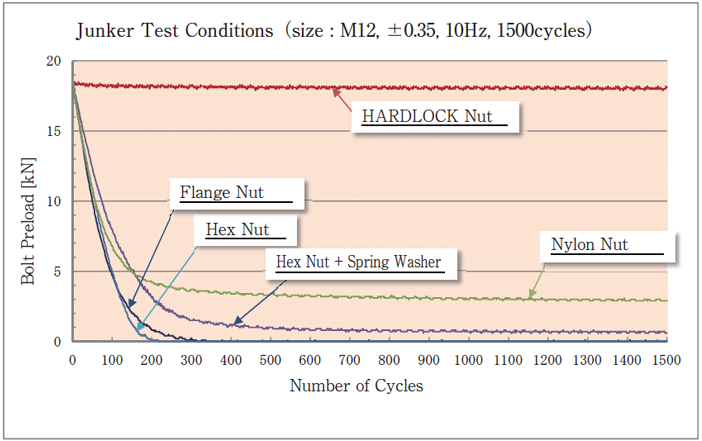
The HARDLOCK® Nut was tested using a Junker-style transverse vibration testing machine.
The result confirmed that the HARDLOCK® Nut prevented loosening in the Junker Test.
As a Junker Test lock nut, HARDLOCK® is designed to resist rotational loosening by using a mechanical wedge-locking principle instead of relying only on friction. HARDLOCK® uses a mechanical wedge effect created by two nut components:
- a concave lower nut
- a convex upper nut
When tightened together, the upper nut wedges into the lower nut. This creates radial force against the bolt threads and eliminates thread clearance.
The result is a stable mechanical lock that resists rotational loosening even under severe vibration.
Related reading:
HARDLOCK® Nut: Main Benefits and How It Prevents Loosening
Why Bolts Loosen (And How HARDLOCK® Nuts Prevent It)
Why Conventional Locking Methods Can Fail Under Vibration
Many fastening methods are described as “locking” solutions, but not all of them maintain preload under severe vibration.
Common approaches include:
- nylon insert nuts
- prevailing torque nuts
- spring washers
- serrated washers
- double nuts
- thread-locking adhesives
These methods may provide resistance in certain conditions, but they often depend on friction, deformation, surface condition or installation quality.
Under repeated transverse vibration, this can create problems:
- friction decreases
- inserts wear or degrade
- preload drops
- locking performance becomes inconsistent
- re-tightening or replacement becomes necessary
For vibration-critical applications, engineers need a fastening system that addresses the root cause of loosening: rotational movement caused by thread clearance.
Related comparison:
HARDLOCK® Nuts vs Locking Nuts & Washers: Which Solution Performs Best Under Vibration?
HARDLOCK® Nut vs. Nord-Lock® Washer: A Comparison of Anti-Loosening Solutions
Engineering Value of the Junker Test
The Junker Test is useful because it shows how a fastener behaves when vibration directly challenges the joint.
For engineers, it helps answer practical questions:
- Does the nut maintain preload?
- Does loosening start immediately after vibration begins?
- Is the locking mechanism stable over time?
- Does the solution rely only on friction?
- Can the fastener be trusted in vibration-critical assemblies?
For OEMs and maintenance teams, choosing a Junker Test lock nut helps reduce the risk of preload loss in equipment exposed to repeated vibration.
A nut that performs well in transverse vibration can help reduce:
- unplanned downtime
- repeated inspections
- re-tightening work
- failure-related maintenance costs
- safety risks in critical equipment
Related ROI article:
Steel Plant Downtime Reduction: ROI of Anti-Loosening Fasteners
Where to Use a Vibration Resistant Lock Nut
Junker Test Lock Nut for Railway and Rolling Stock
Railway systems are exposed to constant vibration, shock and cyclic loading. Fastener loosening can affect safety, reliability and maintenance frequency.
HARDLOCK® Nuts are suitable for railway applications where long-term resistance to loosening is required.
Related articles:
HARDLOCK® Nuts in Rolling Stock
HARDLOCK® Nuts in Rail Track Systems
Junker Test Lock Nut for Wind Power
Wind turbines operate under changing loads, vibration and environmental stress. Secure bolted joints are essential for reducing maintenance and improving long-term reliability.
Related article:
HARDLOCK® Nuts in Wind Power Turbines
Junker Test Lock Nut for Steel Plants and Heavy Industry
In steel plants, loosening fasteners can stop conveyors, hoppers, rail systems and production equipment. Even short downtime can result in significant operational losses.
HARDLOCK® Nuts help address loosening at the root cause, especially in high-vibration areas.
Related articles:
Steel Plant Downtime Reduction: ROI of Anti-Loosening Fasteners
Vibration Resistant Nuts Steel Plant: Conveyor & Hopper Failures Solved
Automotive and Transport Equipment
Automotive assemblies are exposed to engine vibration, torque shock, braking forces, road impact and progressive preload loss.
Applications include:
- drivetrains
- suspension systems
- rotating shafts
- heavy-duty vehicle chassis
- steering systems
Related article:
Anti Loosening Nuts for Automotive: HARDLOCK® Applications
Bridges and Civil Infrastructure
Civil infrastructure requires long service life, high safety margins and reduced maintenance intervention. For bridges, towers, highways and other structures, bolt loosening can create long-term safety and cost risks.
Related articles:
Anti Loosening Nuts for Civil Infrastructure: HARDLOCK® Solution
Anti Loosening Nut for Bridges: HARDLOCK® Nut Solution for Bridge Structures
HARDLOCK®: Mechanical Locking Instead of Friction Dependence
The key difference between HARDLOCK® and many conventional locking products is the locking principle.
HARDLOCK® does not rely only on surface friction. It creates a mechanical wedge lock that eliminates thread clearance and prevents rotational movement.
This provides important advantages:
- stable performance under vibration
- resistance to preload loss caused by loosening
- suitability for harsh industrial environments
- reduced need for re-tightening
- improved safety in critical assemblies
- long-term maintenance cost reduction
For engineers designing equipment exposed to vibration, the Junker Test result provides technical confidence that HARDLOCK® is not just a locking nut by name — it is a proven anti-loosening solution.
When to Specify HARDLOCK® Nuts
Specify HARDLOCK® Nuts when:
- vibration is continuous or unavoidable
- preload retention is critical
- maintenance access is difficult
- downtime is expensive
- joint failure creates safety risks
- conventional locking methods have failed
- long service life is required
Typical industries include:
- railway
- energy and wind power
- mining and earth moving
- bridges and civil infrastructure
- steel plants
- automotive and heavy vehicles
- industrial machinery
- construction equipment
Explore applications:
Energy / Power
Railway Infrastructure
Mining and Earth Moving
Machinery
Conclusion: Junker Test Performance Builds Engineering Confidence
The Junker Test is one of the most important methods for evaluating lock nut performance under transverse vibration.
It shows whether a fastening solution can maintain preload when exposed to one of the most severe causes of self-loosening.
If your application requires a proven Junker Test lock nut for high-vibration environments, HARDLOCK® provides a technically verified anti-loosening solution.
For engineers, OEMs and maintenance teams, HARDLOCK® offers a proven solution for reducing loosening risk, improving reliability and lowering long-term maintenance costs.
Looking for a Proven Anti-Loosening Solution?
Contact HARDLOCK® experts for:
- technical consultation
- application-specific recommendations
- product selection support
- testing information
- case studies for your industry
HARDLOCK® — mechanical locking performance proven under vibration.