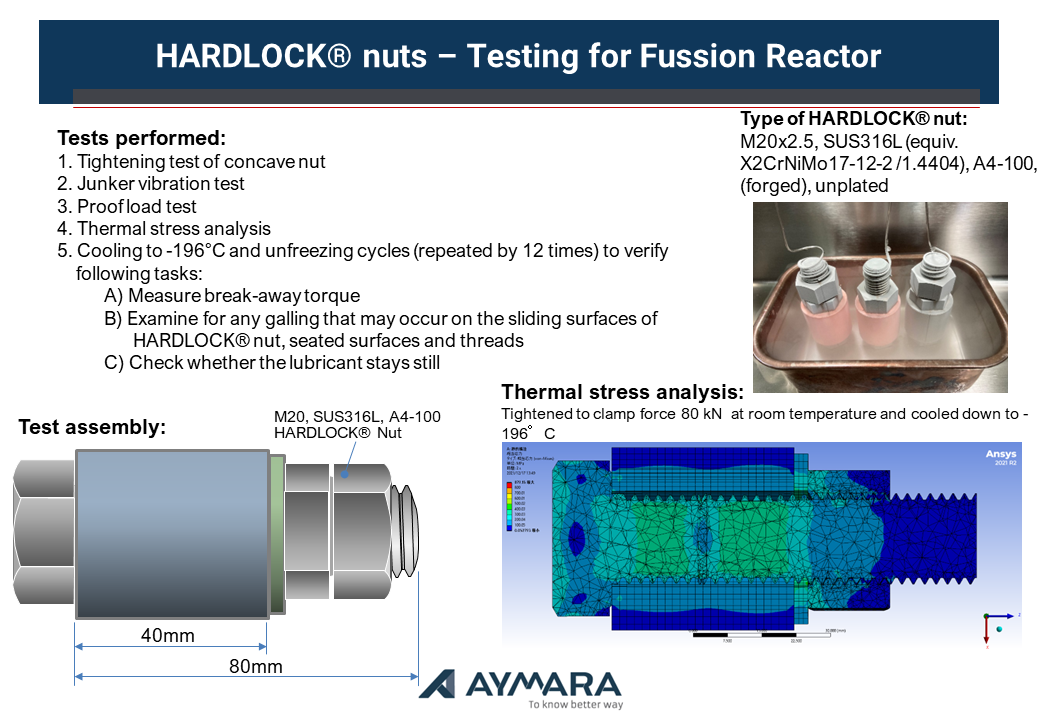
Anti-Loosening Nut Cryogenic Performance in Fusion Reactor Applications
The anti-loosening nut cryogenic performance of HARDLOCK® nuts has been successfully validated through rigorous testing for fusion reactor environments. These extreme conditions require fastening solutions that maintain integrity under intense vibration and ultra-low temperatures.
Fusion reactors present unique engineering challenges, especially in cryogenic systems where conventional fasteners often fail. HARDLOCK® nuts provide a proven solution by preventing loosening even in the most demanding conditions.
Why Fastening Matters in Fusion Reactor Systems
Fusion reactor systems rely on complex assemblies where bolted joints are used in:
- Structural support systems
- High-temperature components
- Magnetic confinement systems
- Auxiliary mechanical and electrical equipment
These connections must ensure:
- Mechanical stability
- Precision alignment
- Long-term reliability
The Challenge: Extreme Operating Conditions
Fusion environments expose components to some of the most demanding conditions in engineering.
Extreme Temperature Variations
Fusion systems involve:
- High operating temperatures
- Rapid thermal cycling
- Significant thermal expansion and contraction
These effects can lead to preload loss in conventional fasteners.
Vibration and Mechanical Stress
Operation and supporting systems generate:
- Continuous vibration
- Dynamic mechanical loads
- Stress on structural joints
High Reliability Requirements
Fusion reactors require:
- Maximum operational reliability
- Minimal maintenance intervention
- Long-term performance stability
Failure of a single fastening point can affect the entire system.
Complex and Restricted Maintenance Environments
Many components are:
- Difficult to access
- Installed in controlled or hazardous environments
- Designed for long service intervals
👉 Learn more about preload loss:
https://www.hardlock.eu/why-do-bolts-nuts-come-loose-factors-influencing-bolt-preload-loss/
Purpose of HARDLOCK® Nut Testing in Fusion Applications
The testing of HARDLOCK® Nut in fusion-related environments focuses on verifying its ability to:
- Maintain preload under thermal cycling
- Resist loosening under vibration
- Ensure long-term fastening stability
Such testing supports its potential use in advanced energy systems and high-reliability engineering applications.
HARDLOCK® Nut: Mechanical Locking for Extreme Conditions
HARDLOCK® Nut uses a mechanical wedge-locking principle designed to maintain preload without relying solely on friction.
How it works:
- Two nuts form a single locking system
- The top nut has an eccentric (off-center) thread
- Tightening creates a radial locking force
- This force prevents rotational loosening
👉 Full technical explanation:
https://www.hardlock.eu/why-the-hardlock-nut-does-not-loosen/
Key Benefits for Fusion Reactor Environments
✔ Maintains Preload Under Thermal Cycling
The mechanical locking principle supports consistent clamping force despite extreme temperature changes.
✔ Resists Loosening Under Vibration
HARDLOCK® Nut helps ensure stable fastening in systems exposed to continuous mechanical stress.
✔ Supports High-Reliability Engineering Requirements
Reliable fastening contributes to:
- System stability
- Reduced risk of failure
- Compliance with strict engineering standards
✔ Reduces Maintenance Requirements
Stable fastening can help:
- Extend maintenance intervals
- Reduce intervention in difficult-to-access environments
- Improve operational efficiency
✔ Suitable for Advanced Energy Applications
Testing demonstrates the potential of HARDLOCK® Nut for use in:
- Fusion energy systems
- High-temperature industrial environments
- Precision engineering applications
Comparison with Conventional Fastening Methods
Traditional fastening solutions may rely on friction or additional locking elements.
Limitations:
- Sensitivity to thermal expansion
- Loosening under vibration
- Reduced effectiveness over time
HARDLOCK® Nut provides a mechanical locking solution designed for extreme conditions.
👉 Compare fastening technologies:
https://www.hardlock.eu/hardlock-nut-vs-prevailing-torque-type-nut/
Engineering Perspective: Risk in Advanced Energy Systems
In fusion reactor applications, fastening reliability directly impacts:
- System safety
- Experimental integrity
- Operational continuity
Failure of a bolted joint can result in:
- Misalignment of critical components
- Increased maintenance complexity
- Potential system downtime
Reliable fastening solutions help mitigate these risks.
👉 Learn more about benefits:
https://www.hardlock.eu/hardlock-nut-main-benefits/
Related Applications in High-Performance Engineering
Similar challenges exist in other demanding environments:
- Nuclear power plants → https://www.hardlock.eu/hardlock-nut-in-nuclear-power-plants/
- Gas turbines → https://www.hardlock.eu/hardlock-nut-in-gas-turbines/
- Power plants → https://www.hardlock.eu/hardlock-nut-in-power-plants/
- High Temperature Applications: Proven Performance up to 800°C in Critical Industries → https://www.hardlock.eu/hardlock-nuts-in-high-temperature-applications-proven-performance-up-to-800-c-in-critical-industries/
👉 Explore full application range:
https://www.hardlock.eu/where-is-hardlock-nut-often-used/
When to Consider HARDLOCK® Nut for Advanced Applications
Consider this solution if your application involves:
- Extreme temperature conditions
- High vibration or dynamic loads
- Limited maintenance access
- High cost of failure
Conclusion
Fusion reactor systems require fastening solutions capable of performing under some of the most extreme conditions in engineering.
Testing shows that HARDLOCK® Nut provides a mechanical solution for maintaining preload and resisting loosening in advanced energy applications.
Looking to Improve Reliability in Extreme Environments?
Choosing the right fastening solution can enhance system stability, reduce maintenance, and support long-term performance.
👉 Start with the fundamentals:
https://www.hardlock.eu/why-do-bolts-nuts-come-loose-factors-influencing-bolt-preload-loss/