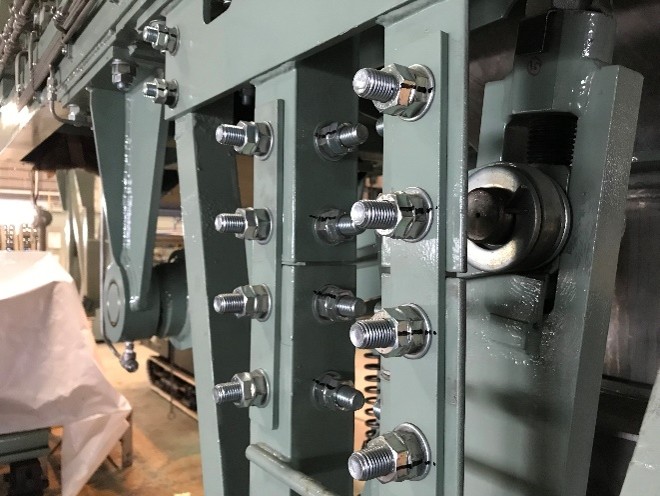
Steel Mill Bolted Joint Failures: Why Conventional Fastening Fails—and What Actually Works
In steel mills, bolted joints are constantly exposed to extreme vibration, thermal cycling, and shock loads. From coking plants to rolling lines, these conditions make loosening not just likely—but inevitable with conventional fastening methods.
The result?
Unplanned downtime. Costly maintenance. And most critically—serious safety risks.
At Hardlock Industry Co., Ltd., we’ve spent decades solving exactly this problem. This article explores real-world steel mill applications where traditional solutions fail—and how HARDLOCK® Nuts deliver measurable improvements.
The Hidden Weak Points in Steel Mill Fastening
Based on field applications across steel production environments, five recurring challenges appear:
1. Welding Limits Maintenance Efficiency
Welding is often used to prevent loosening—but it creates new problems:
- Difficult disassembly during maintenance
- Increased downtime
- Risk of structural damage
➡️ In many cases, operators are now actively switching from welding to mechanical locking solutions
2. Bolted Joints Are Hard to Inspect or Re-Tighten
In areas like:
- Conveyor systems
- Hopper liners
- Rail tracks
Access is limited. Once installed, bolts are often:
- Impossible to re-tighten safely
- Left unchecked until failure occurs
3. Safety Requirements Are Extremely High
Steel plants operate under strict safety demands:
- Molten iron transport
- Blast furnace systems
- Heavy moving equipment
Even a single loosened bolt can escalate into a critical incident.
4. Low or No Preload Conditions
Many applications—such as:
- Liners
- Skirts
- Rail components
operate with minimal preload, making conventional nuts ineffective against vibration loosening.
5. Retrofit Constraints
Steel mills rarely allow full redesigns. Any solution must:
- Fit existing bolts
- Work without structural modification
➡️ Retrofit capability is essential for real-world adoption
Where These Problems Occur: Real Steel Mill Use Cases
HARDLOCK® solutions are already deployed across key steel production stages:
Coking & Sintering Plants
- Coal charging cars
- Ignition furnaces
- Blowers
- Hopper systems
Ironmaking & Steelmaking
- Blast furnace components
- Rail track turnbuckles
- Fishplate bolts
- Tuyere heat-resistant joints
Continuous Casting & Rolling
- Mold oscillators
- Rolling mills
- Coil lifters
- Hydraulic systems
- Piping (air, water, steam, acid)
➡️ These are not theoretical scenarios—these are field-proven installations across critical infrastructure
Why HARDLOCK® Nuts Work Where Others Fail
Unlike friction-based locking systems, HARDLOCK® Nuts use a wedge-locking principle that:
- Prevents rotation under vibration
- Maintains locking even with low preload
- Eliminates the need for re-tightening
This makes them particularly effective in:
- Conveyor skirts and hopper liners
- Rail track fastening systems
- High-temperature and high-vibration zones
👉 For a deeper understanding of why loosening occurs in vibration environments, see:
https://www.hardlock.eu/why-the-hardlock-nut-does-not-loosen/
From Welding to Mechanical Locking: A Strategic Shift
One of the most impactful changes we see in steel mills is the transition away from welding.
Before:
- Welded bolts
- Time-consuming maintenance
- High downtime
After:
- HARDLOCK® Nuts
- Easy removal and reinstallation
- Reduced maintenance time
This shift directly improves:
- Operational uptime
- Worker safety
- Maintenance flexibility
👉 Learn how the mechanism works:
- https://www.hardlock.eu/hardlock-nut-the-worlds-strongest-self-locking-nut/
- https://www.hardlock.eu/why-the-hardlock-nut-does-not-loosen/
High-Impact Application Example: Rail Track Stability
Rail systems in steel mills face constant stress from:
- Heavy loads
- Repetitive motion
- Thermal expansion
HARDLOCK® Nuts are used in:
- Turnbuckles
- Fishplate bolts
➡️ Ensuring rails remain securely fixed and aligned—even under extreme conditions
Similar challenges exist in:
- Ball and rod mills → https://www.hardlock.eu/hardlock-nut-in-ball-and-rod-mills/
- Offshore & Onshore Applications of HARDLOCK Nuts: Engineering Reliability in Extreme Environments → https://www.hardlock.eu/offshore-onshore-applications-of-hardlock-nuts-engineering-reliability-in-extreme-environments/
- Sintering Plants → https://www.hardlock.eu/hardlock-nut-in-sintering-plants/
- Ball and Rod Mills → https://www.hardlock.eu/hardlock-nut-in-ball-and-rod-mills/
- Vibration Screens → https://www.hardlock.eu/hardlock-nut-on-vibration-screens/?preview_id=5113&preview_nonce=50bbb8fe5c&preview=true&_thumbnail_id=5114
- Steel Making Lines → https://www.hardlock.eu/hardlock-bearing-nut-in-steel-making-lines/
- Cone Crushers → https://www.hardlock.eu/hardlock-nut-on-cone-crushers/
Why This Matters for Plant Operators
If your plant is experiencing:
- Repeated bolt loosening
- Frequent maintenance cycles
- Safety concerns in critical joints
Then the issue is not torque—it’s locking reliability.
👉 Learn more about benefits:
https://www.hardlock.eu/hardlock-nut-main-benefits/
Conclusion: Safety Is Power
Steel mills demand absolute reliability. In environments where:
- Failure is costly
- Access is limited
- Safety is non-negotiable
Conventional fastening is simply not enough.
HARDLOCK® Nuts provide a proven, retrofit-ready solution that eliminates loosening at the root cause—helping operators achieve safer, more efficient operations.
Looking to eliminate bolt loosening in your steel mill?
Contact our engineering team for a use-case evaluation tailored to your plant.