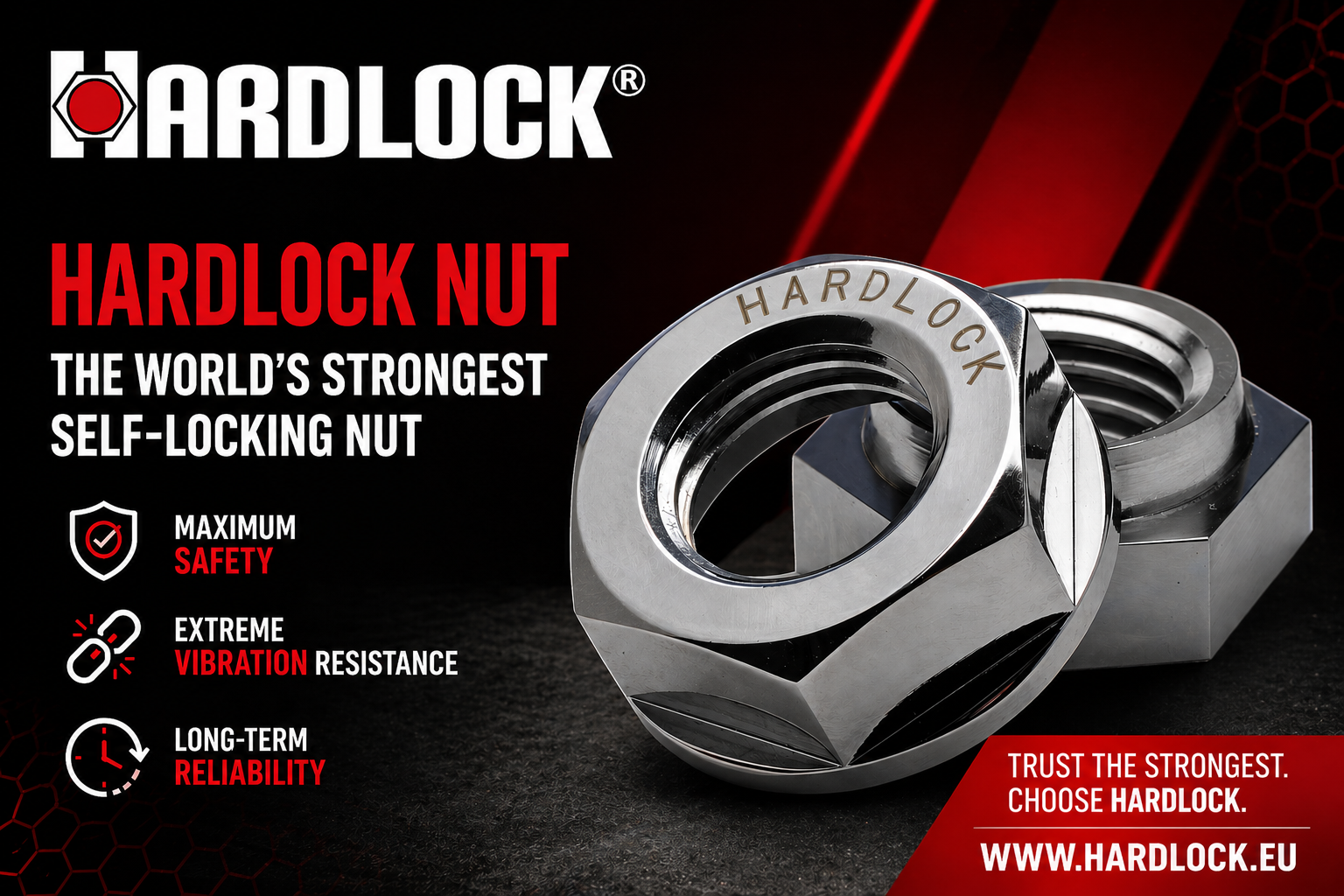
When it comes to securing critical joints in high-vibration environments, choosing the best locking nut for vibration is essential. The HARDLOCK® Nut is engineered to deliver unmatched reliability, preventing loosening even under extreme conditions such as railways, heavy machinery, and infrastructure applications.Unlike conventional nuts, HARDLOCK® uses a unique wedge-locking mechanism that ensures long-term stability and safety.
HARDLOCK® Nut is designed as a high-performance self-locking solution that helps maintain secure bolted joints even under demanding conditions.
What Is a Self-Locking Nut?
A self-locking nut is designed to resist loosening without requiring additional components.
However, not all self-locking mechanisms perform equally—especially in environments with:
- Continuous vibration
- Dynamic loads
- Thermal cycling
👉 Learn more about why bolts loosen:
Why Bolts Loosen (And How HARDLOCK® Nut Prevents It)
The Challenge with Conventional Self-Locking Nuts
Most traditional self-locking nuts rely on friction to prevent loosening.
Common types include:
- Nylon insert nuts
- Deformed thread nuts
Limitations:
- Friction can decrease over time
- Performance may be affected by vibration
- Temperature can impact materials (e.g., nylon inserts)
👉 See a detailed comparison here:
- HARDLOCK® Nuts vs Locking Nuts & Washers: Which Solution Performs Best Under Vibration?
- HARDLOCK® Nut vs. Nord-Lock® Washer: A Comparison of Anti-Loosening Solutions
HARDLOCK® Nut: A Different Approach
HARDLOCK® Nut uses a mechanical wedge-locking principle, rather than relying on friction alone.
How it works:
- Two nuts function as a single system
- The top nut has an eccentric (off-center) thread
- Tightening creates a radial locking force
- This force helps prevent rotation
👉 Full explanation of the principle:
Why Bolts Loosen (And How HARDLOCK® Nut Prevents It)
Performance in High-Vibration Environments
HARDLOCK® Nut is designed for applications where vibration is a constant factor.
Typical use cases include:
- Railway systems
- Industrial machinery
- Construction equipment
👉 Explore real applications:
- HARDLOCK® Nut on High-Speed Trains
- HARDLOCK® Nut on Vibration Screens
- Aerospace Applications: Preventing Bolt Loosening Under Extreme Conditions
- Agricultural Machinery
- Aerospace Industry
- Military Vehicles
- Sintering Plants
- Tunnel Boring Machines
- Ball and Rod Mills
- Building Dampers
- Cone Crushers
- Hydraulic Breakers
- High-Speed Trains
Key Benefits of HARDLOCK® Nut
✔ Reliable Anti-Loosening Performance
The mechanical locking principle helps maintain preload even under dynamic conditions.
✔ Increased Safety
Secure fastening is essential in safety-critical applications such as infrastructure and transportation.
👉 Learn more:
HARDLOCK® – The Ultimate Fastener for Safety-Critical Applications
✔ Reduced Maintenance
By minimizing loosening, HARDLOCK® Nut can help reduce:
- Inspection frequency
- Retightening requirements
- Maintenance costs
✔ Long-Term Stability
Performance is based on mechanical interaction, supporting consistent results over time.
✔ Versatile Application Range
HARDLOCK® Nut can be used across industries, including:
- Energy and power systems
- Manufacturing and heavy industry
- Infrastructure and construction
👉 See where it is used:
Where Is HARDLOCK® Nut Used? Key Applications Across Industries
Engineering Perspective: Why Locking Strength Matters
In many applications, the cost of failure is significantly higher than the cost of the fastener itself.
Loss of preload can lead to:
- Equipment damage
- Downtime
- Safety risks
A fastening system that maintains joint integrity helps reduce these risks.
When to Choose a High-Performance Self-Locking Nut
Consider HARDLOCK® Nut if your application involves:
- Continuous vibration
- Safety-critical components
- High maintenance costs due to loosening
- Long service life requirements
Conclusion
HARDLOCK® Nut offers a high-performance approach to self-locking fastening.
By using a mechanical locking principle, it provides a reliable solution for maintaining secure bolted joints in demanding environments.
👉 Discover the main benefits:
HARDLOCK® Nut – Key Benefits of a Reliable Anti-Loosening Fastener
Frequently Asked Questions
What is a self-locking nut?
A nut designed to resist loosening without additional locking components.
How does HARDLOCK® Nut differ from standard self-locking nuts?
It uses a mechanical locking principle rather than relying primarily on friction.
Is it suitable for high-vibration applications?
Yes, it is designed for environments where vibration is a key factor.
Looking for a Reliable Self-Locking Solution?
Choosing the right fastening system can improve safety, reduce maintenance, and increase long-term reliability.
👉 Learn more about HARDLOCK® technology:
Why Bolts Loosen (And How HARDLOCK® Nut Prevents It)