Maintaining bolt preload is critical for the safety, durability, and performance of mechanical assemblies. However, no single locking method works for every application, thread size, or environment. Selecting the right solution requires understanding the mechanism of loosening and the limitations of each approach.
In this guide, we classify bolt locking solutions into three practical categories and explain when and how to use them effectively.
The 3 Main Types of Bolt Locking Methods
Bolt locking (self-locking) solutions can be divided into:
- Fall-off Prevention
→ Prevents nuts from detaching (partial preload loss mitigation) - Jamming & Adhesive Methods
→ Prevents rotational loosening (full preload loss mitigation) - Relaxation & Settlement Compensation
→ Addresses non-rotational preload loss (embedment, creep, etc.)
Key takeaway:
- If preload is not critical → use Category 1
- If preload must be maintained → prioritize Category 2
- If preload loss still occurs → add Category 3
1. Fall-off Prevention Methods
These solutions are designed to stop nuts from falling off, but they do not reliably maintain preload.
Positive Locking Devices
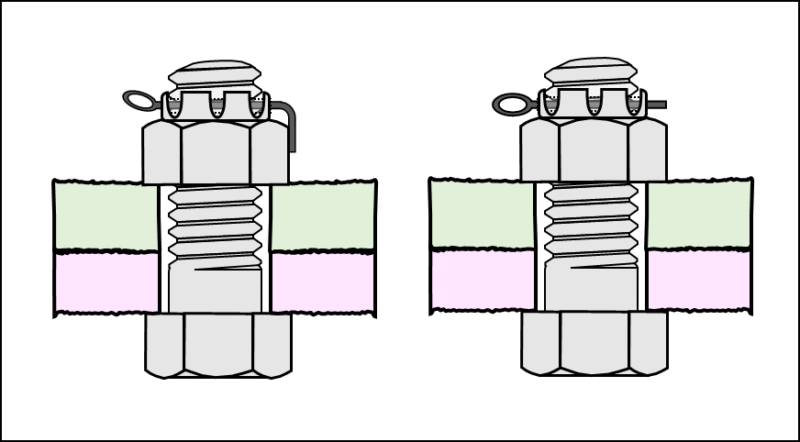
Positive locking physically blocks rotation without relying on friction.
Examples:
- Castle nuts with cotter pins
- Safety wire systems
- Tab washers / locking plates
- Push-on fasteners
Advantages:
- High reliability in safety-critical sectors (aviation, defense)
- Prevents complete disassembly
Limitations:
- Does not fully prevent preload loss
- Time-consuming installation
- Requires skilled technicians
- Fatigue failure possible under vibration
Thread Forming & Huck Bolts
Thread-forming fasteners create zero-clearance threads by deforming material.
Typical applications:
- Furniture
- Lightweight assemblies
Limitations:
- Not suitable for repeated disassembly
- Limited industrial use in high-load joints
Friction Locking Methods
Prevailing Torque Locknuts
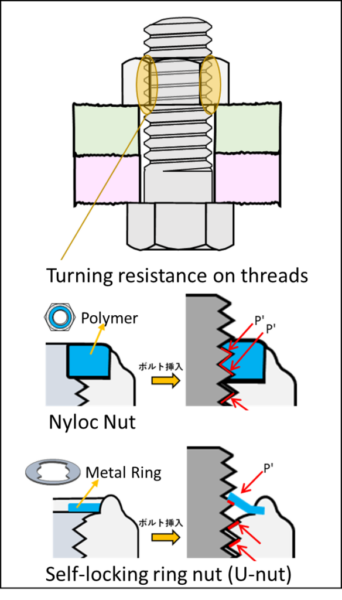
These nuts create resistance through thread interference.
👉 A Comparison of Anti-Loosening Solutions:
Types:
- Nylon insert nuts (Nyloc)
- All-metal distorted thread nuts
Key characteristics:
- Increased torque required for rotation
- Effectiveness decreases with reuse
Flanged & Serrated Fasteners
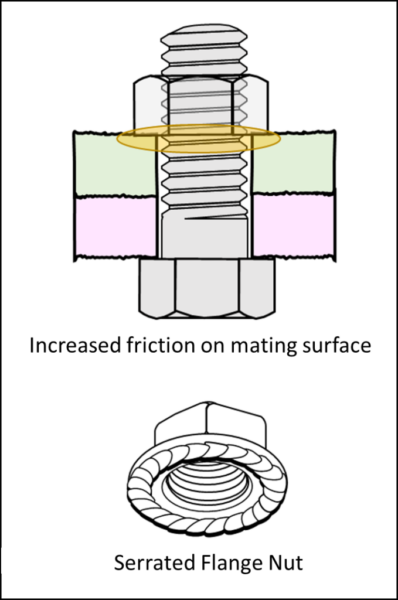
These increase friction at the bearing surface.
Important considerations:
- Require softer mating surfaces for serration grip
- Must be installed without washers
Summary: Fall-off Prevention
These methods:
- Prevent detachment
- Provide limited preload retention
- Are insufficient for vibration-critical applications
2. Jamming & Adhesive Methods (Primary Locking Solutions)
These are the most important category for maintaining preload and preventing loosening.
Double Nutting (Jam Nuts)
Double nutting eliminates axial clearance between threads.
Best practice: “Nelson Hold” tightening method
- Creates opposing forces between nuts
- Ensures full thread engagement
Challenges:
- Installation complexity
- High dependency on technician skill
- Inconsistent results in real-world use
Thread-Locking Adhesives
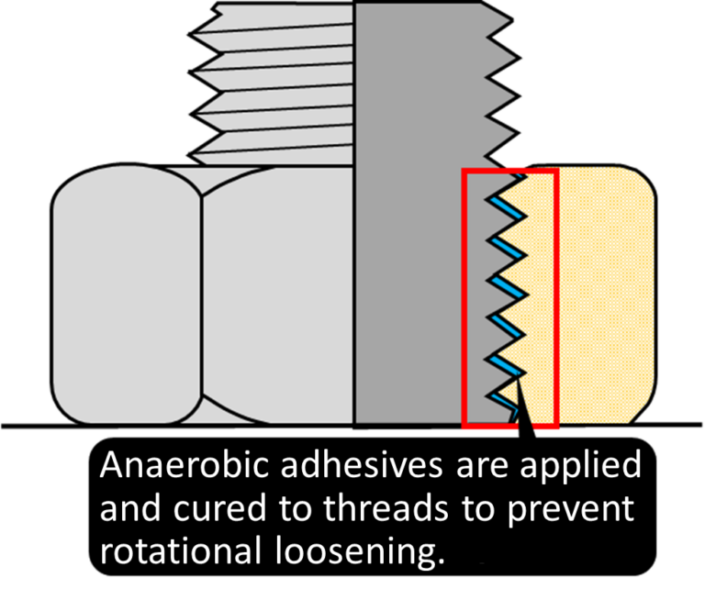
Anaerobic adhesives:
- Fill thread gaps (zero clearance)
- Cure without oxygen
Advantages:
- Prevent loosening
- Provide sealing (fluid leakage prevention)
Limitations:
- Up to 24h curing time
- Surface preparation required
- Difficult inspection during maintenance
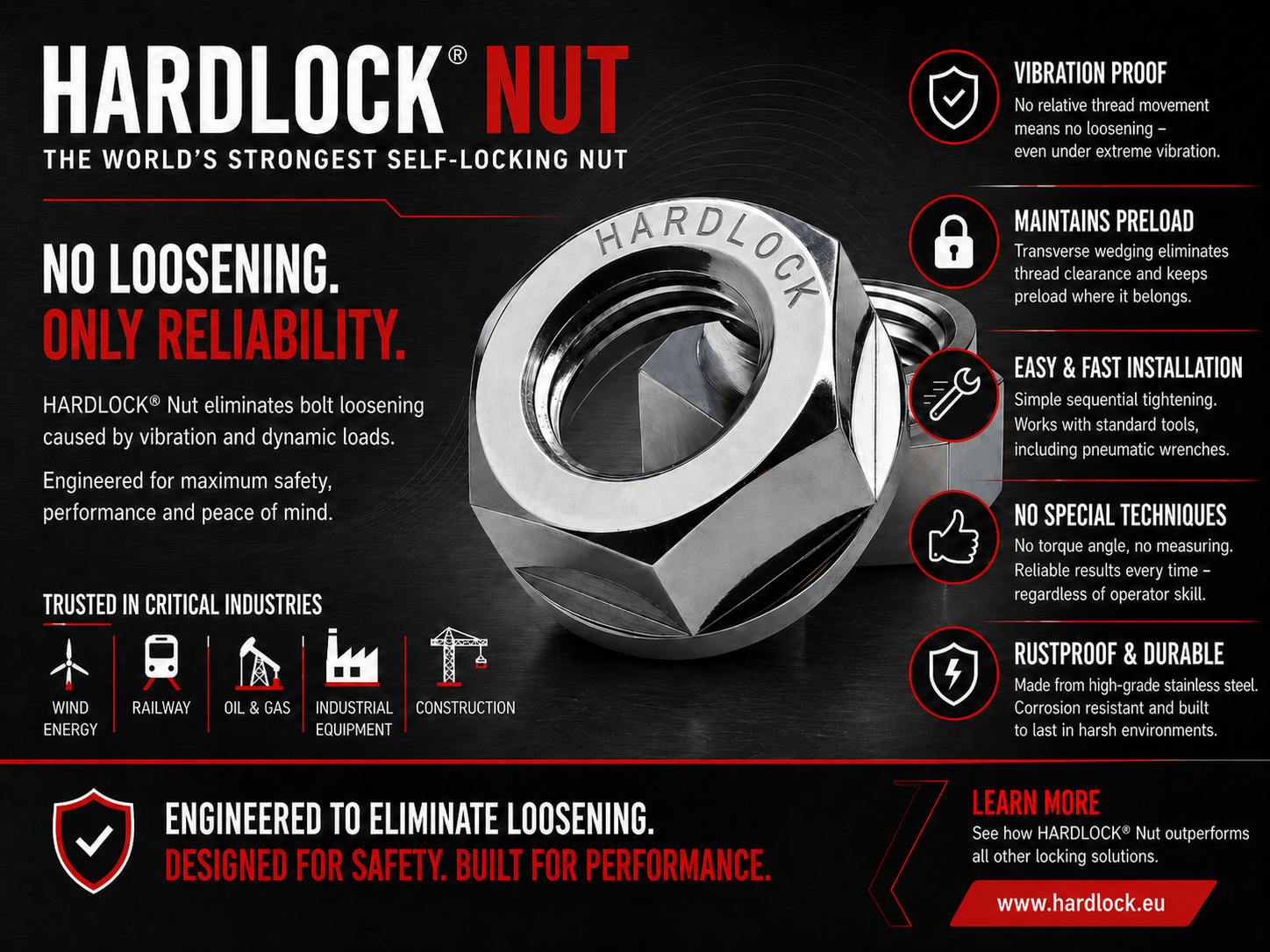
HARDLOCK® Nut (Advanced Mechanical Locking)

The HARDLOCK® Nut improves on traditional double nutting by eliminating thread clearance through transverse wedging.
👉 Detailed explanation:
- https://www.hardlock.eu/hardlock-nut-the-worlds-strongest-self-locking-nut/
- https://www.hardlock.eu/why-the-hardlock-nut-does-not-loosen/
- https://www.hardlock.eu/hardlock-nut-main-benefits/
- https://www.hardlock.eu/hardlock-nut-rustproof-and-vibration-resistant-product/
👉 A Comparison of Anti-Loosening Solutions:
- https://www.hardlock.eu/hardlock-nuts-vs-locking-nuts-washers-which-solution-performs-best-under-vibration/
- https://www.hardlock.eu/hardlock-nut-vs-nordlock-washer/
Key benefits:
- No relative thread movement → no loosening
- Simple sequential installation
- Compatible with pneumatic tools
- No special tightening techniques required
👉 Learn more in:
- How HARDLOCK® Nut Works
- Vibration Testing Results of HARDLOCK® Nut
Summary: Jamming & Adhesive Methods
- Most effective against rotational loosening
- Should be the default choice in engineering design
- Still vulnerable to non-rotational preload loss
3. Non-Rotational Loosening (Preload Loss Factors)
Even when rotation is eliminated, preload can decrease due to:
- Embedment
- Stress relaxation
- Creep
- Thermal expansion
Disc Spring Washers (Recommended)

Disc spring washers (DIN 2093) compensate for preload loss by storing mechanical energy.
Why they work:
- Maintain force despite material settling
- React dynamically to load changes
Why Helical Spring Washers Fail
Common split lock washers:
- Provide minimal spring force
- Cannot maintain preload in high-strength joints (≥ 8.8 class)
- Often act only as friction devices
Summary: Non-Rotational Loosening
- These solutions do not lock threads
- They support preload retention
- Best used in combination with Category 2 methods
Final Recommendations for Engineers
For reliable bolted joint performance:
- Start with a proper locking method
→ Prefer mechanical solutions like the HARDLOCK® Nut - Verify installation quality
→ Incorrect installation = failure - Account for preload loss mechanisms
→ Add disc spring washers if needed - Avoid relying solely on fall-off prevention
→ These are not true locking solutions
Conclusion
Bolt loosening is a complex problem that cannot be solved with a single universal method. Understanding the difference between fall-off prevention, rotational locking, and preload compensation is essential for selecting the right solution.
For modern industrial applications—especially where vibration, safety, and maintenance costs matter—advanced mechanical locking systems like the HARDLOCK® Nut offer a reliable and scalable solution.