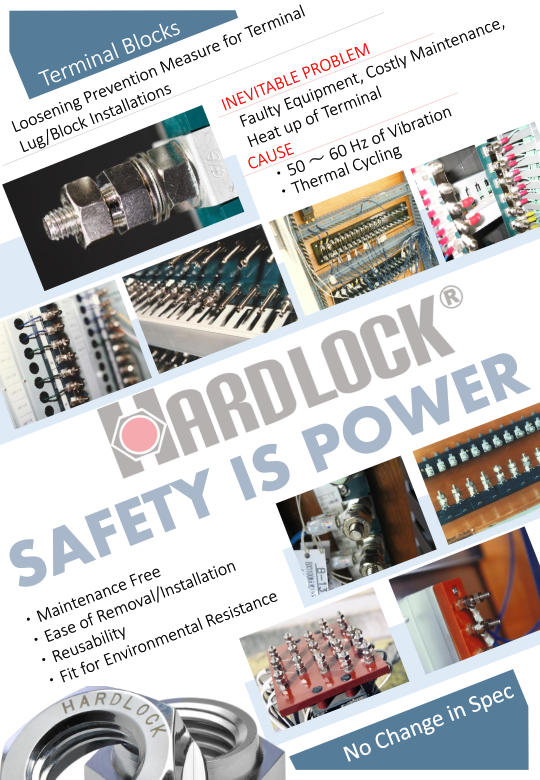
HARDLOCK® Nut in Electrical Applications
In modern electrical infrastructure, safety and reliability are non-negotiable. From power transmission towers to renewable energy systems, every connection must remain secure despite constant stress.
However, vibration, thermal expansion, and dynamic loads can gradually loosen conventional fasteners. As a result, even properly installed bolts may fail over time.
Therefore, engineers and maintenance teams increasingly turn to advanced anti-loosening solutions such as HARDLOCK® Nuts. These components are specifically designed to maintain clamping force under extreme conditions, making them ideal for critical electrical applications.
Why Fasteners Fail in Electrical Systems
Electrical installations are exposed to continuous mechanical and environmental stress. For example, transmission towers and wind turbines experience strong wind-induced vibrations.
In addition, temperature fluctuations cause expansion and contraction of materials. Consequently, these repeated movements reduce preload in bolted joints.
Over time, this leads to:
- Loss of clamping force
- Increased risk of structural instability
- Higher maintenance and inspection costs
👉 For a deeper explanation of loosening mechanisms, see:
What Makes HARDLOCK® Nuts Different?
Unlike standard nuts, HARDLOCK® Nuts use a mechanical wedge-locking principle instead of relying solely on friction.
The system consists of two components:
- A convex nut
- A concave nut
When tightened together, they create a strong wedge effect. As a result, the bolt is locked in place without any clearance between threads.
Moreover, this design ensures:
- Consistent preload
- Resistance to vibration and shock
- Long-term stability without retightening
👉 Learn more about the locking principle here:
Key Applications in Electrical Engineering
HARDLOCK® Nuts are widely used across electrical and energy infrastructure. In particular, they are suitable for applications where failure is not an option.
Common use cases include:
- Power transmission towers
- Substation structures
- Cable support systems
- Wind turbines and renewable energy installations
In these environments, reliability directly impacts safety and operational uptime. Therefore, selecting the right fastening solution is critical.
👉 Related case studies and applications:
Benefits for B2B Projects and Industrial Use
From a B2B perspective, HARDLOCK® Nuts offer measurable advantages that go beyond basic fastening.
1. Reduced Maintenance Costs
Because the nuts do not loosen, there is less need for inspections and retightening. Consequently, maintenance intervals can be extended.
2. Increased Operational Safety
Secure joints reduce the risk of structural failure. Therefore, they help meet strict industry safety standards.
3. Reusability and Cost Efficiency
Unlike nylon or deformed nuts, Hardlock Nuts can be reused without losing performance. As a result, lifecycle costs are lower.
4. Proven Performance in Extreme Conditions
The system has been tested in high-vibration environments such as railways and heavy industry. Moreover, it performs reliably under temperature changes and dynamic loads.
👉 More on benefits and comparisons:
Related Applications in Electrical and Industrial Systems
Similar challenges exist in:
- Electrical Applications → https://www.hardlock.eu/hardlock-nut-on-distribution-boards/
- Auxiliary Railway Equipment → https://www.hardlock.eu/hardlock-nuts-in-auxiliary-railway-equipment/
- Solar systems → https://www.hardlock.eu/hardlock-nut-on-solar-panels/
- Railway Lines → https://www.hardlock.eu/hardlock-nut-in-railway-lines/
👉 Explore full application range:
https://www.hardlock.eu/where-is-hardlock-nut-often-used/
Why Engineers Choose HARDLOCK® Nuts
Engineers and procurement specialists prioritize solutions that deliver long-term reliability. In this context, HARDLOCK® Nuts stand out due to their proven mechanical locking system.
Furthermore, they comply with demanding industrial requirements and are already used in critical infrastructure worldwide.
Because of this, they are often specified in:
- Infrastructure projects
- Energy sector installations
- High-risk environments
Conclusion
Electrical systems require fastening solutions that can withstand vibration, temperature changes, and long-term stress. Traditional nuts often fail under these conditions.
However, HARDLOCK® Nuts provide a reliable alternative by using a mechanical locking principle that prevents loosening.
As a result, they improve safety, reduce maintenance, and increase operational efficiency. Therefore, they represent a smart investment for any B2B project involving critical electrical infrastructure.