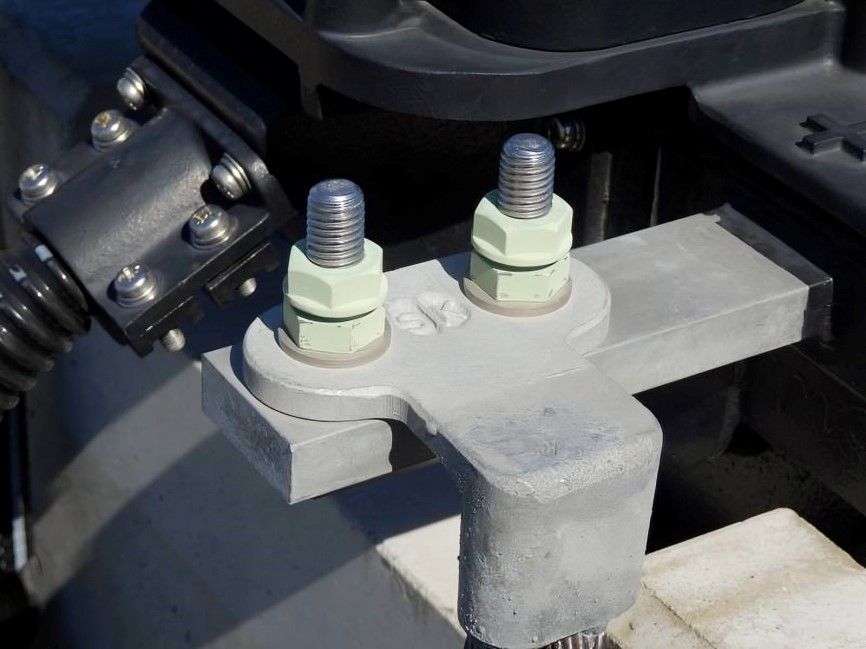
A vibration resistant nut for railway infrastructure is essential for maintaining safety and reliability in high-vibration environments such as rail tracks and fastening systems.
One critical component in railway signaling and track circuits is the impedance bond, which ensures proper current flow while maintaining track safety.
In this context, secure fastening is essential.
HARDLOCK® Nut is used in railway lines to help maintain stable and reliable connections in impedance bond assemblies, even under continuous vibration and environmental stress.
What Is an Impedance Bond and Why It Matters
An impedance bond is used in railway systems to:
- Maintain electrical continuity of the track
- Allow traction return current to pass
- Separate signaling currents for safe train detection
Because it is part of a safety-critical electrical system, connection reliability is essential.
The Challenge: Loosening in Railway Environments
Railway systems are exposed to some of the most demanding operating conditions.
Continuous Vibration
Passing trains generate constant dynamic loads and vibration, which can:
- Reduce friction in threaded connections
- Cause gradual loosening
Electrical Sensitivity
In impedance bond connections, even minor loosening can result in:
- Increased electrical resistance
- Signal instability
- Potential system malfunction
Environmental Exposure
Railway infrastructure is exposed to:
- Temperature changes
- Moisture and corrosion
- Long service intervals with limited maintenance access
👉 Learn more about why bolts loosen:
https://www.hardlock.eu/why-do-bolts-nuts-come-loose-factors-influencing-bolt-preload-loss/
Why Fastening Reliability Is Critical for Impedance Bonds
In impedance bond systems, bolted joints are not only structural—they are also part of the electrical path.
Loss of preload can lead to:
- Reduced contact pressure
- Increased resistance
- Heat generation
- Degradation of signal quality
👉 Related electrical applications:
https://www.hardlock.eu/hardlock-nut-in-electrical-applications/
HARDLOCK® Nut: A Mechanical Solution for Secure Connections
HARDLOCK® Nut is designed to maintain preload using a mechanical locking principle, helping to prevent loosening under vibration.
How it works:
- Two nuts form a single locking system
- The top nut has an eccentric (off-center) thread
- Tightening creates a radial locking force
- This force helps prevent rotation
👉 Detailed explanation:
https://www.hardlock.eu/why-the-hardlock-nut-does-not-loosen/
Benefits in Railway Impedance Bond Applications
✔ Maintains Electrical Contact Stability
Consistent clamping force helps ensure:
- Reliable conductivity
- Stable signal transmission
- Reduced risk of overheating
✔ Resists Loosening Under Vibration
Railway environments involve constant dynamic loading.
The mechanical locking principle helps maintain joint integrity over time.
✔ Reduces Maintenance Requirements
Railway infrastructure often requires:
- Long service intervals
- Minimal manual intervention
A fastening solution that maintains preload can help reduce:
- Inspection frequency
- Maintenance costs
✔ Supports Safety-Critical Systems
Impedance bonds are part of signaling systems where reliability is essential.
👉 Learn more about safety-critical applications:
https://www.hardlock.eu/hardlock-the-ultimate-fastener-for-safety-critical-applications/
Comparison with Conventional Fastening Methods
Traditional fastening solutions may rely on friction or additional components.
Limitations:
- Loosening under vibration
- Reduced long-term reliability
- Increased maintenance requirements
👉 Comparison article:
https://www.hardlock.eu/hardlock-nut-vs-prevailing-torque-type-nut/
Engineering Perspective: Why It Works
In railway impedance bond applications, the combination of:
- Vibration
- Electrical load
- Environmental exposure
creates a high-risk scenario for preload loss.
HARDLOCK® Nut addresses this with a mechanical locking system, helping to maintain:
- Clamping force
- Electrical contact quality
- Long-term system stability
Related Railway Applications
HARDLOCK® Nut is also used in other railway components exposed to similar challenges:
- High-speed trains:
https://www.hardlock.eu/hardlock-nut-in-high-speed-trains/ - Railroad switches:
https://www.hardlock.eu/hardlock-nut-in-railroad-switches/ - Auxiliary Railway Equipment:
https://www.hardlock.eu/hardlock-nuts-in-auxiliary-railway-equipment/ - Railway (Infrastructure):
https://www.hardlock.eu/applications/railway-infrastructure/ - Railway (Rolling Stock):
https://www.hardlock.eu/applications/railway-rolling-stock/ - Rail Track Systems:
https://www.hardlock.eu/hardlock-nuts-in-rail-track-systems/ - Rolling Stock:
https://www.hardlock.eu/hardlock-nuts-in-rolling-stock/ - Bullet Trains:
https://www.hardlock.eu/hardlock-nut-on-bullet-trains/
👉 Explore all applications:
https://www.hardlock.eu/where-is-hardlock-nut-often-used/
When to Use HARDLOCK® Nut in Railway Systems
Consider this solution if your application involves:
- Electrical connections in track systems
- Continuous vibration
- Safety-critical infrastructure
- Limited maintenance access
Conclusion
In railway systems, fastening reliability directly impacts both mechanical integrity and electrical performance.
For impedance bond applications, maintaining stable connections is essential for safe and reliable operation.
HARDLOCK® Nut provides a mechanical anti-loosening solution designed to support long-term performance in demanding railway environments.
Looking to Improve Railway System Reliability?
Choosing the right fastening solution can help reduce maintenance, improve safety, and ensure stable electrical performance.
👉 Start with the fundamentals:
https://www.hardlock.eu/why-do-bolts-nuts-come-loose-factors-influencing-bolt-preload-loss/