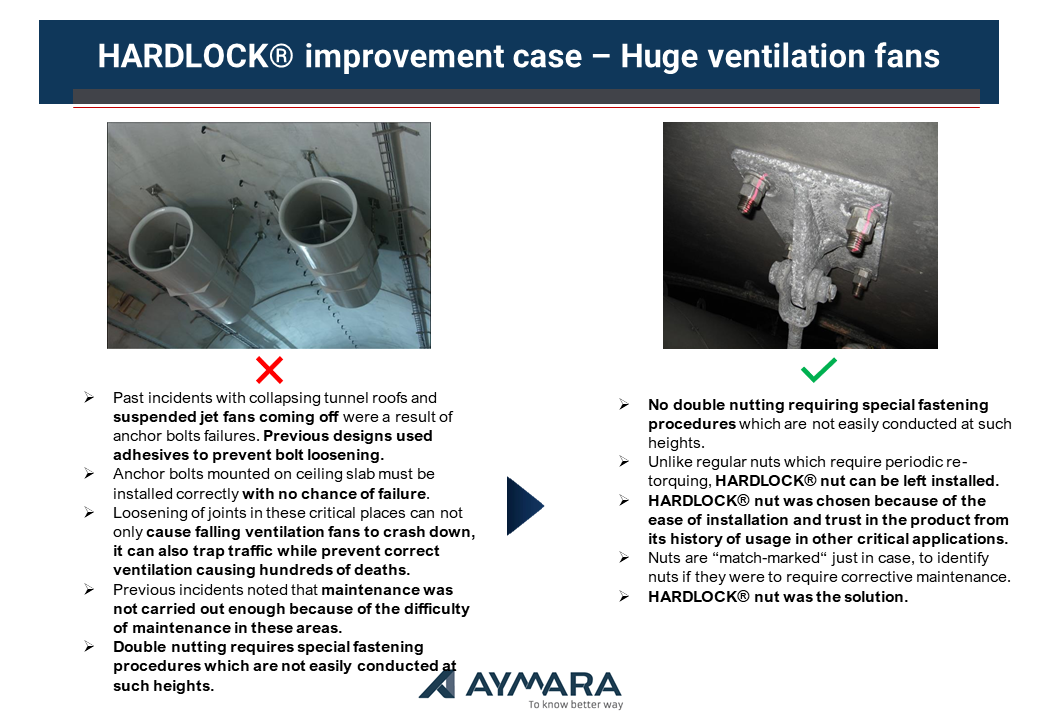
The anti loosening nut for fans is essential for ensuring long-term reliability and safety in ventilation systems. In industrial environments where vibration is constant, conventional fasteners can loosen over time, leading to failures, maintenance costs, and safety risks. Bolted joints used in fans must maintain stable preload and resistance to loosening to ensure safe and efficient operation.
HARDLOCK® Nut is used in ventilation fans to help maintain secure fastening in rotating components, even under continuous vibration and dynamic loads.
Why Fastening Matters in Ventilation Fans
Ventilation systems rely on bolted connections in key components such as:
- Fan blades and hubs
- Rotor assemblies
- Bearing housings
- Motor and structural mountings
These connections must ensure:
- Stable rotation
- Mechanical integrity
- Safe operation over long periods
The Challenge: Continuous Rotation and Vibration
Ventilation fans operate under conditions that are highly demanding for fastening systems.
Constant Vibration and Imbalance
During operation:
- Rotating components generate continuous vibration
- Even minor imbalance can amplify dynamic forces
- Cyclic loading acts on bolts and nuts
Over time, this can lead to loosening of conventional fasteners.
High Rotational Speeds
Fans often operate at:
- High RPM
- Continuous duty cycles
- Variable speed conditions
These factors increase stress on bolted joints.
Bearing Loads and Mechanical Stress
Fan operation involves:
- Radial and axial loads on bearings
- Load transfer through bolted connections
- Stress concentration in critical components
Environmental Factors
Ventilation systems may be exposed to:
- Dust and contaminants
- Humidity and corrosion
- Temperature variations
Maintenance and Downtime Constraints
In many applications (e.g. tunnels, industrial plants):
- Access is limited
- Downtime is costly
- Continuous operation is required
👉 Learn more about preload loss:
https://www.hardlock.eu/why-do-bolts-nuts-come-loose-factors-influencing-bolt-preload-loss/
Why Preload Stability Is Critical in Fan Applications
Maintaining preload ensures:
- Secure attachment of rotating components
- Stable alignment of the rotor
- Reduced vibration and noise
Loss of preload can lead to:
- Increased vibration
- Component damage
- Safety risks
HARDLOCK® Nut: Mechanical Locking for Rotating Equipment
HARDLOCK® Nut uses a mechanical wedge-locking principle that maintains preload under continuous vibration.
How it works:
- Two nuts (convex + concave) create a locking system
- An eccentric thread generates radial locking force
- This force prevents rotational loosening
This design ensures stable fastening even under:
- Continuous rotation
- Vibration and imbalance
- Long-term operation
👉 Full explanation:
https://www.hardlock.eu/why-the-hardlock-nut-does-not-loosen/
Where HARDLOCK® Nut Is Used in Ventilation Fans
HARDLOCK® Nut is applied in critical locations such as:
- Rotor and fan blade assemblies
- Bearing fixation points
- Structural mounting connections
- High-load rotating components
These applications require reliable fastening to ensure safe and efficient operation.
Key Benefits for Ventilation Fan Applications
✔ Prevents Loosening Under Continuous Vibration
Maintains clamping force even under constant rotational stress.
✔ Improves Operational Stability
Stable fastening helps:
- Reduce vibration
- Improve rotor balance
- Enhance system performance
✔ Reduces Maintenance and Downtime
Reliable fastening can:
- Minimize retightening
- Extend maintenance intervals
- Reduce operational costs
✔ Extends Component Lifespan
Stable connections contribute to:
- Reduced wear on bearings
- Lower stress on components
- Longer service life
✔ Enhances Safety in Industrial Environments
Secure fastening reduces the risk of:
- Component detachment
- Equipment failure
- Safety incidents
Comparison with Conventional Fastening Methods
Traditional solutions rely on friction or auxiliary locking elements.
Limitations:
- Loosening under vibration
- Reduced effectiveness over time
- Increased maintenance requirements
HARDLOCK® Nut provides a mechanical anti-loosening solution independent of friction, making it suitable for rotating machinery.
👉 Compare fastening technologies:
https://www.hardlock.eu/hardlock-nut-vs-prevailing-torque-type-nut/
Engineering Perspective: Cost of Failure in Ventilation Systems
In industrial and infrastructure applications, fastening reliability directly impacts:
- Equipment availability
- Maintenance costs
- Operational safety
Failure of a bolted joint can result in:
- Unplanned downtime
- Reduced airflow performance
- Increased repair costs
Reliable fastening solutions help minimize these risks.
👉 Learn more about benefits:
https://www.hardlock.eu/hardlock-nut-main-benefits/
Related Applications in Rotating and Industrial Equipment
Similar challenges exist in:
- Foundation Bolts → https://www.hardlock.eu/hardlock-nut-on-foundation-bolts/
- Aluminum Beam Trusses → https://www.hardlock.eu/hardlock-nut-on-aluminum-beam-trusses/
- Steel Structures → https://www.hardlock.eu/hardlock-nut-on-steel-structures/
- Where Is HARDLOCK® Nut Used? Key Applications Across Industries → https://www.hardlock.eu/where-is-hardlock-nut-often-used/
- Bridge Structures → https://www.hardlock.eu/hardlock-nut-on-bridge-structures/
- Pumps → https://www.hardlock.eu/hardlock-bearing-nut-in-pumps/
- Power Plants → https://www.hardlock.eu/hardlock-nut-in-power-plants/
👉 Explore full application range:
https://www.hardlock.eu/where-is-hardlock-nut-often-used/
When to Use HARDLOCK® Nut in Ventilation Fans
Consider this solution if your application involves:
- Continuous rotation
- Vibration and imbalance
- Critical rotating components
- High cost of downtime
Conclusion
Ventilation fans require fastening solutions that ensure stable operation under continuous rotation and vibration.
By maintaining preload and preventing loosening, HARDLOCK® Nut provides a mechanical solution for secure and reliable fastening in industrial airflow systems.
Looking to Improve Fan Reliability?
Choosing the right fastening system can reduce maintenance, improve performance, and enhance operational safety.
👉 Start with the fundamentals:
https://www.hardlock.eu/why-do-bolts-nuts-come-loose-factors-influencing-bolt-preload-loss/