Anti Loosening Nut for Trains in High-Speed Rail Applications
The anti loosening nut for trains is a critical component in modern high-speed railway systems, where extreme vibration and dynamic loads can cause standard fasteners to fail. At speeds exceeding 250–300 km/h, components are exposed to continuous vibration, cyclic loading, and repeated impact forces, especially at rail joints and track irregularities. HARDLOCK® nuts are specifically designed to eliminate loosening, ensuring maximum safety and reliability in demanding rail environments.
High-speed trains operate under intense conditions, including continuous vibration, temperature fluctuations, and high mechanical stress. These factors make conventional fastening methods unreliable over time. In this environment, even minor loosening of fasteners can affect safety, performance, and maintenance requirements.
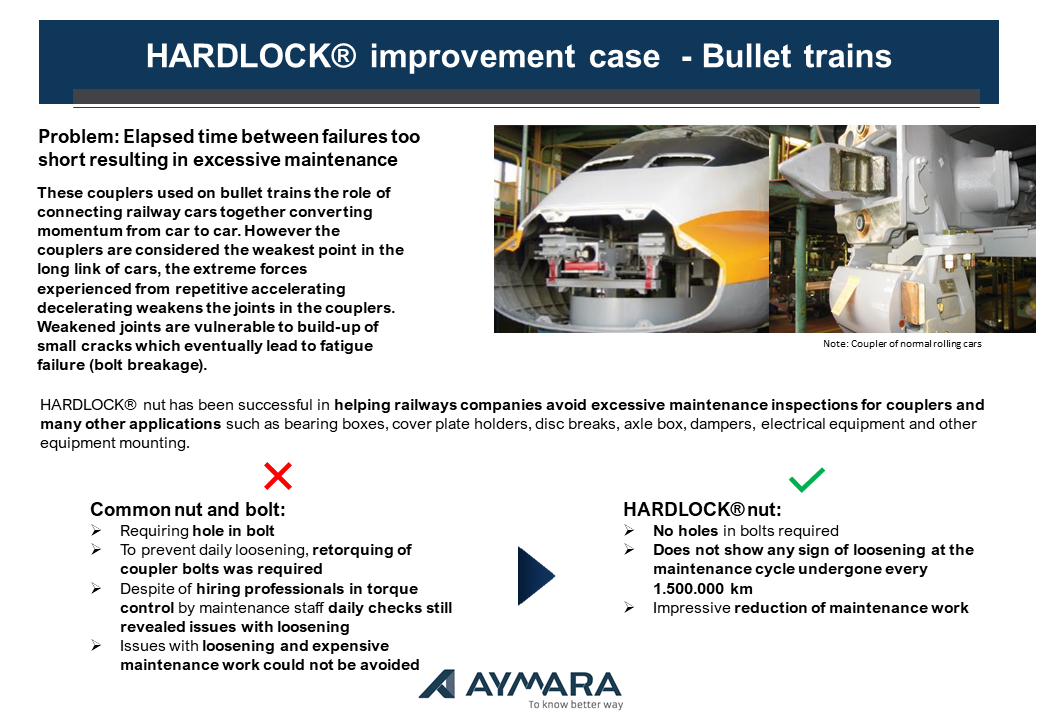
HARDLOCK® Nut is used in high-speed trains to provide secure, anti-loosening fastening in critical rolling stock components, ensuring reliable long-term operation.
Why Fastening Matters in High-Speed Trains
High-speed train systems rely on bolted joints across multiple subsystems:
- Bogies and suspension systems
- Coupling devices between train cars
- Braking systems (e.g., disc brakes)
- Drive units and transmission components
- Onboard equipment and structural assemblies
These connections must ensure:
- Structural integrity under dynamic loads
- Precise alignment of moving components
- Safe and stable operation at high speed
The Challenge: Extreme Dynamic Railway Environment
High-speed rail creates a unique combination of mechanical stresses that directly impact bolted joints.
Continuous High-Frequency Vibration
During operation:
- Wheel–rail interaction generates constant vibration
- Components are exposed to multi-axial cyclic loading
- Vibrations propagate through the entire structure
This accelerates preload loss in conventional fasteners. ()
Repeated Impact Loads
Even on high-quality tracks:
- Rail joints and irregularities create impact forces
- High-speed travel amplifies these effects
- Repeated shocks stress fastening points
In real railway applications, repeated impacts can cause conventional nuts to loosen or fail over time. ()
Acceleration, Deceleration, and Dynamic Forces
Train operation involves:
- Frequent acceleration and braking cycles
- Load transfer between components
- Dynamic stress on couplings and structural joints
Critical components like couplers are especially exposed to these forces. ()
Safety-Critical Requirements
High-speed trains are safety-critical systems where:
- Fastener failure can affect system integrity
- Strict inspection standards apply
- Reliability must be guaranteed over long service intervals
Maintenance and Lifecycle Cost Pressure
Rail operators aim to:
- Reduce inspection frequency
- Minimize downtime
- Lower lifecycle costs
Traditional fastening solutions often require frequent torque checks and retightening. ()
👉 Learn more about preload loss:
https://www.hardlock.eu/why-do-bolts-nuts-come-loose-factors-influencing-bolt-preload-loss/
Real-World Use Case: Fastening in Rolling Stock Components
In high-speed train applications, HARDLOCK® Nut is used to secure:
- Coupling devices connecting train cars
- Bogie and suspension components
- Brake assemblies and drive systems
- Equipment mounting and structural joints
These components are exposed to:
- Continuous vibration
- Repeated impact loads
- Dynamic operational forces
Conventional fastening methods can loosen under these conditions, leading to increased maintenance and potential safety risks.
HARDLOCK® Nut helps maintain stable preload and secure fastening, even under extreme railway dynamics.
Why Preload Stability Is Critical
Maintaining preload ensures:
- Structural integrity of train components
- Stable alignment of mechanical systems
- Reliable transmission of forces
Loss of preload can lead to:
- Increased vibration and wear
- Reduced system performance
- Higher maintenance requirements
HARDLOCK® Nut: Mechanical Locking for Railway Applications
HARDLOCK® Nut uses a mechanical wedge-locking principle that prevents loosening even under severe vibration and impact.
How it works:
- Two nuts (convex + concave) create a locking system
- An eccentric interface generates radial locking force
- This force eliminates thread clearance and prevents rotation
This ensures reliable performance under:
- High-frequency vibration
- Repeated impact loads
- Long-term cyclic stress
HARDLOCK® has been widely adopted in railway systems, including long-term use in high-speed train applications. ()
👉 Full technical explanation:
https://www.hardlock.eu/why-the-hardlock-nut-does-not-loosen/
Where HARDLOCK® Nut Is Used in High-Speed Trains
Typical applications include:
- Coupling systems between train cars
- Bogies and suspension assemblies
- Brake systems and disc brake mounts
- Drive units and transmission components
- Structural and onboard equipment fastening
These are critical points where loosening must be prevented at all costs.
Key Benefits for High-Speed Train Applications
✔ Prevents Loosening Under Extreme Vibration
Maintains clamping force even under continuous high-frequency vibration and shock.
✔ Enhances Operational Safety
Reliable fastening supports:
- Stable system performance
- Secure component integration
- Compliance with safety standards
✔ Reduces Maintenance and Inspection Frequency
HARDLOCK® Nut helps:
- Extend maintenance intervals
- Reduce retightening work
- Lower operational costs
✔ Improves Reliability and Uptime
Stable fastening contributes to:
- Consistent performance
- Reduced component wear
- Increased system availability
✔ Proven in Railway Industry
HARDLOCK® solutions have been used in railway systems worldwide for decades, helping operators improve safety and reduce maintenance burdens. ()
Comparison with Conventional Fastening Methods
Traditional fastening solutions rely on friction or deformation.
Limitations:
- Loosening under vibration and impact
- High maintenance requirements
- Reduced long-term reliability
HARDLOCK® Nut provides a mechanical anti-loosening solution independent of friction, ensuring stable performance in high-speed rail environments.
👉 Compare fastening technologies:
https://www.hardlock.eu/hardlock-nut-vs-prevailing-torque-type-nut/
Engineering Perspective: Cost of Failure in High-Speed Rail
In high-speed railway systems, fastening reliability directly impacts:
- Passenger safety
- Operational uptime
- Maintenance costs
Failure of bolted joints can result in:
- Service disruptions
- Increased inspection requirements
- Safety risks
Reliable fastening solutions help minimize these risks.
👉 Learn more about benefits:
https://www.hardlock.eu/hardlock-nut-main-benefits/
Related Applications in Railway Systems
Similar challenges exist in:
- Railroad switches → https://www.hardlock.eu/hardlock-nut-in-railroad-switches/
- Railway lines → https://www.hardlock.eu/hardlock-nut-in-railway-lines/
- Auxiliary Railway Equipment → https://www.hardlock.eu/hardlock-nuts-in-auxiliary-railway-equipment/
- Rail Track Systems → https://www.hardlock.eu/hardlock-nuts-in-rail-track-systems/
- Railway (Infrastructure) → https://www.hardlock.eu/applications/railway-infrastructure/
- Railway (Rolling Stock) → https://www.hardlock.eu/applications/railway-rolling-stock/
- Railroad Switches → https://www.hardlock.eu/hardlock-nut-in-railroad-switches/
- Rolling Stock → https://www.hardlock.eu/hardlock-nuts-in-rolling-stock/
- Bullet Trains → https://www.hardlock.eu/hardlock-nut-on-bullet-trains/
👉 Explore full application range:
https://www.hardlock.eu/where-is-hardlock-nut-often-used/
When to Use HARDLOCK® Nut in High-Speed Train Applications
Consider this solution if your application involves:
- High-speed dynamic loads
- Continuous vibration
- Safety-critical components
- High cost of maintenance
Conclusion
High-speed trains require fastening solutions capable of withstanding extreme dynamic forces while ensuring safety and reliability.
By maintaining preload and preventing loosening, HARDLOCK® Nut provides a mechanical solution for secure fastening in advanced railway rolling stock systems.
Looking to Improve Railway Reliability?
Choosing the right fastening system can reduce maintenance, improve safety, and ensure long-term operational performance.
👉 Start with the fundamentals:
https://www.hardlock.eu/why-do-bolts-nuts-come-loose-factors-influencing-bolt-preload-loss/