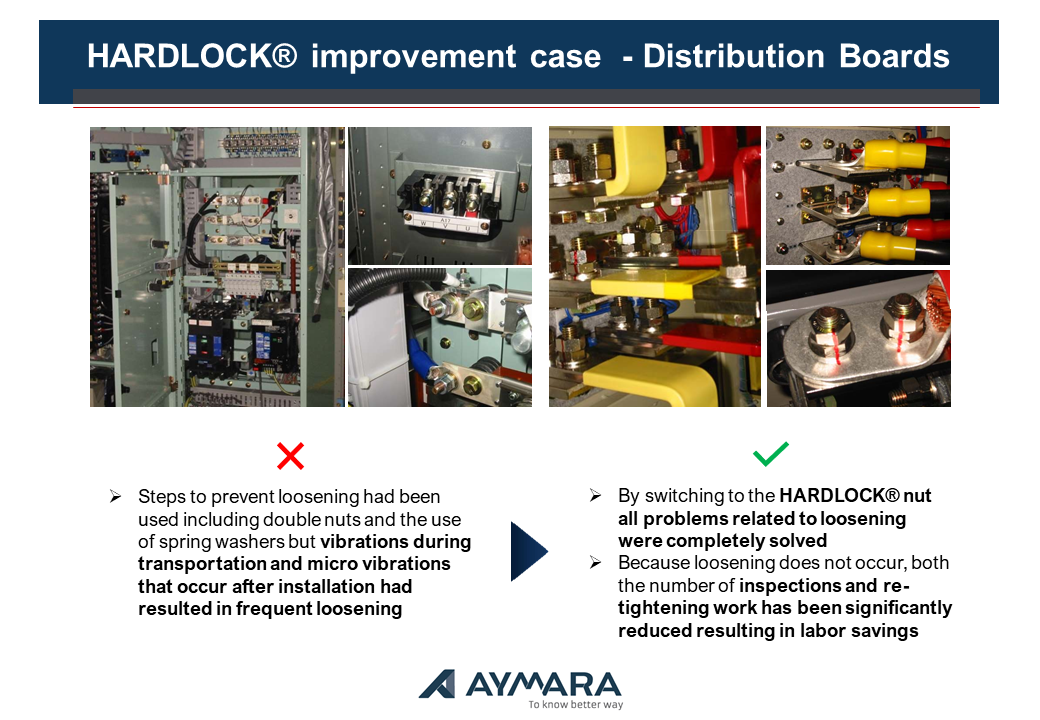
Anti loosening nut for busbars in distribution boards
The anti loosening nut for busbars from HARDLOCK® is designed to prevent self-loosening of bolted connections in electrical distribution boards. Distribution boards (electrical panels and switchgear) are essential components in power distribution systems across industrial, commercial, and infrastructure applications. In environments exposed to vibration, thermal expansion, or mechanical stress, conventional fastening methods often fail over time.
They ensure the safe and reliable distribution of electrical energy through busbars, terminals, and connection points. In these systems, fastening reliability is critical—not only for mechanical stability but also for electrical performance and safety.
HARDLOCK® Nut is used on distribution boards to provide secure, anti-loosening fastening for electrical and structural connections, ensuring long-term reliability in demanding environments.
Why Fastening Matters in Distribution Boards
Distribution boards rely on bolted connections in key areas such as:
- Busbar connections
- Cable terminals and lugs
- Grounding systems
- Structural mounting components
These connections must ensure:
- Low electrical resistance
- Stable contact pressure
- Safe and reliable operation
The Challenge: Electrical and Thermal Effects on Fasteners
Electrical systems introduce unique challenges that directly affect bolted connections.
Thermal Cycling from Electrical Load
During operation:
- Electrical current generates heat
- Components expand and contract with load changes
- Daily and operational cycles affect joint preload
Thermal cycling is a major cause of loosening in electrical connections.
Contact Resistance and Connection Stability
Proper fastening ensures:
- Stable electrical contact
- Low resistance at connection points
- Efficient current flow
Loose connections can lead to:
- Increased resistance
- Localized overheating
- Potential failure
Vibration and External Influences
Distribution boards may be exposed to:
- Vibration from nearby machinery
- Building or infrastructure movement
- External mechanical stress
These factors can accelerate loosening over time.
Safety and Fire Risk
Electrical systems are safety-critical environments:
- Loose connections can cause overheating
- Overheating may lead to insulation damage
- In extreme cases, this can increase fire risk
Maintenance and Inspection Requirements
Operators often need to:
- Perform periodic torque checks
- Retighten connections
- Monitor critical points
This increases maintenance workload and operational cost.
👉 Learn more about preload loss:
https://www.hardlock.eu/why-do-bolts-nuts-come-loose-factors-influencing-bolt-preload-loss/
Real-World Use Case: Electrical Connections and Structural Fixing
In distribution boards, HARDLOCK® Nut is used to secure:
- Busbar connections
- Terminal and cable lug fastening
- Structural mounting of electrical components
These applications require:
- Stable contact pressure
- Resistance to thermal expansion
- Long-term reliability
Conventional nuts may loosen due to thermal cycling and vibration, leading to reduced contact quality.
HARDLOCK® Nut helps maintain consistent preload and secure electrical connections, supporting safe and efficient operation.
Why Preload Stability Is Critical in Electrical Systems
Maintaining preload ensures:
- Stable electrical contact
- Low resistance connections
- Reliable current transmission
Loss of preload can lead to:
- Increased contact resistance
- Heat generation and energy loss
- Reduced system reliability
HARDLOCK® Nut: Mechanical Locking for Electrical Reliability
HARDLOCK® Nut uses a mechanical wedge-locking principle that maintains preload without relying solely on friction.
How it works:
- Two nuts (convex + concave) form a locking system
- An eccentric interface generates radial locking force
- This force eliminates thread clearance and prevents rotation
This ensures reliable performance under:
- Thermal expansion and contraction
- Vibration and mechanical stress
- Long-term electrical operation
👉 Full technical explanation:
https://www.hardlock.eu/why-the-hardlock-nut-does-not-loosen/
Where HARDLOCK® Nut Is Used in Distribution Boards
Typical applications include:
- Industrial electrical panels
- Power distribution systems
- Switchgear assemblies
- Control cabinets and enclosures
These are areas where secure electrical connections are essential.
Key Benefits for Electrical Applications
✔ Prevents Loosening Due to Thermal Cycling
Maintains clamping force despite repeated heating and cooling.
✔ Ensures Stable Electrical Contact
Supports:
- Low resistance
- Efficient energy transfer
- Reliable system performance
✔ Reduces Risk of Overheating and Failure
Stable fastening helps prevent:
- Hot spots
- Insulation damage
- Potential safety hazards
✔ Reduces Maintenance Requirements
Reliable fastening can:
- Minimize torque checks
- Reduce retightening
- Lower maintenance costs
✔ Enhances Safety and Compliance
Secure connections support:
- Electrical safety standards
- Reliable system operation
- Reduced risk of failure
Comparison with Conventional Fastening Methods
Traditional fastening solutions rely on friction or deformation.
Limitations:
- Loosening due to thermal cycling
- Reduced contact stability over time
- Increased maintenance requirements
HARDLOCK® Nut provides a mechanical anti-loosening solution independent of friction, ensuring stable long-term performance.
👉 Compare fastening technologies:
- HARDLOCK® Nut vs. Prevailing Torque Type Nut: Which Locking Solution Performs Better? → https://www.hardlock.eu/hardlock-nut-vs-prevailing-torque-type-nut/
- HARDLOCK® Nut vs. Nord-Lock® Washer: A Comparison of Anti-Loosening Solutions → HARDLOCK® Nut vs. Nord-Lock® Washer: A Comparison of Anti-Loosening Solutions
Engineering Perspective: Cost of Failure in Electrical Systems
In electrical infrastructure, fastening reliability directly impacts:
- System safety
- Operational continuity
- Maintenance costs
Failure of electrical connections can result in:
- Equipment damage
- Power outages
- Safety risks
Reliable fastening solutions help minimize these risks.
👉 Learn more about benefits:
https://www.hardlock.eu/hardlock-nut-main-benefits/
Related Applications in Electrical and Industrial Systems
Similar challenges exist in:
- Electrical Applications → https://www.hardlock.eu/hardlock-nut-in-electrical-applications/
- Auxiliary Railway Equipment → https://www.hardlock.eu/hardlock-nuts-in-auxiliary-railway-equipment/
- Solar systems → https://www.hardlock.eu/hardlock-nut-on-solar-panels/
- Railway Lines → https://www.hardlock.eu/hardlock-nut-in-railway-lines/
👉 Explore full application range:
https://www.hardlock.eu/where-is-hardlock-nut-often-used/
When to Use HARDLOCK® Nut in Distribution Boards
Consider this solution if your application involves:
- Thermal cycling due to electrical load
- Critical electrical connections
- High safety requirements
- Frequent maintenance needs
Conclusion
Distribution boards require fastening solutions that ensure electrical stability, safety, and long-term reliability.
By maintaining preload and preventing loosening, HARDLOCK® Nut provides a mechanical solution for secure fastening in electrical distribution systems.
Looking to Improve Electrical Reliability?
Choosing the right fastening system can reduce maintenance, improve safety, and ensure consistent system performance.
👉 Start with the fundamentals:
https://www.hardlock.eu/why-do-bolts-nuts-come-loose-factors-influencing-bolt-preload-loss/