Anti Loosening Nut for Structural Frames in Noise Barriers
An anti loosening nut for structural frames is essential for ensuring long-term stability in infrastructure exposed to vibration. In noise barrier systems along highways and railways, traditional fastening solutions often fail due to constant dynamic loads. Noise barriers are widely used along highways and railways to reduce environmental noise and improve living conditions in surrounding areas. These structures must remain stable and reliable over decades despite continuous exposure to wind loads, vibration from traffic, and environmental conditions.
In such applications, fastening reliability is essential to ensure structural integrity, safety, and minimal maintenance.
HARDLOCK® Nut is used on noise barriers to provide secure, anti-loosening fastening for panels and structural components, ensuring long-term performance in demanding infrastructure environments.
Why Fastening Matters in Noise Barrier Systems
Noise barrier systems rely on bolted connections in:
- Structural support frames (steel or aluminum posts)
- Panel mounting systems
- Base connections and anchoring systems
- Modular assembly joints
These connections must ensure:
- Structural stability under dynamic loads
- Secure panel positioning
- Long-term durability with minimal maintenance
The Challenge: Outdoor Infrastructure Under Continuous Stress
Noise barriers operate in harsh outdoor environments where multiple factors contribute to bolt loosening.
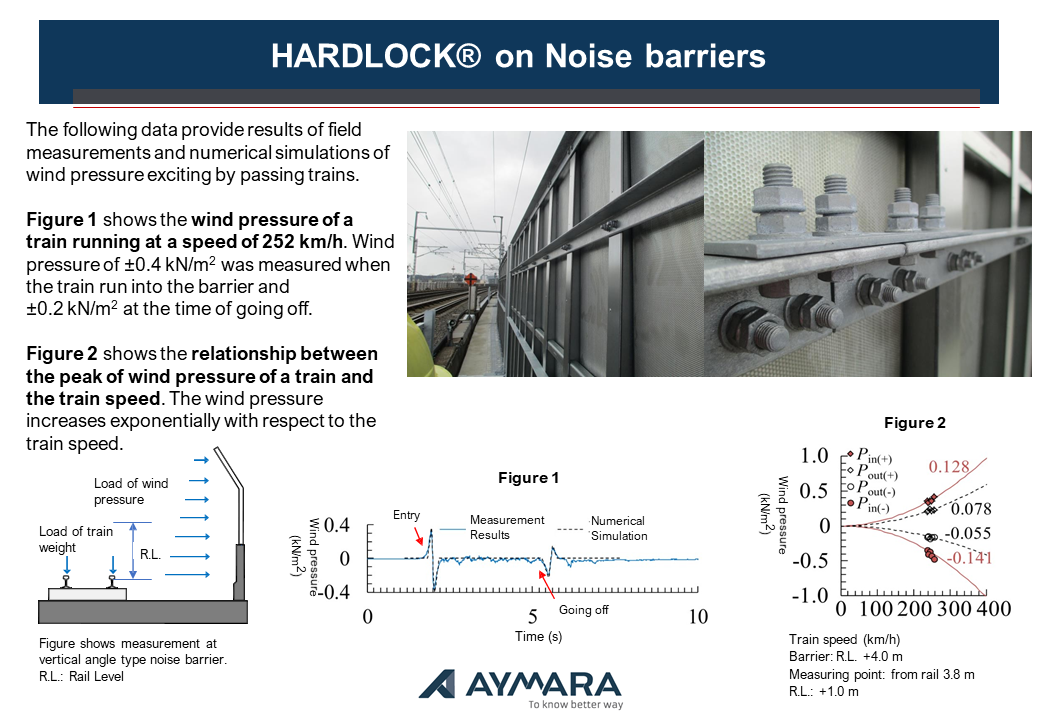
Wind Loads and Aerodynamic Forces
Noise barriers are exposed to:
- Strong wind pressure and suction forces
- Repeated load cycles caused by wind gusts
- Large surface areas increasing structural stress
These forces can gradually reduce bolt preload.
Vibration from Traffic and Trains
Along highways and railways:
- Passing vehicles generate continuous vibration
- High-speed trains create strong pressure waves and dynamic loads
- Vibrations are transmitted through the structure
This is a key factor in loosening conventional fasteners.
Fatigue from Cyclic Loading
Over time:
- Repeated stress cycles affect bolted joints
- Micro-movements occur at connection points
- Fatigue can reduce clamping force
Corrosion and Environmental Exposure
Noise barriers are exposed to:
- Rain, humidity, and temperature changes
- Road salt and environmental contaminants
- UV radiation
Fastening systems must maintain performance despite these conditions.
Long Service Life Requirements
Infrastructure projects require:
- Decades of reliable operation
- Minimal maintenance interventions
- High safety standards
Loose fasteners can result in:
- Panel instability
- Increased maintenance costs
- Safety risks for nearby traffic
👉 Learn more about preload loss:
https://www.hardlock.eu/why-do-bolts-nuts-come-loose-factors-influencing-bolt-preload-loss/
Real-World Use Case: Panel Fixation and Structural Connections
In noise barrier systems, HARDLOCK® Nut is used to secure:
- Panel mounting systems to support posts
- Structural frames and connecting elements
- Base and anchoring connections
These applications are critical because:
- Panels must remain securely fixed under wind and vibration
- Structural connections must maintain long-term stability
- Maintenance access is often limited
Conventional nuts may loosen over time due to combined effects of vibration and environmental stress.
HARDLOCK® Nut helps maintain stable preload and secure fastening, ensuring reliable performance over the entire service life of the structure.
Why Preload Stability Is Critical
Maintaining preload ensures:
- Secure attachment of noise barrier panels
- Structural integrity under wind loads
- Reduced vibration and movement
Loss of preload can lead to:
- Panel displacement or detachment
- Increased structural stress
- Safety risks
HARDLOCK® Nut: Mechanical Locking for Infrastructure Applications
HARDLOCK® Nut uses a mechanical wedge-locking principle that prevents loosening even under vibration and dynamic loads.
How it works:
- Two nuts (convex + concave) form a locking system
- An eccentric interface generates radial locking force
- This force eliminates thread clearance and prevents rotation
This ensures reliable performance under:
- Continuous vibration from traffic
- Wind-induced cyclic loading
- Long-term environmental exposure
👉 Full technical explanation:
https://www.hardlock.eu/why-the-hardlock-nut-does-not-loosen/
Where HARDLOCK® Nut Is Used in Noise Barriers
Typical applications include:
- Highway noise barriers
- Railway noise protection systems
- Urban infrastructure installations
- Industrial noise reduction structures
These are locations where maintenance is difficult and reliability is critical.
Key Benefits for Noise Barrier Applications
✔ Prevents Loosening Under Vibration and Wind Loads
Maintains clamping force under continuous environmental stress.
✔ Reduces Maintenance and Lifecycle Costs
Reliable fastening helps:
- Minimize inspections and retightening
- Reduce maintenance costs
- Improve long-term cost efficiency
✔ Enhances Structural Safety
Secure fastening reduces the risk of:
- Panel movement
- Structural instability
- Safety hazards
✔ Supports Long-Term Infrastructure Durability
Stable fastening contributes to:
- Extended service life
- Reduced wear and fatigue
- Improved reliability
✔ Suitable for Harsh Outdoor Environments
Designed for:
- Corrosion-prone conditions
- Temperature fluctuations
- Long-term exposure
Comparison with Conventional Fastening Methods
Traditional fastening solutions rely on friction or deformation.
Limitations:
- Loosening under vibration and cyclic loads
- Reduced effectiveness over time
- Increased maintenance requirements
HARDLOCK® Nut provides a mechanical anti-loosening solution independent of friction, ensuring stable long-term performance.
👉 Compare fastening technologies:
- HARDLOCK® Nut vs. Prevailing Torque Type Nut: Which Locking Solution Performs Better? → https://www.hardlock.eu/hardlock-nut-vs-prevailing-torque-type-nut/
- HARDLOCK® Nut vs. Nord-Lock® Washer: A Comparison of Anti-Loosening Solutions → HARDLOCK® Nut vs. Nord-Lock® Washer: A Comparison of Anti-Loosening Solutions
Engineering Perspective: Cost of Failure in Infrastructure Projects
In infrastructure systems, fastening reliability directly impacts:
- Public safety
- Maintenance costs
- Long-term performance
Failure of bolted joints can result in:
- Structural damage
- Increased maintenance
- Safety risks
Reliable fastening solutions help minimize these risks.
👉 Learn more about benefits:
https://www.hardlock.eu/hardlock-nut-main-benefits/
Related Applications in Infrastructure
Similar challenges exist in:
- Bridge structures → https://www.hardlock.eu/hardlock-nut-on-bridge-structures/
- Railway systems → https://www.hardlock.eu/hardlock-nut-in-railway-lines/
- Steel Structures → https://www.hardlock.eu/hardlock-nut-on-steel-structures/
- Steel Structures → https://www.hardlock.eu/hardlock-nut-on-aluminum-beam-trusses/
👉 Explore full application range:
https://www.hardlock.eu/where-is-hardlock-nut-often-used/
When to Use HARDLOCK® Nut in Noise Barrier Systems
Consider this solution if your application involves:
- Continuous vibration from traffic
- Exposure to wind loads
- Long-term outdoor operation
- High cost of maintenance
Conclusion
Noise barriers require fastening solutions that ensure structural stability, safety, and long-term reliability under environmental stress.
By maintaining preload and preventing loosening, HARDLOCK® Nut provides a mechanical solution for secure fastening in infrastructure noise protection systems.
Looking to Improve Infrastructure Reliability?
Choosing the right fastening system can reduce maintenance, improve safety, and ensure long-term structural performance.
👉 Start with the fundamentals:
https://www.hardlock.eu/why-do-bolts-nuts-come-loose-factors-influencing-bolt-preload-loss/