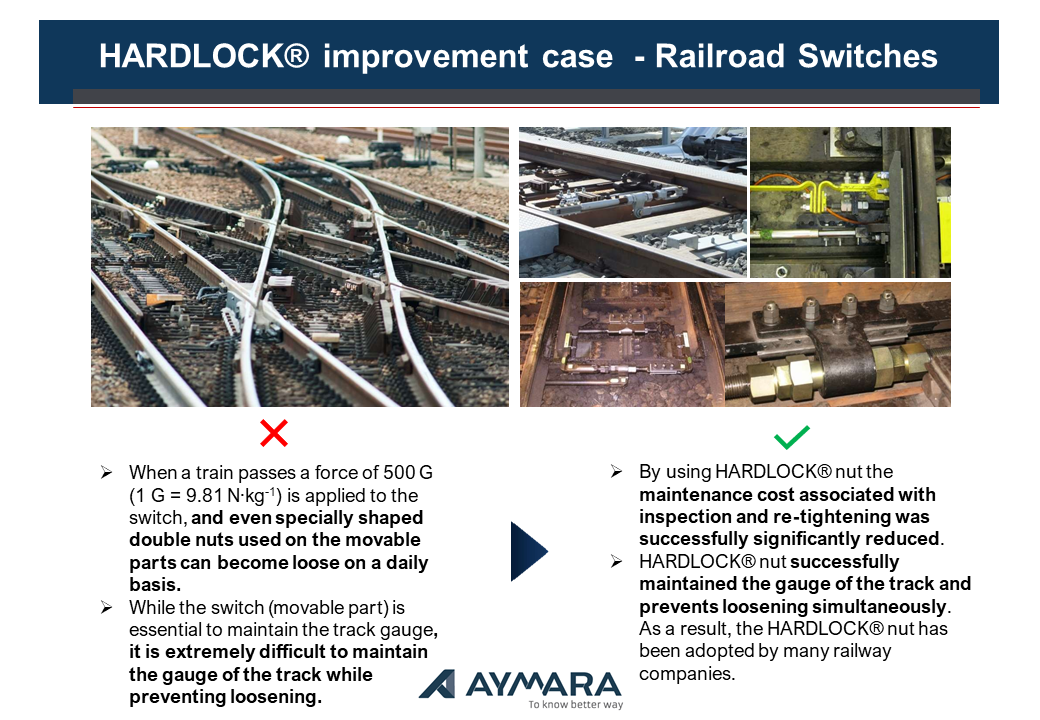
Railway systems demand absolute reliability, especially in critical components like switches. The anti loosening nut for railroad applications from HARDLOCK® is designed to prevent bolt loosening caused by vibration, ensuring long-term safety and stability in rail infrastructure.
These systems operate under extreme dynamic loads, high-frequency vibration, and continuous mechanical stress, making fastening reliability essential for safety and performance. Even minor loosening in switch components can lead to misalignment, operational failure, or safety risks.
HARDLOCK® Nut is used in railroad switches to provide secure, anti-loosening fastening in critical railway components, ensuring long-term reliability under demanding conditions.
Why Fastening Matters in Railroad Switches
Railroad switches rely on bolted joints in key components such as:
- Switch adjusters and drive mechanisms
- Tongue rail positioning systems
- Stretcher bars and connecting rods
- Structural fastening of turnout assemblies
These connections must ensure:
- Accurate rail positioning
- Reliable switching operation
- Safe train movement
The Challenge: Extreme Railway Operating Conditions
Railway environments are among the most demanding for bolted joints.
High-Impact Loads from Passing Trains
When trains pass over switches:
- Forces can reach extremely high levels (up to hundreds of G)
- Loads are transferred directly into fastening points
- Repeated impacts stress bolted joints
👉 Real-world data shows forces of up to ~500G acting on switch components during train passage. ()
Continuous Vibration and Cyclic Loading
Railway systems generate:
- Constant vibration from wheel-rail interaction
- Repeated load cycles from train traffic
- Dynamic stress on moving components
This environment accelerates preload loss in conventional nuts.
Critical Role of Moving Components
Switch adjusters and point mechanisms:
- Control the position of the rails
- Ensure proper alignment of the train path
- Operate under continuous motion and stress
These components are particularly sensitive to loosening.
Safety-Critical Requirements
Railway switches are safety-critical systems:
- Any misalignment can affect train guidance
- Fastener failure can lead to operational disruption
- Strict reliability is required
Maintenance and Inspection Burden
Traditional fastening solutions often require:
- Frequent inspections
- Retightening cycles
- High maintenance costs
This is not efficient for large-scale railway networks. ()
👉 Learn more about preload loss:
https://www.hardlock.eu/why-do-bolts-nuts-come-loose-factors-influencing-bolt-preload-loss/
Real-World Use Case: Switch Adjusters and Turnout Mechanisms
In railway switch systems, HARDLOCK® Nut is used to secure:
- Switch adjusters responsible for rail positioning
- Mechanical linkages transmitting movement
- Structural joints exposed to vibration and shock
These components experience:
- High-impact loads
- Continuous vibration
- Critical alignment requirements
Conventional nuts can loosen under these conditions, compromising performance.
HARDLOCK® Nut helps maintain stable preload and secure positioning, ensuring reliable switch operation even under extreme stress. ()
Why Preload Stability Is Critical in Railway Switches
Maintaining preload ensures:
- Accurate positioning of switch rails
- Reliable transmission of mechanical movement
- Stable operation under dynamic loads
Loss of preload can lead to:
- Misalignment of track components
- Increased wear and vibration
- Potential safety risks
HARDLOCK® Nut: Mechanical Locking for Railway Reliability
HARDLOCK® Nut uses a mechanical wedge-locking principle that prevents loosening even under severe vibration and impact.
How it works:
- Two nuts (convex + concave) create a locking system
- An eccentric interface generates radial locking force
- This force eliminates thread clearance and prevents rotation
This ensures reliable performance under:
- High-impact loads
- Continuous vibration
- Long-term cyclic stress
👉 Full technical explanation:
https://www.hardlock.eu/why-the-hardlock-nut-does-not-loosen/
Where HARDLOCK® Nut Is Used in Railroad Switches
Typical applications include:
- Switch adjusters and actuator systems
- Stretcher bar connections
- Rail fastening and positioning systems
- Structural elements of turnout assemblies
These locations require maximum reliability and minimal maintenance.
Key Benefits for Railway Applications
✔ Prevents Loosening Under Extreme Impact
Maintains clamping force even under high-impact loads from passing trains.
✔ Improves Railway Safety
Reliable fastening supports:
- Accurate rail alignment
- Stable switching operation
- Reduced risk of failure
✔ Reduces Maintenance and Inspection Frequency
HARDLOCK® Nut helps:
- Minimize retightening
- Reduce inspection workload
- Lower maintenance costs
✔ Extends Service Life of Components
Stable fastening contributes to:
- Reduced wear
- Improved load distribution
- Longer service intervals
✔ Proven in Railway Infrastructure
HARDLOCK® Nut has been specified in railway systems worldwide, including long-term use in rail networks where vibration-induced loosening is a major challenge. ()
Comparison with Conventional Fastening Methods
Traditional fastening systems rely on friction or deformation.
Limitations:
- Loosening under vibration and impact
- High maintenance requirements
- Reduced reliability over time
HARDLOCK® Nut provides a mechanical anti-loosening solution independent of friction, ensuring stable long-term performance.
👉 Compare fastening technologies:
https://www.hardlock.eu/hardlock-nut-vs-prevailing-torque-type-nut/
Engineering Perspective: Cost of Failure in Railway Infrastructure
In railway systems, fastening reliability directly impacts:
- Operational safety
- Network availability
- Maintenance costs
Failure of switch components can result in:
- Service disruptions
- Increased inspection requirements
- Safety risks
Reliable fastening solutions help minimize these risks.
👉 Learn more about benefits:
https://www.hardlock.eu/hardlock-nut-main-benefits/
Related Applications in Railway Systems
Similar challenges exist in:
- Railroad switches → https://www.hardlock.eu/hardlock-nut-in-railroad-switches/
- Railway lines → https://www.hardlock.eu/hardlock-nut-in-railway-lines/
- Auxiliary Railway Equipment → https://www.hardlock.eu/hardlock-nuts-in-auxiliary-railway-equipment/
- Rail Track Systems → https://www.hardlock.eu/hardlock-nuts-in-rail-track-systems/
- Railway (Infrastructure) → https://www.hardlock.eu/applications/railway-infrastructure/
- Railway (Rolling Stock) → https://www.hardlock.eu/applications/railway-rolling-stock/
- Railroad Switches → https://www.hardlock.eu/hardlock-nut-in-railroad-switches/
- Rolling Stock → https://www.hardlock.eu/hardlock-nuts-in-rolling-stock/
- Bullet Trains → https://www.hardlock.eu/hardlock-nut-on-bullet-trains/
👉 Explore full application range:
https://www.hardlock.eu/where-is-hardlock-nut-often-used/
When to Use HARDLOCK® Nut in Railroad Switches
Consider this solution if your application involves:
- High-impact railway loads
- Continuous vibration
- Safety-critical infrastructure
- High maintenance costs
Conclusion
Railroad switches require fastening solutions that ensure safety, precision, and long-term reliability under extreme conditions.
By maintaining preload and preventing loosening, HARDLOCK® Nut provides a mechanical solution for secure fastening in critical railway turnout systems.
Looking to Improve Railway Safety and Reliability?
Choosing the right fastening system can reduce maintenance, improve safety, and ensure long-term infrastructure performance.
👉 Start with the fundamentals:
https://www.hardlock.eu/why-do-bolts-nuts-come-loose-factors-influencing-bolt-preload-loss/