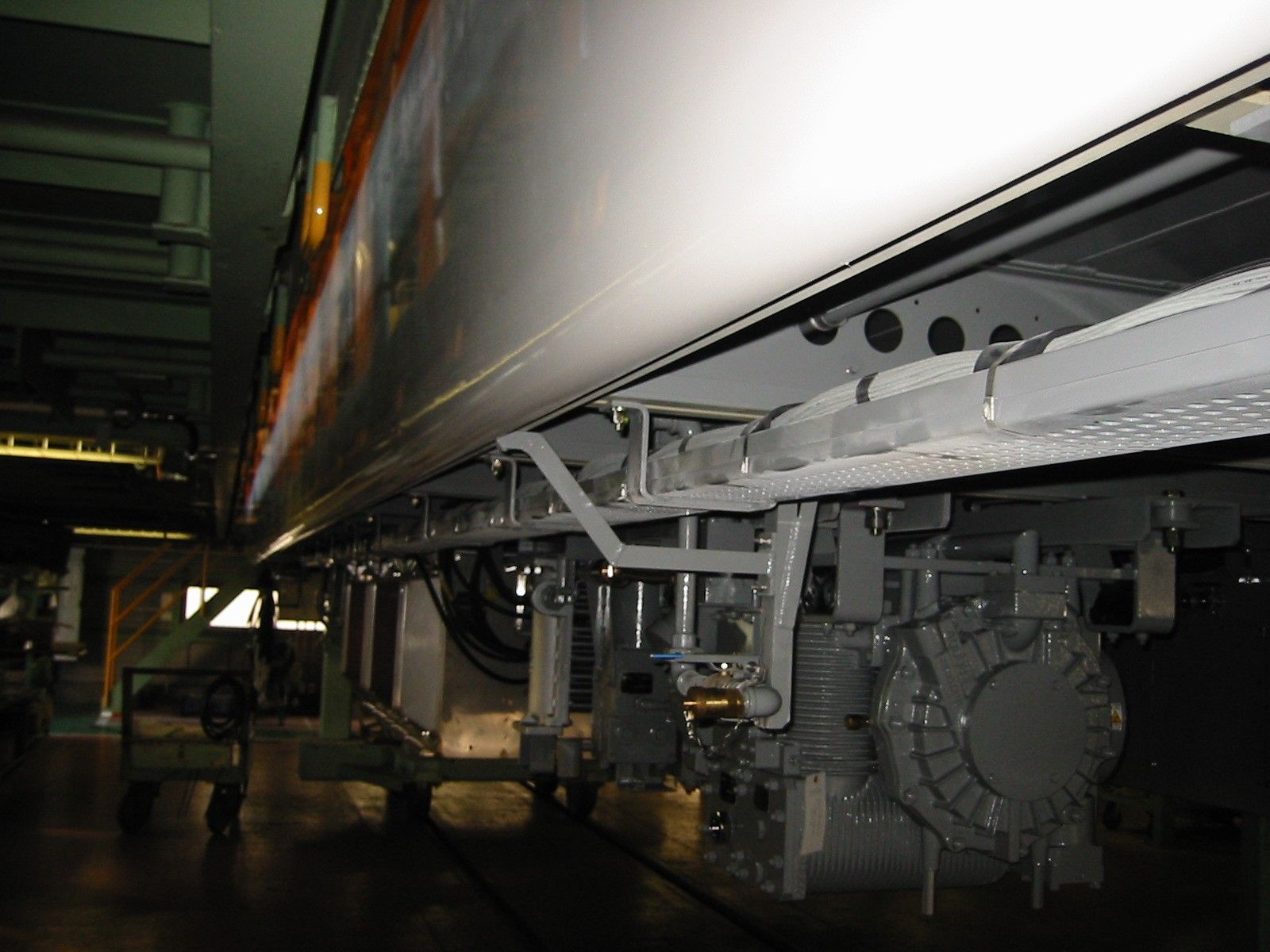
For Shinkansen (Japanese Bullet Train) models prior to the 300 Series released in 1992, underfloor equipment was welded. However, after approximately 1,2 million km of travel (roughly 1,5–2 years later), the maintenance process of removing underfloor equipment became a significant challenge due to time constraints.
Bullet trains (high-speed trains) represent one of the most advanced and demanding applications in modern transportation.
Operating at high speeds, these systems are exposed to continuous vibration, dynamic loads, and strict safety requirements.
In such conditions, the reliability of every component—including bolted joints—is critical.
An anti loosening nut for bullet trains is essential for ensuring safety and stability in high-speed rail systems. The HARDLOCK® nut for bullet trains is a highly reliable fastening solution designed to withstand extreme vibration and dynamic loads in high-speed railway systems.
Why Fastening Matters in High-Speed Trains
High-speed trains rely on precisely engineered systems where bolted joints play a key role in:
- Structural assemblies
- Bogie and suspension systems
- Track-related components
- Electrical and signaling equipment
These connections must maintain:
- Mechanical integrity
- Alignment stability
- Long-term reliability
The Challenge: Extreme Conditions in High-Speed Rail
Bullet train environments present unique challenges for fastening systems.
Continuous High-Frequency Vibration
At high speeds, trains generate:
- Constant vibration
- Resonance effects
- Dynamic stress on components
These factors can gradually loosen conventional fasteners.
Dynamic Loads and Fatigue
Acceleration, braking, and track interaction create:
- Cyclic loading
- Fatigue stress
- Micro-movements in joints
Safety-Critical Requirements
High-speed rail systems require:
- Maximum reliability
- Strict safety standards
- Consistent performance over time
Even minor loosening can affect system performance and safety.
Environmental Exposure
Railway systems are exposed to:
- Temperature fluctuations
- Weather conditions
- Long operational cycles
👉 Learn more about why bolts loosen:
https://www.hardlock.eu/why-do-bolts-nuts-come-loose-factors-influencing-bolt-preload-loss/
Why Preload Stability Is Critical
Maintaining preload in high-speed train applications ensures:
- Stable structural connections
- Reduced vibration impact
- Consistent system performance
Loss of preload can lead to:
- Increased wear
- Component misalignment
- Higher maintenance requirements
HARDLOCK® Nut: Mechanical Locking for High-Speed Applications
HARDLOCK® Nut uses a mechanical wedge-locking principle designed to maintain preload under dynamic conditions.
How it works:
- Two nuts form a single locking system
- The top nut has an eccentric (off-center) thread
- Tightening creates a radial locking force
- This force helps prevent rotation
👉 Full explanation:
https://www.hardlock.eu/why-the-hardlock-nut-does-not-loosen/
Why Bullet Trains Use HARDLOCK® Nuts
✔ Resists Loosening Under High-Speed Vibration
HARDLOCK® Nut helps maintain joint stability even under continuous high-frequency vibration.
✔ Supports Safety-Critical Systems
Reliable fastening contributes to:
- Safe train operation
- Stable system performance
- Compliance with railway safety standards
👉 Learn more about safety-critical applications:
https://www.hardlock.eu/hardlock-the-ultimate-fastener-for-safety-critical-applications/
✔ Reduces Maintenance and Inspection Frequency
High-speed rail systems require efficient maintenance strategies.
Stable fastening can help:
- Reduce retightening needs
- Lower maintenance costs
- Improve operational uptime
✔ Improves Long-Term Reliability
Maintaining preload contributes to:
- Reduced fatigue effects
- Improved component lifespan
- Consistent performance
✔ Suitable for Demanding Railway Environments
Designed to perform under:
- Dynamic loads
- Continuous operation
- Challenging environmental conditions
Comparison with Conventional Fastening Methods
Traditional fastening solutions may rely on friction or additional locking elements.
Limitations:
- Loosening under vibration
- Reduced long-term effectiveness
- Increased maintenance requirements
👉 Compare fastening technologies:
https://www.hardlock.eu/hardlock-nut-vs-prevailing-torque-type-nut/
Engineering Perspective: Risk and Cost in High-Speed Rail
In bullet train systems, fastening reliability directly impacts:
- Passenger safety
- Operational efficiency
- Maintenance costs
Failure of a bolted joint can lead to:
- Increased wear
- System downtime
- Safety risks
A reliable fastening solution helps reduce these risks.
👉 Learn more about benefits:
https://www.hardlock.eu/hardlock-nut-main-benefits/
Related Railway Applications
Similar challenges exist in other railway environments:
- Railroad switches → https://www.hardlock.eu/hardlock-nut-in-railroad-switches/
- Railway lines → https://www.hardlock.eu/hardlock-nut-in-railway-lines/
- Auxiliary Railway Equipment → https://www.hardlock.eu/hardlock-nuts-in-auxiliary-railway-equipment/
- Rail Track Systems → https://www.hardlock.eu/hardlock-nuts-in-rail-track-systems/
- Railway (Infrastructure) → https://www.hardlock.eu/applications/railway-infrastructure/
- Railway (Rolling Stock) → https://www.hardlock.eu/applications/railway-rolling-stock/
- Railroad Switches → https://www.hardlock.eu/hardlock-nut-in-railroad-switches/
- Rolling Stock → https://www.hardlock.eu/hardlock-nuts-in-rolling-stock/
- High-Speed Trains → https://www.hardlock.eu/hardlock-nut-in-high-speed-trains/
👉 Explore all applications:
https://www.hardlock.eu/where-is-hardlock-nut-often-used/
When to Use HARDLOCK® Nut in High-Speed Trains
Consider this solution if your application involves:
- High-speed operation
- Continuous vibration
- Safety-critical systems
- High maintenance costs
Conclusion
Bullet trains require fastening solutions that can perform reliably under extreme dynamic conditions.
By maintaining preload and resisting loosening, HARDLOCK® Nut provides a mechanical solution for secure and stable connections in high-speed railway systems.
Looking to Improve Railway System Reliability?
Choosing the right fastening solution can enhance safety, reduce maintenance, and improve long-term performance.
👉 Start with the fundamentals:
https://www.hardlock.eu/why-do-bolts-nuts-come-loose-factors-influencing-bolt-preload-loss/