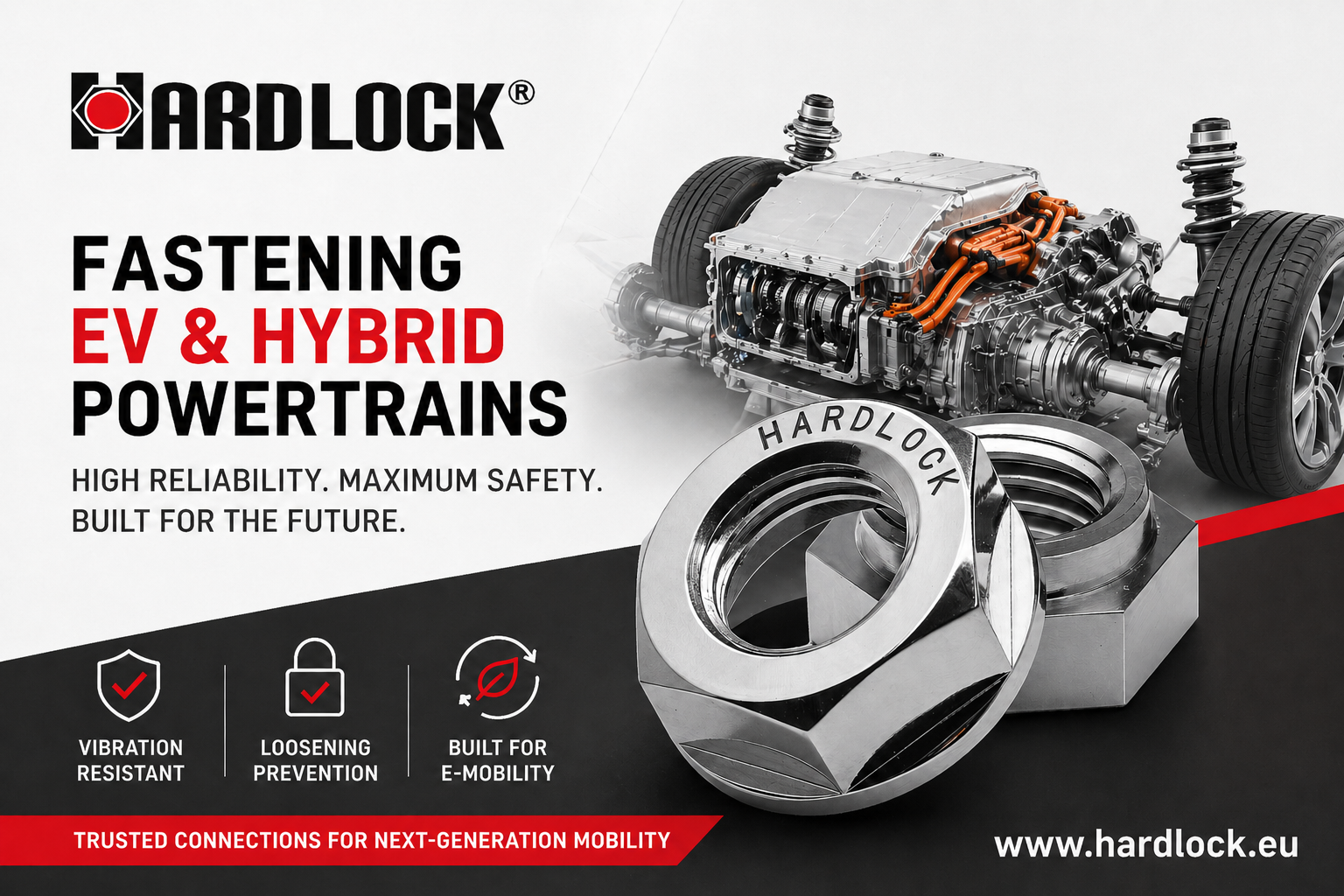
Fastening Solutions EV Hybrid for High-Speed Powertrains
Electric and hybrid vehicles introduce new mechanical challenges that go beyond conventional automotive design. High-speed rotating components, instant torque delivery, and frequent start-stop cycles place extreme demands on bolted joints. Fastening solutions EV hybrid applications must ensure stability under vibration, torque fluctuation, and long-term wear—conditions where traditional locking methods often fail.
The Hidden Challenge in EV and Hybrid Systems
Unlike internal combustion engines, EV and hybrid systems generate:
- Instant torque at start-up
- High-frequency vibration from electric motors
- Rapid load transitions in power-split systems
- Continuous operation at high rotational speeds
Studies on hybrid powertrains confirm that torque ripple and system shock during start-up create significant vibration in transmission components, directly affecting fastening reliability .
➡️ https://www.hardlock.eu/why-the-hardlock-nut-does-not-loosen/
Power-Split Hybrid Systems: A Critical Use Case
Application
Power-split hybrid electric vehicles (PSHEV) combine:
- Internal combustion engine
- Electric motor
- Complex transmission system
Mechanical Challenge
During engine start-up:
- Pulsating torque creates system jerk
- Transmission shafts experience vibration spikes
- Load distribution changes rapidly
Risk
- Loss of clamp force
- Micro-movement in joints
- Progressive loosening
HARDLOCK® Approach
- Maintains locking independent of friction
- Resists loosening under dynamic load
- Stabilizes critical drivetrain connections
High-Speed Rotating Components and Bearing Fixation
Application Areas
- Motor shafts
- Gearbox assemblies
- Bearing preload systems
Challenge
EV systems operate at:
- Higher RPM than conventional engines
- Frequent acceleration/deceleration cycles
- Tight tolerances for positioning accuracy
Solution: HARDLOCK® Bearing Nuts (HLB)
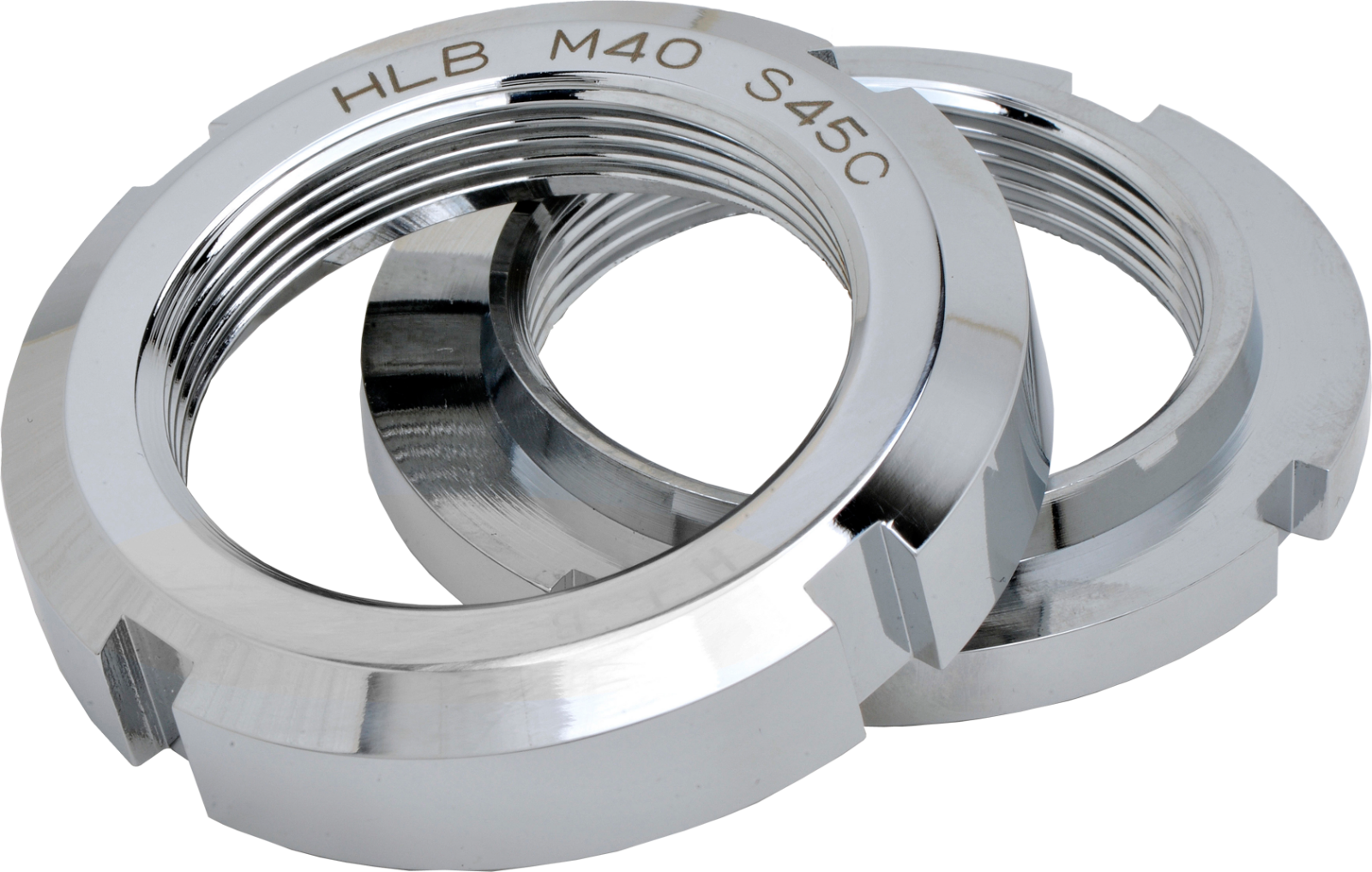
HARDLOCK® Bearing Nuts enable:
- Precise preload control via torque tightening
- Stable axial positioning under load
- Resistance to vibration and rotational forces
Engineering Advantage
Unlike standard lock nuts:
- Locking performance does not depend on friction
- Preload remains stable over time
- Suitable for high-speed rotating shafts
➡️ https://www.hardlock.eu/blog/how-hardlock-nuts-work/
Why Conventional Locking Methods Fail in EV Systems
Traditional solutions rely on friction:
- Nylon insert nuts degrade under temperature
- Spring washers lose effectiveness under vibration
- Adhesives complicate maintenance
In EV and hybrid systems:
- Vibration is continuous, not occasional
- Torque changes are rapid and frequent
- Thermal cycles accelerate material fatigue
➡️ https://www.hardlock.eu/blog/vibration-test-results/
Real Impact: Reliability, Safety, and Cost
1. Increased System Reliability
Stable fastening ensures consistent drivetrain performance.
2. Reduced Maintenance
No need for periodic re-tightening or replacement.
3. Improved Safety Margins
Critical in high-speed rotating assemblies.
4. Lower Lifecycle Costs
Prevention of loosening reduces wear and failure risk.
Where to Use in EV & Hybrid Vehicles
HARDLOCK® solutions are suitable for:
Powertrain Systems
- Transmission shafts
- Motor-to-gear connections
- Coupling assemblies
- Busbar connections (Cu-Al…)
Rotating Components
- Bearing fixation
- High-speed shafts
- Rotor assemblies
Structural and Auxiliary Systems
- Mounting brackets
- Chassis connections
- Vibration-exposed joints
Engineering Insight: Locking Independent of Clamp Force
One of the key advantages of HARDLOCK® technology:
- Locking is achieved through mechanical interaction
- Performance remains even if clamp force decreases
- Ideal for systems exposed to wear and dynamic loads
This is particularly important in EV systems, where:
- Micro-movements accumulate over time
- High-frequency vibration accelerates loosening
When to Specify HARDLOCK® in EV Design
Consider HARDLOCK® when:
- Components operate at high rotational speeds
- Torque fluctuations are frequent
- Maintenance access is limited
- Failure risk impacts safety or cost
Conclusion: Designed for the Next Generation of Mobility
EV and hybrid vehicles redefine mechanical requirements. Fastening systems must evolve accordingly.
HARDLOCK® provides a proven mechanical locking solution that performs under:
- High-speed rotation
- Continuous vibration
- Dynamic torque conditions
For engineers designing next-generation mobility systems, reliable fastening is not optional—it is fundamental.