Anti Loosening Nut for Aluminum Construction
Aluminum structures require reliable fastening solutions, especially in applications exposed to vibration or dynamic loads. The anti loosening nut for aluminum construction from HARDLOCK® is specifically designed to prevent loosening and ensure long-term stability in aluminum frames and profiles. Aluminum frames are widely used in modern construction for facade systems, curtain walls, and lightweight structural frameworks.
These systems offer high strength-to-weight ratio, corrosion resistance, and design flexibility, but they also introduce unique challenges for bolted connections. Ensuring long-term fastening stability is essential for maintaining structural integrity, safety, and performance.
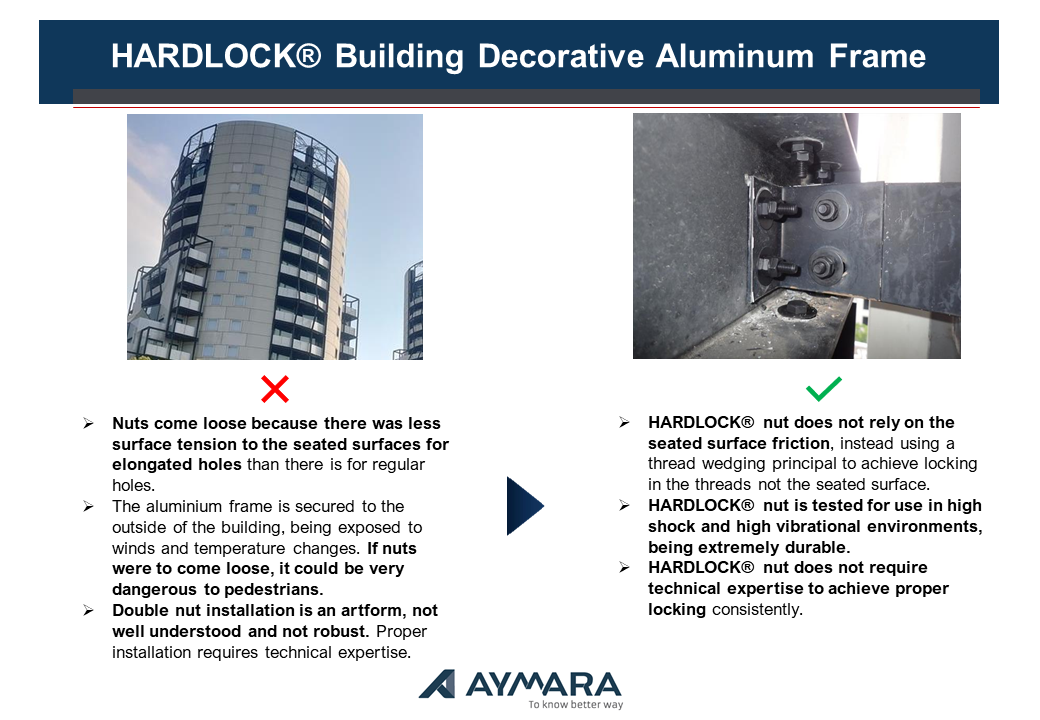
HARDLOCK® Nut is used on building aluminum frames to provide secure, anti-loosening fastening, even under environmental and operational stress.
Why Fastening Matters in Aluminum Frame Structures
Aluminum frame systems rely on bolted joints in key areas such as:
- Façade and curtain wall connections
- Structural frame joints
- Mounting systems for panels and glazing
- Support structures and brackets
These connections must ensure:
- Structural stability
- Alignment and positioning
- Long-term durability
The Challenge: Lightweight Material with Dynamic Behavior
While aluminum offers many advantages, it behaves differently from steel in fastening applications.
Thermal Expansion of Aluminum
Aluminum has a higher coefficient of thermal expansion than steel.
In real conditions:
- Temperature changes cause expansion and contraction
- Daily and seasonal cycles affect joint preload
- Differential expansion between materials can occur
This can lead to gradual loosening of conventional nuts.
Wind Loads and Building Movement
Aluminum structures are exposed to:
- Wind pressure and suction forces
- Dynamic movement of façades
- Vibrations from environmental conditions
These forces create cyclic stress in bolted joints.
Reduced Friction and Surface Deformation
Compared to steel:
- Aluminum surfaces can deform more easily
- Friction-based locking may be less reliable
- Contact surfaces may change over time
Long Service Life Requirements
Building structures must perform reliably for:
- Decades of operation
- Minimal maintenance cycles
- Continuous environmental exposure
Maintenance Challenges
Façade systems and structural frames are often:
- Difficult to access
- Expensive to maintain
- Critical for building safety and aesthetics
Loose fasteners can result in:
- Panel misalignment
- Noise and vibration
- Increased maintenance costs
👉 Learn more about preload loss:
https://www.hardlock.eu/why-do-bolts-nuts-come-loose-factors-influencing-bolt-preload-loss/
Real-World Use Case: Aluminum Frame Connections
In aluminum construction systems, fastening reliability is critical for:
- Maintaining façade alignment
- Ensuring structural integrity
- Preventing loosening due to thermal and dynamic effects
HARDLOCK® Nut is used in:
- Frame-to-frame connections
- Panel mounting systems
- Structural brackets exposed to environmental loads
In these applications, stable preload is essential for long-term performance.
Why Preload Stability Is Critical
Maintaining preload ensures:
- Secure fixation of structural elements
- Stable alignment of façade systems
- Resistance to environmental forces
Loss of preload can lead to:
- Misalignment of panels
- Increased vibration and noise
- Potential safety concerns
HARDLOCK® Nut: Mechanical Locking for Construction Applications
HARDLOCK® Nut uses a mechanical wedge-locking principle that maintains preload without relying solely on friction.
How it works:
- Two nuts (convex + concave) create a locking system
- An eccentric thread generates radial locking force
- This force prevents rotational loosening
This ensures reliable performance under:
- Thermal expansion and contraction
- Wind-induced vibration
- Long-term environmental exposure
👉 Full technical explanation:
https://www.hardlock.eu/why-the-hardlock-nut-does-not-loosen/
Where HARDLOCK® Nut Is Used in Aluminum Frame Structures
Typical applications include:
- Curtain wall and façade systems
- Aluminum structural frameworks
- Mounting brackets and supports
- Architectural and design structures
These areas require long-term fastening stability and minimal maintenance.
Key Benefits for Aluminum Construction Applications
✔ Prevents Loosening Due to Thermal Expansion
Maintains clamping force despite temperature changes and material movement.
✔ Improves Structural Stability
Ensures consistent alignment and secure connections.
✔ Reduces Maintenance and Lifecycle Costs
Reliable fastening helps:
- Minimize inspection and retightening
- Reduce maintenance interventions
- Lower total cost of ownership
✔ Enhances Safety and Reliability
Secure connections reduce the risk of:
- Panel movement
- Structural instability
- Safety issues
✔ Suitable for Long-Term Building Applications
Designed for:
- Long service life
- Environmental exposure
- High-performance construction systems
Comparison with Conventional Fastening Methods
Traditional fastening solutions rely on friction or deformation.
Limitations:
- Reduced effectiveness with aluminum surfaces
- Sensitivity to thermal expansion
- Gradual loosening over time
HARDLOCK® Nut provides a mechanical anti-loosening solution independent of friction, ensuring stable long-term performance.
👉 Compare fastening technologies:
https://www.hardlock.eu/hardlock-nut-vs-prevailing-torque-type-nut/
Engineering Perspective: Cost of Failure in Building Structures
In construction, fastening reliability directly impacts:
- Structural integrity
- Maintenance costs
- Building safety
Loose fasteners can result in:
- Façade misalignment
- Increased service requirements
- Potential safety risks
Reliable fastening solutions help minimize these risks.
👉 Learn more about benefits:
https://www.hardlock.eu/hardlock-nut-main-benefits/
Related Applications in Construction and Infrastructure
Similar challenges exist in:
- Steel structures → https://www.hardlock.eu/hardlock-nut-on-steel-structures/
- Bridge Structures → https://www.hardlock.eu/hardlock-nut-on-bridge-structures/
- Power plants → https://www.hardlock.eu/hardlock-nut-in-power-plants/
- Suspension Bridges→ https://www.hardlock.eu/hardlock-nut-in-power-plants/
- Bridge → https://www.hardlock.eu/applications/bridge/
- Building Dampers → https://www.hardlock.eu/hardlock-nut-on-building-dampers/
- Cranes → https://www.hardlock.eu/hardlock-nut-on-cranes/
- Building Aluminum Frames → https://www.hardlock.eu/hardlock-nut-on-building-aluminum-frames/
- Noise Barriers → https://www.hardlock.eu/hardlock-nut-on-noise-barriers/
👉 Explore full application range:
https://www.hardlock.eu/where-is-hardlock-nut-often-used/
When to Use HARDLOCK® Nut in Aluminum Frame Applications
Consider this solution if your application involves:
- Aluminum structures with thermal expansion
- Exposure to wind and environmental forces
- Long-term performance requirements
- Limited maintenance access
Conclusion
Aluminum frame structures require fastening solutions that ensure stability, durability, and long-term reliability under environmental stress.
By maintaining preload and preventing loosening, HARDLOCK® Nut provides a mechanical solution for secure and reliable fastening in modern construction systems.
Looking to Improve Structural Reliability?
Choosing the right fastening system can reduce maintenance, improve safety, and ensure long-term performance.
👉 Start with the fundamentals:
https://www.hardlock.eu/why-do-bolts-nuts-come-loose-factors-influencing-bolt-preload-loss/