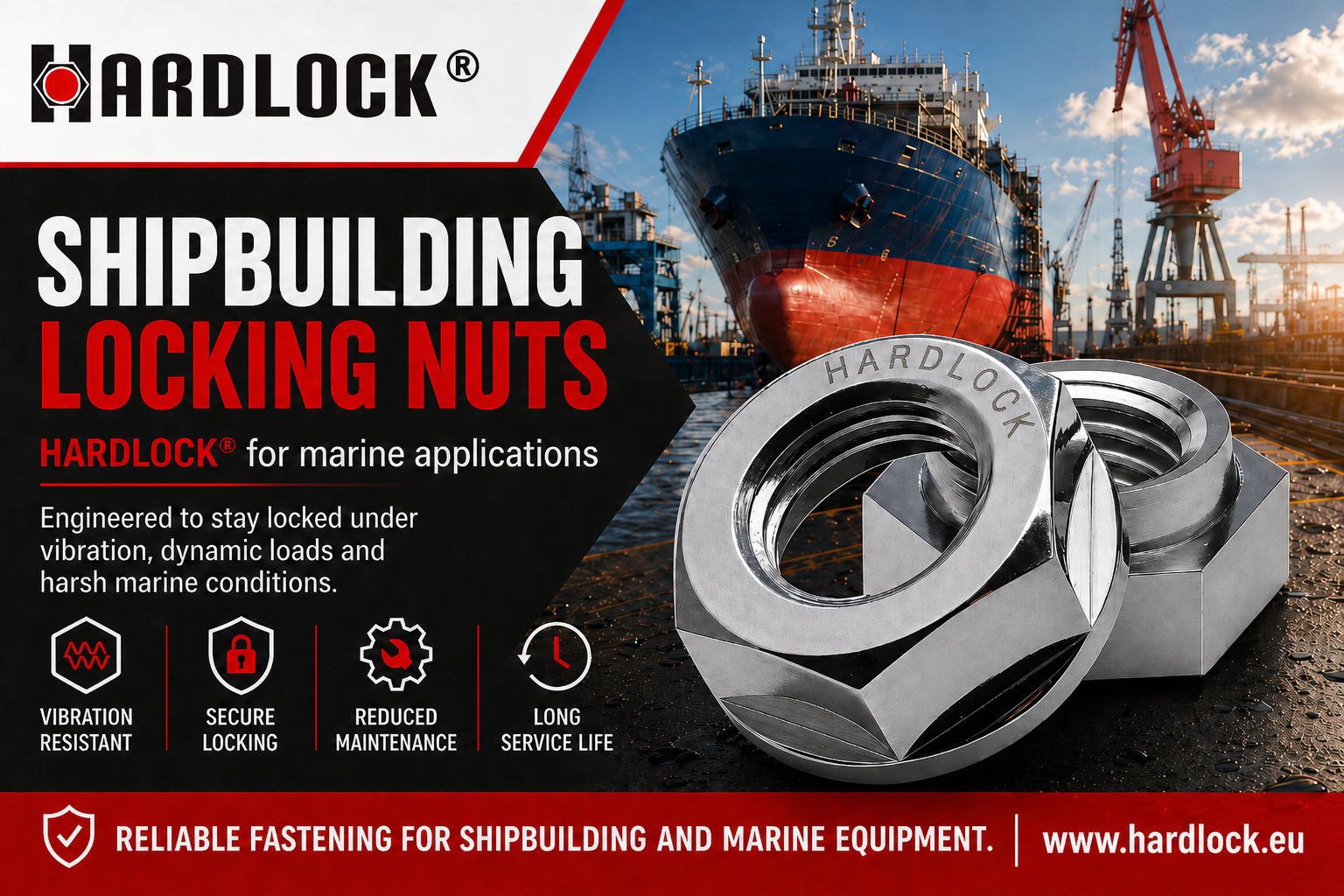
Shipbuilding Locking Nuts: HARDLOCK® Anti-Loosening Solution for Marine Applications
Shipbuilding locking nuts are essential for ensuring safety, reliability, and long-term performance in marine environments. Ships, offshore vessels, ferries, naval vessels, and marine equipment operate under continuous vibration, shock loads, corrosion risk, and difficult maintenance conditions.
For shipyards, vessel operators, and marine equipment manufacturers, choosing the right shipbuilding locking nuts can reduce maintenance work, prevent bolt loosening, and improve long-term equipment reliability.
In these environments, even minor loosening of bolted joints can lead to:
- equipment malfunction
- increased maintenance costs
- reduced operational safety
- unplanned downtime
- damage to critical marine systems
This is why advanced mechanical fastening solutions such as HARDLOCK® nuts are increasingly used in vibration-critical marine and shipbuilding applications.
For a deeper understanding of the locking principle, see:
https://www.hardlock.eu/hardlock-nut-the-worlds-strongest-self-locking-nut/
Why Bolt Loosening Is a Critical Problem in Shipbuilding
Marine structures and onboard systems are exposed to demanding operating conditions. Unlike static industrial environments, vessels experience constant movement and dynamic forces.
Typical causes of loosening include:
- engine and propulsion vibration
- wave impact and hull movement
- cyclic loading from rotating equipment
- thermal expansion and contraction
- shock loads during docking or heavy operation
- long-term exposure to moisture and harsh environments
These conditions can gradually reduce preload in bolted joints. Once preload is lost, vibration can accelerate loosening, leading to component fatigue, leakage, misalignment, or failure.
Engineering Standards and Marine Fastening References:
Shipbuilding locking nuts are often selected in projects where bolted joint reliability, vibration resistance, and safety are critical. Marine engineers may also consider relevant industry standards and classification requirements during specification.
– International Maritime Organization — https://www.imo.org/
– DNV maritime classification and offshore standards — https://www.dnv.com/maritime/
– Lloyd’s Register marine classification — https://www.lr.org/en/marine-shipping/
– ABS marine and offshore classification — https://ww2.eagle.org/
Real-World Applications of HARDLOCK® Nuts in Shipbuilding
1. Propulsion Systems and Engine Room Equipment
Ship propulsion systems generate continuous vibration and high dynamic loads. Critical fastening points must remain secure over long operating periods.
Typical applications include:
- main engine auxiliary equipment
- propulsion shaft-related assemblies
- generator foundations
- pump and compressor mounts
- vibration-sensitive engine room components
In these areas, conventional nuts may require periodic inspection and re-tightening. HARDLOCK® nuts provide a mechanical anti-loosening solution designed to maintain secure bolted joints even under continuous vibration.
Similar vibration-critical applications can be seen here:
https://www.hardlock.eu/hardlock-nut-on-vibration-screens/
2. Deck Machinery and Mooring Equipment
Deck machinery operates under repeated load cycles, impact, and outdoor exposure.
Typical fastening points include:
- winches
- capstans
- cranes
- davits
- anchor handling equipment
- mooring systems
Loose fasteners in deck machinery can create operational risks, especially when equipment is used under heavy load or emergency conditions.
HARDLOCK® nuts help reduce the need for re-tightening and support long-term reliability in demanding marine operations.
Related heavy-duty application:
https://www.hardlock.eu/anti-loosening-nut-for-cranes-hardlock-solution-for-vibration-safety/
3. Pumps, Valves, and Piping Systems
Marine piping systems are exposed to vibration, pressure changes, and thermal movement.
Applications include:
- seawater pumps
- ballast systems
- fuel systems
- cooling water systems
- flange connections
- valve assemblies
Loosening in these systems may cause leakage, pressure loss, or maintenance shutdowns.
A similar industrial use case is described here:
https://www.hardlock.eu/hardlock-nut-in-oil-gas-flange-connections/
For flange-specific applications, see also:
https://www.hardlock.eu/anti-loosening-nuts-flange-connections/
4. Ship Electrical and Control Systems
Electrical and control equipment on vessels must remain reliable despite vibration and temperature variation.
Typical applications include:
- switchboards
- control cabinets
- terminal blocks
- cable fixing systems
- onboard electronic equipment
- monitoring systems
Loose electrical connections can lead to overheating, signal interruption, or system failure.
Related electrical application:
https://www.hardlock.eu/blog-locking-nut-electronic-equipment/
5. LNG, Offshore, and Energy-Related Marine Equipment
Shipbuilding is closely connected with offshore energy, LNG terminals, and marine infrastructure. These applications require fastening solutions that can perform under vibration, harsh environments, and difficult maintenance access.
Typical use cases include:
- LNG handling equipment
- offshore vessel systems
- marine energy platforms
- loading arms
- rotating equipment
- safety-critical support structures
Related HARDLOCK® applications:
https://www.hardlock.eu/offshore-onshore-applications-of-hardlock-nuts-engineering-reliability-in-extreme-environments/
https://www.hardlock.eu/lng-terminal-nuts-vibration-critical-equipment/
Why HARDLOCK® Nuts Are Ideal for Shipbuilding
1. Mechanical Anti-Loosening Performance
HARDLOCK® nuts use a unique convex–concave wedge locking mechanism. This creates a powerful mechanical locking force and prevents rotational loosening.
Unlike friction-based locking methods, HARDLOCK® does not depend only on torque retention or surface friction.
Technical explanation:
https://www.hardlock.eu/why-the-hardlock-nut-does-not-loosen/
2. Reliability Under Continuous Vibration
Ships operate for long periods under constant vibration. In such conditions, fastening reliability is not only a maintenance issue—it is a safety issue.
HARDLOCK® nuts are suitable for applications where:
- vibration is continuous
- re-tightening is difficult
- access is limited
- safety requirements are high
- downtime is costly
Comparison with conventional locking methods:
https://www.hardlock.eu/hardlock-nuts-vs-locking-nuts-washers-which-solution-performs-best-under-vibration/
3. Maintenance Reduction
Marine maintenance is expensive because access is often limited and downtime affects operations.
HARDLOCK® nuts help reduce:
- inspection frequency
- re-tightening work
- unexpected loosening
- maintenance-related downtime
This makes them suitable for shipyards, vessel operators, OEM manufacturers, and marine maintenance teams.
Benefits overview:
https://www.hardlock.eu/hardlock-nut-main-benefits/
4. Fully Metallic and Reusable Design
In shipbuilding, fastening solutions must withstand demanding environments and long service periods.
HARDLOCK® nuts are:
- fully metallic
- reusable
- suitable for high-vibration applications
- designed for long-term mechanical performance
This is especially valuable in marine systems where polymer inserts, adhesives, or friction-based methods may not provide the desired long-term reliability.
Comparison: HARDLOCK® vs Conventional Marine Fastening Methods
| Feature | Standard Nut | Nylon Lock Nut | Adhesive Locking | HARDLOCK® Nut |
|---|---|---|---|---|
| Vibration resistance | Low | Medium | Medium | Very high |
| Maintenance required | High | Medium | Medium/High | Low |
| Reusability | High | Low | None | High |
| Suitability for critical marine systems | Limited | Limited | Conditional | Excellent |
| Dependence on friction | High | High | Medium | Low |
| Long-term reliability | Low/Medium | Medium | Medium | Very high |
Engineering Perspective: Cost of Loosening in Shipbuilding
In marine applications, the cost of failure can be significantly higher than the cost of the fastener.
Bolt loosening can lead to:
- emergency maintenance
- vessel downtime
- system leakage
- equipment damage
- safety risks
- delayed operations
For this reason, shipbuilders and marine engineers often select anti-loosening fasteners during the design phase, especially for vibration-critical and safety-critical assemblies.
When to Use HARDLOCK® Marine Locking Nuts
Consider HARDLOCK® nuts when your marine application involves:
- continuous vibration
- rotating machinery
- shock loads
- difficult maintenance access
- flange connections
- deck machinery
- electrical equipment
- propulsion-related systems
- offshore or LNG-related equipment
- safety-critical bolted joints
For broader application examples, see:
https://www.hardlock.eu/where-is-hardlock-nut-often-used/
Related Articles
Explore more real-world HARDLOCK® applications:
- HARDLOCK® Nuts vs Locking Nuts & Washers
https://www.hardlock.eu/hardlock-nuts-vs-locking-nuts-washers-which-solution-performs-best-under-vibration/ - HARDLOCK® Nut Main Benefits
https://www.hardlock.eu/hardlock-nut-main-benefits/ - HARDLOCK® Nut in Oil & Gas Flange Connections
https://www.hardlock.eu/hardlock-nut-in-oil-gas-flange-connections/ - Anti-Loosening Nuts for Flange Connections
https://www.hardlock.eu/anti-loosening-nuts-flange-connections/ - Locking Nut for Electronic Equipment
https://www.hardlock.eu/blog-locking-nut-electronic-equipment/ - Offshore & Onshore Applications of HARDLOCK Nuts
https://www.hardlock.eu/offshore-onshore-applications-of-hardlock-nuts-engineering-reliability-in-extreme-environments/ - LNG Terminal Nuts for Vibration-Critical Equipment
https://www.hardlock.eu/lng-terminal-nuts-vibration-critical-equipment/ - HARDLOCK® Nut vs. Nord-Lock® Washer
https://www.hardlock.eu/hardlock-nut-vs-nordlock-washer/
Conclusion: Reliable Fastening for Modern Shipbuilding
Shipbuilding requires fastening solutions that can withstand vibration, shock loads, harsh environments, and long service intervals.
HARDLOCK® nuts provide a proven mechanical anti-loosening solution for marine applications where safety, reliability, and maintenance reduction are critical.
From propulsion systems and deck machinery to piping, electrical equipment, and offshore-related systems, HARDLOCK® helps secure bolted joints in demanding shipbuilding environments.
Looking to Improve Fastening Reliability in Shipbuilding?
Looking to improve the reliability of your marine equipment or vessel systems?
Contact HARDLOCK® experts for:
- technical consultation
- application-specific recommendations
- test data
- sample selection
- fastening solution support for shipbuilding projects
HARDLOCK® – Secure fastening for vibration-critical marine applications.