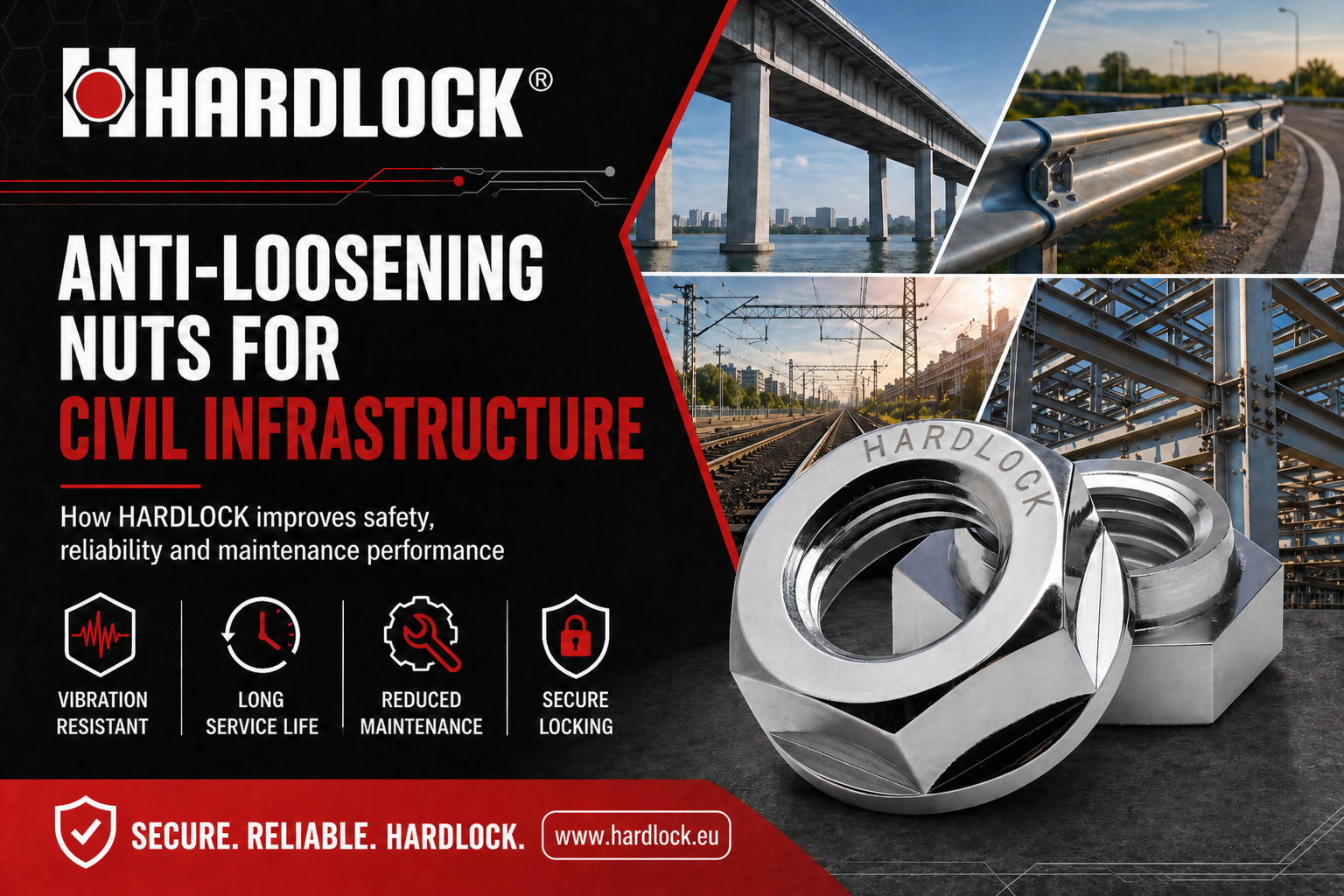
HARDLOCK® Solution for Long-Term Safety and Reliability
Anti loosening nuts are critical for civil infrastructure where bridges, highways, railways, tunnels, noise barriers, and foundation systems are exposed to vibration, dynamic loads, wind, and long-term environmental stress. HARDLOCK® Nuts provide a proven mechanical solution to prevent bolt loosening, improve safety, and reduce maintenance in demanding public infrastructure applications.
In these environments, even small bolt loosening can lead to:
- Reduced structural stability
- Increased maintenance costs
- Safety risks
- Service interruptions
- Shorter infrastructure lifespan
For engineers and infrastructure operators, the key question is clear:
How can bolted joints remain secure over decades without repeated re-tightening?
HARDLOCK® Nuts provide a proven mechanical anti-loosening solution for civil infrastructure applications where reliability, safety, and lifecycle cost matter.
Why Anti Loosening Nuts Matter in Civil Infrastructure
Bolted joints in infrastructure are continuously exposed to forces that gradually reduce preload and create micro-movements between connected components.
Common causes include:
- Traffic-induced vibration
- Wind loads and cyclic stress
- Train and vehicle impact forces
- Thermal expansion and contraction
- Corrosion and environmental exposure
- Settlement and long-term material relaxation
Once preload decreases, conventional nuts may begin to rotate or lose clamping force. Over time, this can lead to joint movement, component wear, fatigue damage, or complete loosening.
Learn more about the root causes of bolt loosening:
Why Bolts Loosen and How HARDLOCK® Nuts Prevent It
Real-World Applications for Anti Loosening Nuts
HARDLOCK® Nuts are used in a wide range of public infrastructure and civil engineering systems where loosening prevention is essential. For general engineering guidance on bolted joints and preload, see the technical resources from the Fastener Training Institute:
Technical resources on bolted joints and preload
1. Anti Loosening Nuts for Bridges and Steel Structures
Bridge structures are subject to dynamic traffic loads, environmental exposure, and long service-life requirements. International bridge engineering guidance highlights the importance of reliable structural connections.
Bridge engineering guidance from the Federal Highway Administration
Typical fastening points include:
- Structural steel connections
- Expansion joints
- Anchor bolts and base plates
- Suspension bridge components
- Maintenance platforms and auxiliary equipment
In bridge applications, stable preload is critical for load transfer, structural alignment, and long-term safety.
Related article:
Anti Loosening Nut for Bridges: HARDLOCK® Nut Solution for Bridge Structures
2. Anti Loosening Nuts for Highways and Road Infrastructure
Highway infrastructure is exposed to constant vibration from vehicles and heavy trucks.
Typical applications include:
- Guardrails and safety barriers
- Lighting columns
- Road signs and information boards
- Expansion joints
- Drainage systems
- Tunnel equipment
- Electronic toll collection systems
Loose fasteners in highway infrastructure can increase inspection frequency and create safety risks for road users.
Related article:
Anti-Loosening Nuts for Highways: How HARDLOCK® Improves Safety and Reduces Maintenance
3. Anti Loosening Nuts for Railway Infrastructure
Railway systems are among the most vibration-intensive infrastructure environments.
Railway infrastructure guidance from UIC
Fasteners must resist:
- Repeated wheel loads
- High-frequency vibration
- Impact forces
- Thermal expansion
- Track movement
- Outdoor exposure
Typical applications include:
- Rail fastening systems
- Fishplates and rail joints
- Switches and crossings
- Trackside equipment
- Signaling systems
- Auxiliary railway equipment
Using anti-loosening nuts for railway infrastructure helps maintain track stability, reduce maintenance, and improve operational safety.
Related articles:
HARDLOCK® Nuts in Rail Track Systems
HARDLOCK® Nuts in Auxiliary Railway Equipment
Anti Loosening Nut for Railroad Switches: HARDLOCK® Solution
4. Noise Barriers and Structural Frames
Noise barriers along highways and railways are exposed to wind loads, passing vehicle vibration, and long-term outdoor conditions.
Critical fastening points include:
- Panel mounting systems
- Support frames
- Base connections
- Modular structural joints
- Anchoring systems
If bolts loosen, panels may move, vibrate, or become unstable. This increases maintenance cost and can create safety risks near traffic areas.
Related article:
Anti Loosening Nut for Structural Frames: HARDLOCK® for Noise Barriers
5. Anti Loosening Nuts for Foundation Bolts and Anchor Systems
Foundation bolts are essential for securing infrastructure equipment and structural elements to concrete bases.
Common applications include:
- Steel columns
- Machinery foundations
- Roadside equipment
- Pylons and towers
- Tunnel ventilation systems
- Bridge and highway auxiliary structures
Because these bolts are often difficult to access after installation, loosening prevention is especially important.
Related article:
Anti Loosening Nut for Foundation Bolts: HARDLOCK® Solution for Secure Anchoring
Why HARDLOCK® Nuts Work in Civil Infrastructure
HARDLOCK® Nuts use a mechanical wedge-locking principle.
The system consists of two parts:
- A convex lower nut
- A concave upper nut
When tightened, the eccentric wedge effect creates a powerful locking force perpendicular to the bolt axis. This eliminates thread clearance and prevents rotational loosening.
Unlike conventional fastening methods, HARDLOCK® does not rely only on friction, adhesives, or deformation.
Key advantages:
- Prevents loosening under vibration
- Maintains stable preload
- Suitable for long service life applications
- Reusable and fully metallic
- No curing time required
- No chemical adhesive needed
- Effective in outdoor and harsh environments
- Reduces re-tightening and maintenance work
Technical explanation:
Why the HARDLOCK® Nut Does Not Loosen
HARDLOCK® Nut: Main Benefits and How It Prevents Loosening
Comparison with Conventional Locking Methods
Traditional locking solutions are often used in infrastructure projects, but each has limitations.
| Method | Limitation in Infrastructure |
|---|---|
| Standard nuts | High risk of loosening under vibration |
| Spring washers | Limited preload retention in high-load joints |
| Nylon insert nuts | Not ideal for high temperature or long-term outdoor exposure |
| Adhesives | Surface preparation and curing time required |
| Double nutting | Installation quality depends heavily on technician skill |
| HARDLOCK® Nut | Mechanical locking, reusable, vibration resistant |
For applications where inspection access is limited and failure risk must be minimized, a mechanical anti-loosening solution provides higher reliability.
Related comparison articles:
HARDLOCK® Nuts vs Locking Nuts & Washers
HARDLOCK® Nut vs. Prevailing Torque Type Nut
HARDLOCK® Nut vs. Nord-Lock® Washer
Engineering Benefits for Infrastructure Owners and Contractors
✔ Reduced Maintenance Costs
Infrastructure maintenance is expensive, disruptive, and often difficult to schedule.
By preventing loosening, HARDLOCK® Nuts help reduce:
- Re-tightening work
- Inspection frequency
- Emergency maintenance
- Component replacement
- Traffic or railway service interruptions
✔ Improved Safety
Civil infrastructure is directly connected to public safety.
Reliable fastening helps protect:
- Bridges
- Roads
- Railways
- Noise barriers
- Tunnels
- Public equipment
- Structural frames
Loose bolts are small components with potentially serious consequences. HARDLOCK® helps eliminate this risk at the fastening point.
✔ Long-Term Reliability
Infrastructure projects are designed for decades of operation.
HARDLOCK® Nuts support long-term reliability by maintaining joint stability under:
- Vibration
- Shock loads
- Wind loads
- Thermal cycles
- Outdoor exposure
- Repeated dynamic stress
✔ Lower Lifecycle Cost
Initial component cost is only one part of infrastructure economics.
The real cost includes:
- Installation
- Inspection
- Maintenance
- Retightening
- Downtime
- Failure risk
For safety-critical and difficult-to-access locations, preventing loosening can significantly improve lifecycle performance.
Where to Specify HARDLOCK® Nuts in Civil Infrastructure Projects
Consider HARDLOCK® Nuts when your application involves:
- Continuous vibration
- Dynamic loads
- Safety-critical fastening points
- Limited maintenance access
- Long service life requirements
- Outdoor exposure
- High cost of failure
- Infrastructure operated under public safety requirements
Typical project types include:
- Bridges
- Highways
- Railway infrastructure
- Tunnels
- Noise barriers
- Steel structures
- Pylons
- Foundation systems
- Urban infrastructure
- Public transportation systems
Explore full application areas:
HARDLOCK® Applications
Related Infrastructure Articles
- Anti-Loosening Nuts for Highways: How HARDLOCK® Improves Safety and Reduces Maintenance
- Anti Loosening Nut for Bridges: HARDLOCK® Nut Solution for Bridge Structures
- HARDLOCK® Nuts in Rail Track Systems
- Anti Loosening Nut for Structural Frames: HARDLOCK® for Noise Barriers
- Anti Loosening Nut for Foundation Bolts: HARDLOCK® Solution for Secure Anchoring
- Bolt Locking Methods Explained: How to Prevent Loosening and Maintain Preload
Conclusion: A Proven Anti-Loosening Solution for Civil Infrastructure
Civil infrastructure requires fastening systems that can perform reliably under vibration, dynamic loading, environmental stress, and long maintenance intervals.
HARDLOCK® Nuts provide a mechanical anti-loosening solution for bridges, highways, railways, noise barriers, foundation bolts, and structural systems.
For infrastructure owners, contractors, and engineers, the benefit is clear:
Higher safety. Lower maintenance. Long-term fastening reliability.
Contact HARDLOCK® Experts
Planning an infrastructure project or solving a loosening issue in an existing structure?
Contact HARDLOCK® experts for technical consultation and product recommendations.