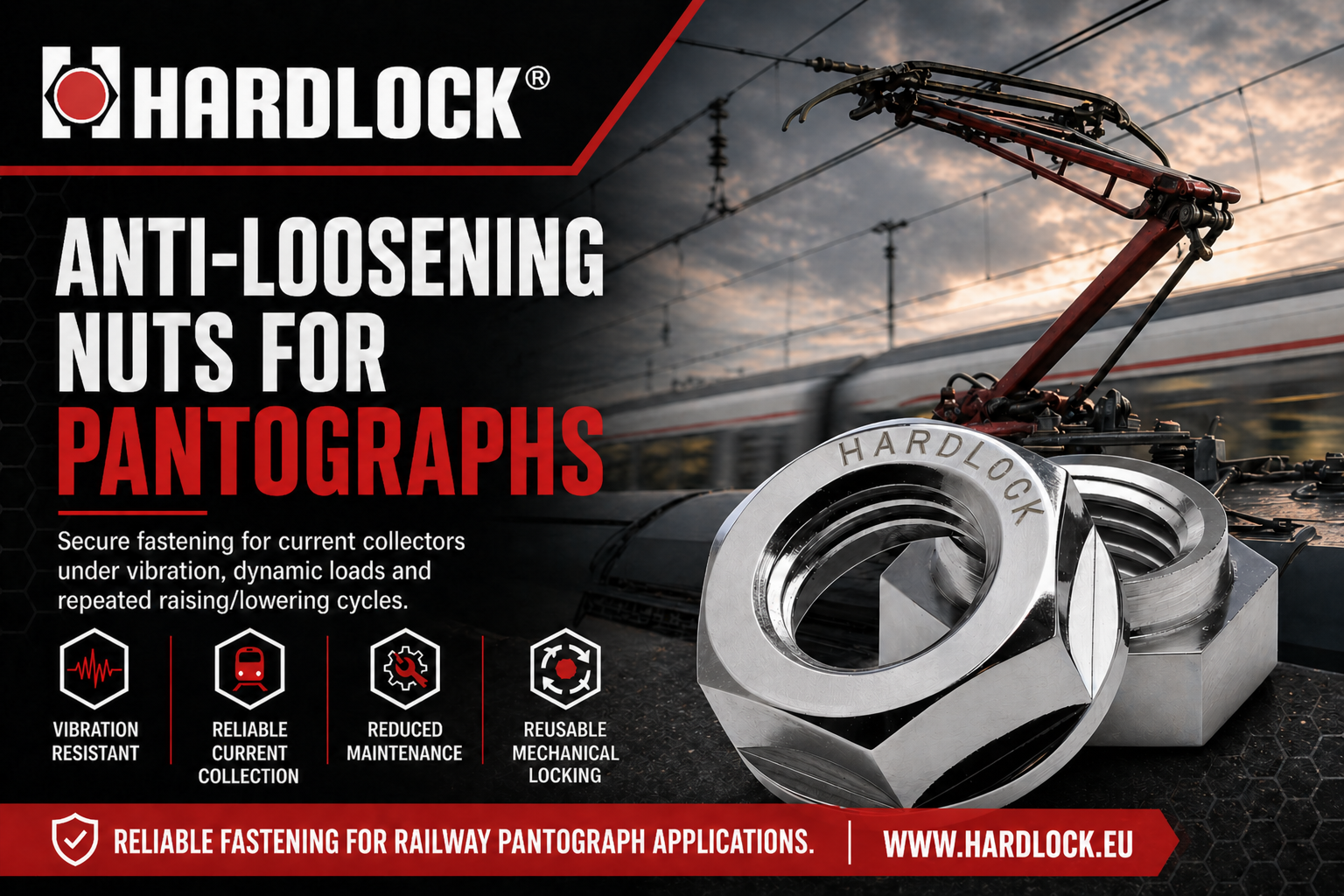
HARDLOCK® Current Collector Solution
Anti-loosening nuts for pantographs are essential for securing current collectors exposed to vibration, dynamic loads, raising and lowering cycles, and harsh railway operating conditions. In electric railway systems, pantographs transfer power from the overhead contact line to the vehicle, so every bolted joint must remain stable during long-term service.
In this application, bolted joints are exposed to vibration, repeated raising and lowering cycles, aerodynamic forces, shock loads, thermal changes, and long-term maintenance demands.
If fastening points loosen, the result can be serious. Loose bolts may affect current collection stability, increase wear, create noise, cause equipment damage, or lead to unplanned maintenance.
For this reason, anti-loosening nuts for pantographs are an important solution for railway operators, rolling stock manufacturers, pantograph suppliers, and maintenance teams.
The HARDLOCK® Nut provides a mechanical anti-loosening solution for pantograph and current collector applications where stable fastening is required under vibration and dynamic loads.
Why Anti-Loosening Nuts for Pantographs Matter
Pantographs operate in one of the most demanding areas of a railway vehicle: the roof-mounted interface between rolling stock and overhead contact line.
During service, pantograph assemblies are affected by:
- Continuous vibration from vehicle movement
- Dynamic interaction with the overhead contact line
- Raising and lowering cycles
- Aerodynamic loads at operating speed
- Shock and impact forces
- Thermal expansion and contraction
- Outdoor exposure to rain, dust, snow, and temperature changes
- Maintenance operations and repeated inspections
The pantograph and overhead contact line interface is important for railway interoperability and reliable current collection. European standard EN 50367 defines technical compatibility criteria between pantographs and overhead contact lines for free access to railway networks.
In real operation, vibration and dynamic loads can reduce bolt preload. Once preload is reduced, the bolted joint becomes less stable. This may cause small movements, further loosening, and increased maintenance requirements.
Learn more about the general mechanism here:
Why Bolts Loosen (And How HARDLOCK® Nuts Prevent It)
Where Pantograph Bolted Joints Can Loosen
Pantographs include several fastening points where stability is essential.
Typical areas include:
- Pantograph base frame mounting points
- Lower arm and upper arm joints
- Collector head support structures
- Carbon strip fixing points
- Insulator mounting points
- Spring and balancing mechanism brackets
- Pneumatic or electric actuator mounts
- Cable and busbar connection points
- Roof-mounted support frames
- Sensor and monitoring equipment brackets
These components must remain secure during thousands of operating cycles.
A pantograph is not a static structure. It moves, lifts, presses against the overhead contact line, and reacts continuously to vehicle speed, line geometry, and contact wire conditions. Technical literature on pantograph-catenary interaction describes this system as a dynamic interface where contact quality, vibration, and mechanical behavior are closely connected.
For related railway fastening applications, read also:
HARDLOCK® Nuts in Rolling Stock
HARDLOCK® Nuts in Rail Track Systems
HARDLOCK® Nuts in Auxiliary Railway Equipment
The Challenge: Bolt Loosening in Pantograph Current Collectors
Standard hex nuts rely mainly on friction and correct tightening.
In pantograph applications, this may not be enough.
The fastening system must withstand:
- High-frequency vibration
- Repeated mechanical movement
- Dynamic contact forces
- Roof-level environmental exposure
- Long operating hours
- Safety-critical maintenance requirements
If bolts loosen, the pantograph may lose mechanical stability. This can affect alignment, contact strip performance, current collection quality, and service reliability.
In some cases, failure of pantograph components can directly affect railway service. Research on tramcar pantograph component failure describes unexpected failures in articulated frame connections and highlights that pantograph component failure can interrupt correct tram operation.
Therefore, pantograph fasteners must be selected not only for static strength, but also for vibration resistance and long-term joint stability.
HARDLOCK® Anti-Loosening Nuts for Pantograph Applications
The HARDLOCK® Nut uses a unique mechanical wedge-locking principle.
It consists of two specially designed nuts:
- A convex nut
- A concave nut
When tightened together, they create a strong wedge effect. This removes thread clearance between the bolt and nut and prevents rotation under vibration.
Unlike adhesives, nylon inserts, or simple lock washers, the locking effect is mechanical.
This makes HARDLOCK® suitable for railway applications where:
- Vibration resistance is required
- Inspection must be simple
- Re-tightening work should be reduced
- Fasteners may need to be removed and reused
- Safety and uptime are important
Learn more about the technology here:
HARDLOCK® Nut – The World’s Strongest Self-locking Nut
Real Use of HARDLOCK® Nuts in Pantograph Applications
Anti-loosening nuts for pantographs can be considered wherever bolted joints are exposed to vibration, movement, and repeated maintenance.
1. Pantograph Base Frame Mounting
The base frame connects the pantograph to the vehicle roof structure.
This area is exposed to:
- Vehicle vibration
- Roof-level aerodynamic forces
- Dynamic movement from pantograph operation
- Outdoor environmental exposure
Loose fasteners at the base frame can reduce structural stability and increase maintenance requirements.
HARDLOCK® nuts help secure these bolted joints by preventing loosening under vibration.
2. Collector Head and Carbon Strip Support
The collector head is one of the most important parts of the pantograph.
It supports the contact strips that touch the overhead contact wire. Stable fastening is important because the collector head must maintain correct geometry and contact performance.
Fastening points in this area may include:
- Collector head frame bolts
- Carbon strip holding brackets
- Support arms
- End horn fixing points
- Electrical connection brackets
If bolts loosen, the result may be uneven wear, noise, arcing risk, or increased inspection work.
Using vibration resistant nuts for pantographs helps maintain fastening reliability in this critical area.
3. Arm Joints and Articulated Mechanisms
Pantographs include articulated arms that move during raising, lowering, and operation.
These joints are affected by:
- Repeated movement
- Shock loads
- Mechanical stress
- Vibration from the vehicle body
- Contact force variation
Bolted joints in articulated systems require reliable locking.
HARDLOCK® nuts provide a mechanical solution for applications where joint movement and vibration can cause standard nuts to loosen over time.
4. Actuator, Spring, and Balancing Mechanism Mounts
Pantographs often use pneumatic, electric, spring, or balancing mechanisms to control movement and contact force.
These systems include fastening points for:
- Actuator brackets
- Spring mounts
- Air cylinder supports
- Linkage components
- Adjustment mechanisms
If these fasteners loosen, pantograph movement may become unstable or require maintenance intervention.
Because HARDLOCK® nuts resist vibration-induced loosening, they are suitable for fastening points where reliable adjustment and mechanical stability are required.
5. Electrical Connections and Cable Supports
Pantographs transfer electrical current from the overhead line to the vehicle.
This means that cable supports, busbar connections, and electrical brackets must remain secure during operation.
Loose electrical fastening points can increase resistance, heat generation, vibration damage, and maintenance risk.
For related electrical fastening applications, read also:
Busbar Connection Reliability with HARDLOCK® Nuts
HARDLOCK® Nut for Electrical Applications: Vibration-Proof Fastening
6. Sensors and Monitoring Equipment
Modern railway systems often use sensors to monitor pantograph and overhead line condition.
Sensor brackets and monitoring equipment may be exposed to:
- Roof vibration
- Weather
- Cable movement
- Long service intervals
- Repeated train operation
If sensor mounting points loosen, measurement accuracy and equipment reliability may be affected.
HARDLOCK® nuts support stable fastening for pantograph monitoring systems and auxiliary railway equipment.
Related article:
HARDLOCK® Nuts in Auxiliary Railway Equipment
Why Conventional Fastening Methods May Not Be Enough
Pantograph fastening points are safety-relevant and maintenance-sensitive.
Traditional fastening methods can have limitations.
Standard Hex Nuts
Standard nuts rely mainly on friction. Under vibration and dynamic loads, preload can gradually decrease.
Spring Washers
Spring washers may be used in some applications, but they may not provide sufficient long-term locking performance in vibration-critical railway systems.
Adhesives
Thread-locking adhesives can help in some cases, but they may require surface preparation, curing time, and more difficult inspection or disassembly.
Nylon Insert Nuts
Nylon insert nuts may not be suitable for all temperature, electrical, or long-term railway environments.
Double Nutting
Double nutting can work when installed correctly, but locking performance depends strongly on the tightening process and technician skill.
HARDLOCK® nuts improve fastening reliability by using a mechanical wedge-locking principle that prevents loosening at the source.
Compare solutions here:
HARDLOCK® Nuts vs Locking Nuts & Washers: Which Solution Performs Best Under Vibration?
Bolt Locking Methods Explained: How to Prevent Loosening and Maintain Preload
Key Benefits for Pantograph and Current Collector Applications
✔ Strong Resistance to Vibration-Induced Loosening
Pantographs are exposed to constant vibration and movement.
HARDLOCK® nuts help prevent loosening by mechanically locking the nut and eliminating thread clearance.
✔ Improved Railway Safety and Reliability
Pantograph failure can affect train operation.
By keeping bolted joints secure, HARDLOCK® nuts support stable current collector performance and reduce the risk of fastener-related failures.
✔ Reduced Maintenance Work
Loose fasteners require inspection, retightening, and sometimes replacement.
Using anti-loosening nuts for pantographs can help reduce:
- Re-tightening work
- Inspection burden
- Unplanned maintenance
- Service interruptions
- Lifecycle cost
This is especially important for operators managing large fleets or high-frequency railway service.
✔ Fully Mechanical Locking
HARDLOCK® nuts do not depend on adhesives, plastic inserts, or chemical curing.
This supports:
- Predictable assembly
- Easier inspection
- Easier removal
- Reuse in suitable applications
- Reliable performance under industrial conditions
✔ Suitable for Harsh Railway Environments
Pantograph fasteners are exposed to outdoor conditions, including rain, dust, snow, temperature variation, and contamination.
HARDLOCK® nuts are available in different materials and surface treatments depending on the application requirement.
For related harsh-environment applications, read also:
Stainless Steel Anti Loosening Nut: HARDLOCK® Vibration-Resistant Solution
HARDLOCK® Nut Rustproof and Vibration-Resistant Product
When to Choose HARDLOCK® Nuts for Pantographs
Consider HARDLOCK® nuts for pantograph applications when your project includes:
- Repeated bolt loosening
- High vibration
- Dynamic roof-mounted equipment
- Safety-critical current collector systems
- Difficult access for maintenance
- High downtime costs
- Long service life requirements
- Need for reusable mechanical locking
- Railway OEM or retrofit projects
They are especially valuable where standard nuts, washers, adhesives, or nylon locking nuts do not provide sufficient long-term reliability.
Related Railway Fastening Applications
HARDLOCK® nuts are already used in railway and industrial applications where vibration, safety, and maintenance reduction are important.
Recommended reading:
- HARDLOCK® Nuts in Rolling Stock
- HARDLOCK® Nuts in Rail Track Systems
- HARDLOCK® Nuts in Auxiliary Railway Equipment
- Anti Loosening Nut for Railways – Secure Fastening for Bullet Trains
- Anti Loosening Nut for Railroad Switches: HARDLOCK® Solution
- HARDLOCK® Nut in Railway Lines
The HARDLOCK blog already contains multiple railway-focused articles, including rolling stock, rail track systems, auxiliary railway equipment, railway lines, bullet trains, trains, and railroad switches.
Conclusion: Reliable Fastening for Pantograph Current Collectors
Pantographs are exposed to vibration, dynamic loads, repeated movement, and harsh railway operating conditions.
In these applications, bolt loosening is not only a maintenance problem. It can affect current collection quality, component reliability, and railway uptime.
The HARDLOCK® Nut provides a proven mechanical anti-loosening solution for pantograph and current collector fastening points.
For rolling stock manufacturers, pantograph suppliers, railway operators, and maintenance teams, HARDLOCK® nuts help improve safety, reduce maintenance, and secure critical bolted joints under real operating conditions.
Contact HARDLOCK® Experts
Working on pantograph, current collector, or railway rolling stock applications?
Contact HARDLOCK® specialists for:
- Technical consultation
- Application-specific recommendations
- Product selection
- Sample testing
- Railway fastening support
HARDLOCK® – The safest choice for critical railway fastening systems.