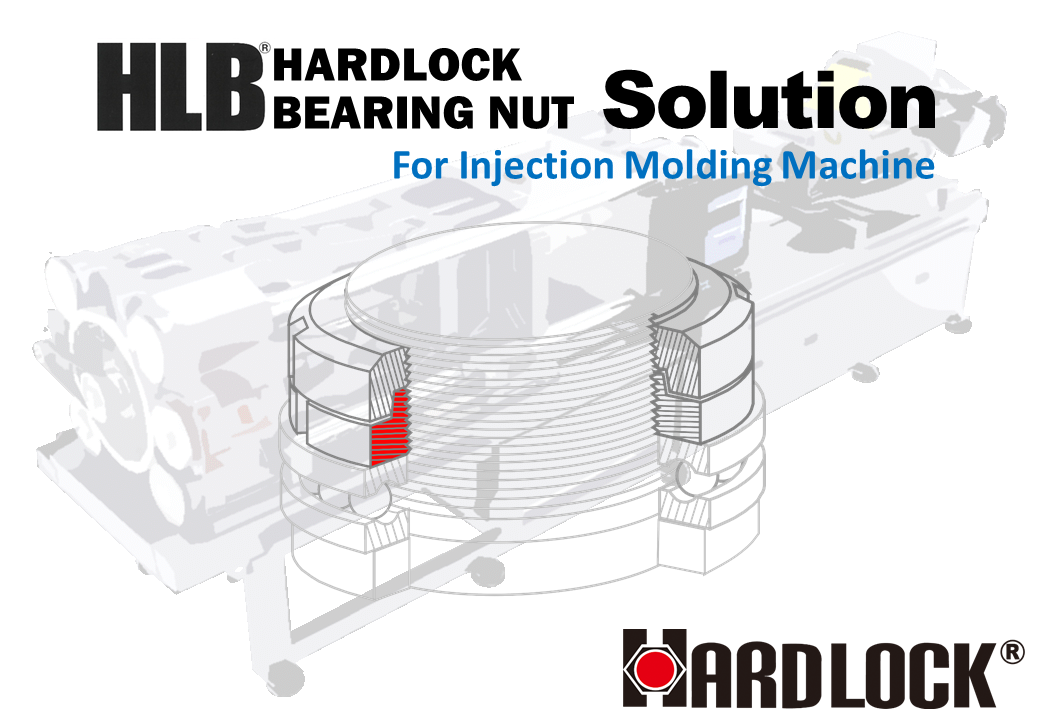
In modern manufacturing, the anti loosening bearing nut for ball screws plays a critical role in maintaining precision and reliability. Injection molding machines operate under high vibration and repetitive motion, which often leads to conventional nuts loosening over time. This can cause misalignment, reduced product quality, and costly downtime.
HARDLOCK® Bearing Nut is used in injection molding machines to help maintain secure bearing fixation and stable preload, ensuring consistent machine performance.
Why Bearing Fixation Matters in Injection Molding Machines
In injection molding machines, the screw and drive system rely on bearings that must be precisely positioned and securely fixed on the shaft.
Bearing lock nuts are responsible for:
- Fixing bearings in the correct axial position
- Maintaining preload
- Preventing movement during operation
These factors directly influence:
- Injection accuracy
- Repeatability of production
- Final product quality
The Challenge: Dynamic Loads and Thermal Effects
Injection molding machines operate under complex mechanical and thermal conditions.
High Axial Loads on the Screw
During operation:
- The screw moves forward under high pressure
- Significant axial forces act on bearings
- Load variations occur during injection cycles
These forces can affect preload in conventional fastening systems.
Continuous Rotation and Vibration
The screw rotation generates:
- Cyclic mechanical loads
- Vibration during operation
- Stress on bearing fixation points
Over time, this can lead to loosening of standard lock nuts.
Thermal Expansion
Injection molding involves:
- High processing temperatures
- Heating and cooling cycles
- Expansion of machine components
Thermal changes can reduce preload and compromise fastening stability.
Precision Requirements
Even minor movement can result in:
- Inconsistent injection pressure
- Dimensional inaccuracies
- Increased scrap rates
👉 Learn more about preload loss:
https://www.hardlock.eu/why-do-bolts-nuts-come-loose-factors-influencing-bolt-preload-loss/
Why Preload Stability Is Critical in Plastic Processing
Maintaining preload ensures:
- Accurate positioning of the screw and bearings
- Consistent injection pressure
- Stable machine operation
Loss of preload can lead to:
- Bearing movement
- Increased vibration
- Reduced product quality
HARDLOCK® Bearing Nut: Mechanical Locking for Precision Machinery
HARDLOCK® Bearing Nut uses a mechanical wedge-locking principle that maintains preload without relying on friction.
How it works:
- Two nuts (convex + concave) act as a single system
- An eccentric thread generates radial locking force
- This force prevents rotational loosening
This design ensures stable fastening even under:
- Repeated load cycles
- Thermal expansion
- Continuous operation
👉 Full explanation:
https://www.hardlock.eu/why-the-hardlock-nut-does-not-loosen/
Where HARDLOCK® Bearing Nut Is Used in Injection Molding Machines
HARDLOCK® Bearing Nut is applied in:
- Screw drive systems
- Bearing fixation on rotating shafts
- High-precision mechanical assemblies
These locations require stable preload and accurate positioning to maintain production quality.
Key Benefits for Injection Molding Applications
✔ Maintains Precise Bearing Positioning
Ensures accurate axial positioning of the screw, supporting consistent injection performance.
✔ Prevents Loosening Under Dynamic Loads
Maintains clamping force even under cyclic loading and vibration.
✔ Improves Product Quality and Consistency
Stable machine operation contributes to:
- Reduced defects
- Improved dimensional accuracy
- Consistent production output
✔ Reduces Maintenance and Downtime
Reliable fastening can help:
- Extend maintenance intervals
- Reduce retightening operations
- Minimize production interruptions
✔ Supports High-Precision Manufacturing
Designed for applications where:
- Accuracy is critical
- Stability is required over long production cycles
- Equipment reliability impacts output quality
Comparison with Conventional Bearing Locking Methods
Traditional solutions include:
- Lock washers
- Tab washers
- Set screws
Limitations:
- Wear over time
- Reduced effectiveness under vibration
- Sensitivity to thermal expansion
HARDLOCK® Bearing Nut provides a mechanical locking solution independent of friction, making it suitable for precision machinery.
👉 Compare fastening technologies:
https://www.hardlock.eu/hardlock-nut-vs-prevailing-torque-type-nut/
Engineering Perspective: Cost of Instability in Injection Molding
In plastic processing, fastening reliability directly impacts:
- Product quality
- Scrap rates
- Production efficiency
Failure of bearing fixation can result in:
- Machine misalignment
- Increased vibration
- Production downtime
Reliable fastening solutions help reduce these risks.
👉 Learn more about benefits:
https://www.hardlock.eu/hardlock-nut-main-benefits/
Related Applications in Precision and Rotating Equipment
Similar challenges exist in:
- Pumps → https://www.hardlock.eu/hardlock-bearing-nut-in-pumps/
- Steel production lines → https://www.hardlock.eu/hardlock-bearing-nut-in-steel-making-lines/
- Automotive production → https://www.hardlock.eu/hardlock-nut-in-automotive-industry/
- HARDLOCK® Set Screw on TESLA Die Castings → https://www.hardlock.eu/hardlock-set-screw-on-tesla-die-castings/
- Injection Molding Machines → https://www.hardlock.eu/hardlock-bearing-nut-in-injection-molding-machines-2/
- Where Is HARDLOCK® Nut Used? Key Applications Across Industries → https://www.hardlock.eu/where-is-hardlock-nut-often-used/
- Injection Molding Machines → https://www.hardlock.eu/hardlock-bearing-nut-in-injection-molding-machines/
👉 Explore full application range:
https://www.hardlock.eu/where-is-hardlock-nut-often-used/
When to Use HARDLOCK® Bearing Nut in Injection Molding Machines
Consider this solution if your application involves:
- Rotating shafts with bearings
- High axial loads
- Thermal cycling
- High precision manufacturing requirements
Conclusion
Injection molding machines require fastening solutions that ensure precise positioning and long-term stability.
By maintaining preload and preventing loosening, HARDLOCK® Bearing Nut provides a mechanical solution for reliable bearing fixation and consistent plastic processing performance.
Looking to Improve Production Stability?
Choosing the right fastening system can improve product quality, reduce downtime, and enhance overall manufacturing efficiency.
👉 Start with the fundamentals:
https://www.hardlock.eu/why-do-bolts-nuts-come-loose-factors-influencing-bolt-preload-loss/