Introduction
Suspension bridges represent some of the most demanding engineering structures in the world. Their integrity depends on thousands of bolted joints exposed to continuous dynamic loads, wind-induced vibration, and temperature fluctuations.
In such environments, even minimal loosening of fasteners can lead to:
- loss of structural integrity
- increased maintenance costs
- long-term safety risks
To prevent these failures, engineers increasingly rely on advanced anti-loosening technologies such as HARDLOCK® nuts.
👉 Learn how the locking mechanism works:
https://www.hardlock.eu/hardlock-nut-the-worlds-strongest-self-locking-nut/
The Challenge: Dynamic Loads and Vibration in Suspension Bridges
Unlike static structures, suspension bridges are constantly moving:
- wind-induced oscillations (aerodynamic forces)
- traffic-induced dynamic loading
- thermal expansion and contraction
- cable vibrations and resonance
These forces create micro-movements in bolted joints, leading to gradual preload loss.
This fundamental problem is explained here:
👉 https://www.hardlock.eu/hardlock-nut-the-worlds-strongest-self-locking-nut/
Without proper locking, standard fasteners may:
- loosen over time
- require frequent maintenance
- compromise long-term reliability
Real-World Applications of HARDLOCK® Nuts in Suspension Bridges
1. Main Cable Clamps and Anchorage Systems
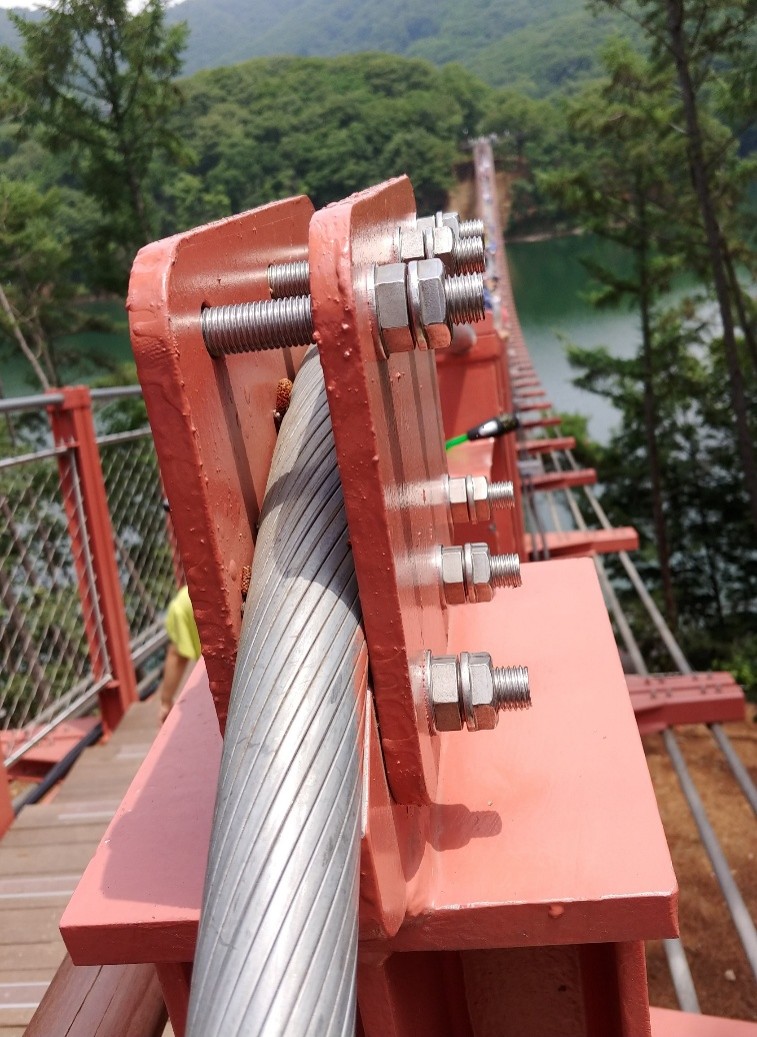
Cable clamps are critical components that transfer loads between cables and structural elements.
Challenges:
- constant tension variation
- vibration from wind and traffic
- long-term fatigue stress
HARDLOCK® nuts ensure stable clamping force without loosening, even under continuous dynamic load.
2. Deck Connections and Structural Joints
Bridge decks experience:
- repeated loading cycles from vehicles
- expansion due to temperature changes
- torsional movement
Typical fastening points:
- steel beam connections
- deck segment joints
- reinforcement structures
A comparable vibration-heavy environment is described in:
👉 https://www.hardlock.eu/hardlock-nut-on-vibration-screens/
3. Hanger Connections and Vertical Suspension Elements
Hangers connect the main cable to the bridge deck and are exposed to:
- cyclic tensile loads
- oscillation from wind
- stress concentration at connection points
Failure in these joints can have critical consequences.
HARDLOCK® nuts provide a mechanical locking effect that remains stable over time, even under fluctuating loads.
4. Maintenance Platforms and Auxiliary Structures
Secondary structures such as:
- inspection walkways
- lighting systems
- safety barriers
are also exposed to vibration and environmental conditions.
In similar infrastructure and energy-related applications, reliability is crucial:
👉 https://www.hardlock.eu/hardlock-nut-in-electrical-applications/
Why HARDLOCK® Nuts Are Ideal for Bridge Engineering
1. Extreme Resistance to Loosening
HARDLOCK® nuts use a unique convex–concave wedge locking system that eliminates thread clearance and prevents rotational loosening.
👉 Technical explanation:
https://www.hardlock.eu/hardlock-nut-the-worlds-strongest-self-locking-nut/
2. Long-Term Structural Reliability
For infrastructure projects, durability over decades is essential.
- maintain preload over long periods
- resist vibration, shock, and environmental stress
- are suitable for safety-critical structures
3. Reduced Maintenance Costs
Bridge maintenance is expensive and logistically complex.
Using HARDLOCK® nuts results in:
- fewer inspections related to loosening
- elimination of re-tightening operations
- reduced downtime
See full benefits:
👉 https://www.hardlock.eu/hardlock-nut-main-benefits/
4. Reusability and Sustainability
HARDLOCK® nuts are:
- fully metallic
- reusable without performance loss
This supports:
- cost efficiency
- sustainable infrastructure solutions
Comparison: HARDLOCK® vs Conventional Fastening Methods
| Feature | Standard Nut | Nylon Lock Nut | Adhesive | HARDLOCK® Nut |
|---|---|---|---|---|
| Vibration resistance | Low | Medium | Medium | Extreme |
| Maintenance | High | Medium | High | Minimal |
| Lifespan | Medium | Low | Low | Very Long |
| Reusability | High | Low | None | High |
| Suitability for infrastructure | Low | Medium | Medium | Excellent |
Related Articles
Explore more applications of HARDLOCK® technology:
- Steel structures → https://www.hardlock.eu/hardlock-nut-on-steel-structures/
- Bridge Structures → https://www.hardlock.eu/hardlock-nut-on-bridge-structures/
- Noise barriers → https://www.hardlock.eu/hardlock-nut-on-noise-barriers/
- Foundation bolts → https://www.hardlock.eu/hardlock-nut-on-foundation-bolts/
- Railway (Infrastructure) → https://www.hardlock.eu/anti-loosening-nuts-for-highways-how-hardlock-improves-safety-and-reduces-maintenance/
- Auxiliary Railway Equipment → https://www.hardlock.eu/hardlock-nuts-in-auxiliary-railway-equipment/
- Rail Track Systems → https://www.hardlock.eu/hardlock-nuts-in-rail-track-systems/
- Suspension Bridges → https://www.hardlock.eu/hardlock-nuts-in-suspension-bridges/
- Railway Lines → https://www.hardlock.eu/hardlock-nut-in-railway-lines/
- Ventilation Fans → https://www.hardlock.eu/hardlock-nut-on-ventilation-fans/
- Railroad Switches → https://www.hardlock.eu/hardlock-nut-in-railroad-switches/
Conclusion: Securing the Future of Bridge Infrastructure
Suspension bridges require fastening solutions that deliver:
- zero loosening
- long-term reliability
- minimal maintenance
HARDLOCK® nuts provide a proven mechanical solution for ensuring the safety and durability of critical infrastructure.
📩 Working on bridge construction or maintenance projects?
Working on bridge construction or maintenance projects?
👉 Contact HARDLOCK® specialists for:
- engineering consultation
- application-specific recommendations
- technical documentation and testing data
HARDLOCK® – Reliable fastening for critical infrastructure.