Locking Nut Total Cost of Ownership: Standard Locknuts and Double Nuts vs HARDLOCK®
A conventional locknut may be inexpensive. Two standard nuts used as a double-nut arrangement may also appear to be a low-cost solution.
But the purchase price of the nut is only one part of the cost of a bolted joint.
A locking nut total cost of ownership review also measures the labour, access, downtime and replacement cost created throughout the service life of the connection.
In railway systems, mining equipment, steel plants, power generation, paper machines, bridges and other vibration-critical applications, the larger costs may come later:
- inspection labour,
- scheduled re-tightening,
- difficult access to the joint,
- replacement of single-use or degraded locking elements,
- production or vehicle downtime,
- secondary component damage,
- and the operational risk created by a loose connection.
The relevant procurement question is therefore not simply:
“Which nut has the lowest unit price?”
It is:
“Which fastening system delivers the lowest verified lifecycle cost under the real service conditions of this joint?”
HARDLOCK® Nuts normally have a higher initial purchase price than a standard hex nut or many common locknuts. Their economic value must therefore be justified by engineering evidence: resistance to rotational self-loosening, repeatable installation, reusability where permitted, fewer maintenance interventions and lower downtime exposure.
This article compares conventional locknuts, ordinary double nuts and HARDLOCK® without assuming that one solution is correct for every joint.
For the basic loosening mechanism, read:
Why Bolts Loosen (And How HARDLOCK® Nuts Prevent It)
Why the Cheapest Locking Nut Can Create the Highest Operating Cost
A fastener is usually a very small item in the bill of materials. Accessing it in service may not be small at all.
A loose nut on an accessible, non-critical guard is a different economic problem from a loose nut on:
- a traction motor beneath a railway vehicle,
- a vibrating screen in a mine,
- a conveyor inside a steel plant,
- a turbine or gate mechanism in a hydropower station,
- a transmission tower in a remote location,
- or a structural joint requiring traffic closure or work at height.
In these applications, the maintenance task may require isolation, lifting equipment, scaffolding, specialist personnel, permits, shutdown coordination or removal of surrounding components. The fastener price may represent only a small fraction of the intervention cost.
How to calculate locking nut total cost of ownership
For a defined evaluation period, calculate:
Total cost of ownership = acquisition + installation + inspection + re-tightening + replacement + planned downtime + unplanned downtime + failure consequences
The calculation should use data from the actual plant, fleet or machine. It should not rely on a generic percentage saving.
Useful inputs include:
- number of affected joints,
- current loosening or re-tightening frequency,
- labour hours per inspection or intervention,
- access equipment and permit costs,
- replacement fastener and consumable costs,
- lost production or asset-availability cost per hour,
- expected disassembly cycles,
- and the consequence of secondary damage.
This approach explains why a higher-priced nut can still have the lower lifecycle cost. It also shows when a conventional solution remains economically sufficient.
For procurement and reliability teams, the locking nut total cost of ownership should be calculated for the specific joint population—not copied from a generic industry estimate.
Related industry example:
Steel Plant Downtime Reduction: ROI of Anti-Loosening Fasteners
First Separate Preload Loss from Rotational Self-Loosening
Technical credibility begins with an important limitation: no locking nut can correct every cause of clamp-load loss.
Bolted joints can lose preload without nut rotation because of:
- embedment and settling of contact surfaces,
- coating compression,
- gasket relaxation,
- material creep,
- thermal expansion differences,
- or plastic deformation caused by incorrect tightening.
A locking product addresses rotational self-loosening only if that is part of the failure mechanism. The joint must still be designed with suitable stiffness, preload, materials, surface condition and tightening control.
Transverse movement is particularly important. Gerhard Junker’s foundational SAE technical paper on self-loosening under vibration described a test method capable of comparing locking elements under repeated lateral movement. Modern transverse-displacement testing is covered by ISO 16130.
When relative slip occurs at the thread and bearing interfaces, small loosening rotations can accumulate and clamp load can fall rapidly. This is why a static torque check alone does not prove vibration resistance.
What Is Actually Being Compared?
The term “locknut” covers products with very different operating principles. They should not be treated as technically equivalent.
1. Standard hex nut
A correctly preloaded standard nut can be fully reliable where the joint remains clamped and transverse slip is prevented.
However, a standard nut has no additional anti-rotation mechanism. If joint movement overcomes the frictional conditions at the threads and bearing surface, rotational self-loosening may begin.
Best economic fit: stable, accessible and non-critical joints where the service loads are well controlled.
2. Non-metallic insert prevailing-torque nut
A nylon-insert nut creates prevailing torque through deformation and friction in the polymer insert. It can be an effective and economical product when used within its specified temperature, chemical and reuse limits.
ISO 2320:2015 covers functional properties for all-metal and non-metallic-insert prevailing-torque steel nuts. The standard notes that laboratory prevailing-torque values may differ from practical service values and that temperature influences performance. It lists typical use ranges of −50 °C to +150 °C for conforming all-metal types and −50 °C to +120 °C for conforming non-metallic-insert types.
The standard also requires the user to consider the reduction in prevailing-torque performance with reuse.
Best economic fit: cost-sensitive applications inside the product’s validated temperature, environment and reuse conditions.
3. All-metal prevailing-torque nut
All-metal prevailing-torque nuts create running resistance through controlled thread interference or deformation. They avoid a polymer insert and can be suitable for higher-temperature duties, subject to the specific material, coating and product qualification.
Prevailing torque is not the same as joint preload. Friction used to create running resistance also affects the relationship between installation torque and achieved clamp load. Product-specific tightening data and validation remain necessary.
Best economic fit: applications needing a compact all-metal nut where the specified prevailing-torque performance is sufficient.
4. Ordinary double nut or jam-nut arrangement
Two ordinary nuts can create significant resistance to loosening—but only when the required locking state is established correctly.
A University of Tokyo/JSME study of double-nut tightening found that a properly created locked state can make a double-nut arrangement highly effective. It also found that the anti-loosening benefit cannot be relied upon if the locking state is not achieved correctly.
A later Engineering Failure Analysis study reached the same central conclusion: correct locking is decisive. The paper also found poor performance for a spring washer in the transverse-loading configuration studied.
More recent transverse-vibration experiments on ordinary and flat-slave double nuts showed that performance changes with the torque ratio between the two nuts. Some configurations maintained a slow preload-decay stage for more than 7,000 vibration cycles, but those results belong to the tested M16 assemblies and torque ratios; they are not a universal rating for every double-nut joint.
The engineering weakness of the ordinary double nut is therefore not that it can never work. It is that its performance depends strongly on assembly procedure, nut order, torque distribution and verification of the locked state.
Best economic fit: applications with sufficient axial space, controlled work instructions, trained installers and reliable assembly verification.
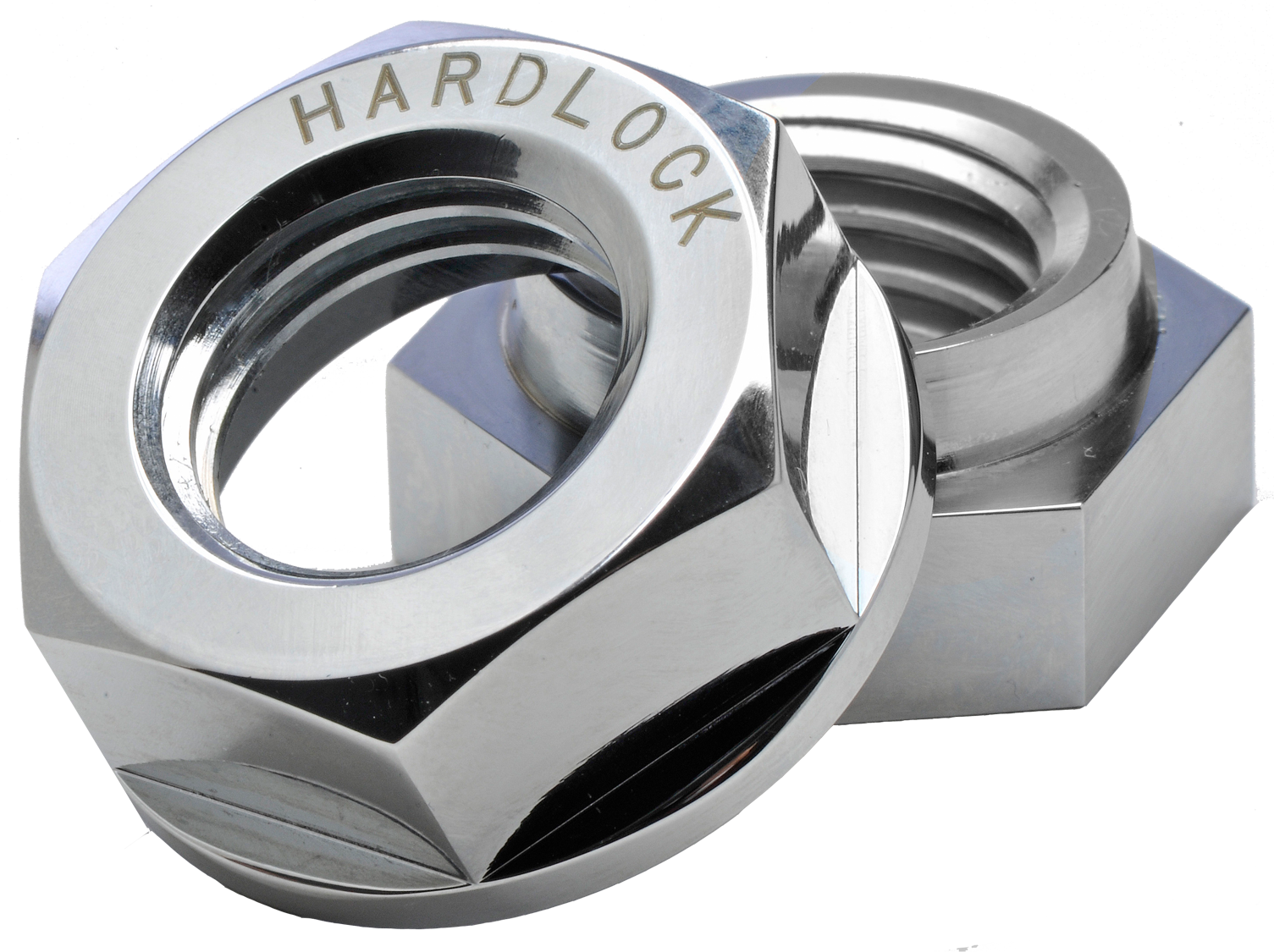
5. HARDLOCK® Nut
HARDLOCK® also uses two nuts, but it is not an ordinary jam-nut arrangement.
The system consists of:
- a lower Convex Nut with a tapered eccentric projection,
- and an upper Concave Nut with a tapered concentric recess.
The Convex Nut is tightened to establish the specified joint preload. When the Concave Nut is tightened, the eccentric interface produces a wedge effect across the bolt axis. The two nuts load opposite sides of the bolt thread, creating a mechanical locking state within the threaded connection.
The locking function is therefore created by purpose-designed geometry rather than by relying only on prevailing torque, bearing-face friction or the counter-tightening of two standard nuts.
Correct installation is still essential. Bolt grade, thread, required preload, lubrication, available thread projection, material, coating and Concave Nut tightening requirements must all be checked.
Technical explanation:
HARDLOCK® Nut: Main Benefits and How It Prevents Loosening
Standard Locknuts, Double Nuts and HARDLOCK®: Engineering Comparison
| Solution | Primary locking principle | Main installation sensitivity | Reuse consideration | Typical TCO position |
|---|---|---|---|---|
| Standard hex nut | Preload-generated thread and bearing friction | Correct preload and prevention of joint slip | Normally reusable if undamaged and permitted by the specification | Lowest purchase cost; economical for stable, accessible joints |
| Nylon-insert prevailing-torque nut | Polymer deformation and friction | Temperature, chemical exposure, lubrication and insert condition | Prevailing torque can decrease with reuse | Low initial cost; lifecycle value depends on service limits and replacement policy |
| All-metal prevailing-torque nut | Controlled metallic thread interference | Coating, lubrication, installation torque and product tolerance | Performance must be checked against the applicable standard and reuse policy | Compact solution; moderate acquisition cost and application-dependent maintenance value |
| Ordinary double nut | Locking of two standard nuts against each other | Nut order, torque ratio and correct creation of the locked state | Potentially reusable if undamaged, but assembly must be recreated correctly | Low component cost but more installation time and high process sensitivity |
| HARDLOCK® Nut | Eccentric mechanical wedge between Convex and Concave Nuts | Correct preload, Concave Nut tightening, thread engagement and installation space | Manufacturer publishes repeated-use testing; reuse remains conditional on inspection and instructions | Higher acquisition cost; strongest business case where access, downtime or failure is expensive |
No generalized table can replace application testing. The correct selection depends on joint movement, preload, temperature, environment, maintenance strategy and consequence of failure.
For a broader product comparison, see:
HARDLOCK® Nuts vs Locking Nuts & Washers: Which Solution Performs Best Under Vibration?
Serrated Washers vs HARDLOCK® Nuts: Preload & Reuse
What the Tests Actually Show
Test names should never be used as marketing labels without the test conditions. Amplitude, preload, frequency, number of cycles, lubrication, specimen size and pass/fail criterion can change the result.
1. Junker transverse-vibration testing
The Junker test applies repeated displacement transverse to the bolt axis while clamp load is monitored. It is demanding because it directly promotes the interface slip associated with rotational self-loosening.
The original method was introduced in Junker’s 1969 SAE paper. ISO 16130 now defines dynamic testing of locking behaviour under transverse loading. A Junker graph should therefore be read together with the full test setup—not as a stand-alone product badge.
Related HARDLOCK.EU article:
Junker Test Lock Nut: HARDLOCK® Vibration Proof Nut
2. Published HARDLOCK® comparison test
HARDLOCK Industry publishes a comparative Junker test using:
- M12 specimens,
- transverse displacement of ±0.35 mm,
- 10 Hz frequency,
- and 1,500 cycles.
The published comparison includes a HARDLOCK® Nut, a standard hex nut, a flange nut, a nylon-insert nut and a hex nut with a spring washer. The manufacturer’s graph shows the HARDLOCK® assembly retaining clamp load through the test, while the comparison products lose substantially more clamp load under the stated setup.
The spring-washer result is consistent with a broader warning in NASA Reference Publication 1228. The NASA Fastener Design Manual explains that, once a helical spring lock washer is fully compressed under correct fastener preload, it acts essentially as a flat washer and no longer provides an independent locking function. This NASA guidance is not a HARDLOCK comparison test, but it helps explain why a familiar component should not automatically be treated as a verified vibration-locking system.
This is relevant product evidence, but it must be described accurately as a manufacturer-published comparative test, not as an independent certification of universal superiority.
View the HARDLOCK Industry Junker test page and the HARDLOCK technical data PDF.
3. Independent peer-reviewed evidence
A peer-reviewed review of anti-loosening methods for threaded fasteners, published in the Chinese Journal of Aeronautics, identifies HARDLOCK® as a typical commercial example of an eccentric double-nut system.
The review describes this principle as a combination of a Convex Nut with an eccentric projection and a Concave Nut with a concentric recess. When tightened together, the two components generate a transverse locking effect through the wedge principle.
The authors also summarize Junker vibration experiments on eccentric double nuts by Sawa and colleagues. In the referenced comparison, the eccentric double-nut arrangement showed the lowest preload loss among the ten anti-loosening structures evaluated. The review concludes that eccentric double nuts generally demonstrate outstanding anti-loosening performance compared with other nut-based locking structures.
This provides valuable independent technical support for the locking principle. However, the review synthesizes results from defined test programmes; performance remains dependent on the specimens, preload levels and loading conditions. The findings should not be interpreted as proof that one locking solution is optimal for every bolted joint.
4. NAS 3350/3354-conforming accelerated vibration test
HARDLOCK Industry also publishes an accelerated vibration and impact test programme described as conforming to NAS 3350/3354.
The published method includes:
- M16 specimens,
- four material groups,
- four nut arrangements,
- a six-hour assembled heat exposure at the specified test temperature,
- vibration at approximately 1,750–1,800 cycles per minute,
- and up to 30,000 cycles, unless the specimen rotates through 360° earlier.
The technical document explicitly explains that the company calls its method “conforming to” NAS 3350/3354 because the implemented conditions are not identical to every requirement of the original inch-size aerospace procedure. That distinction should be retained in technical and marketing communication.
5. Reuse testing
Reuse is a direct lifecycle-cost factor. A product that can be safely reused may reduce replacement stock and consumable waste during planned maintenance.
HARDLOCK Industry’s published reuse programme used M12 components and combined:
- 51 tightening operations,
- six Junker tests,
- an initial target preload of 70% of bolt yield,
- ±0.35 mm transverse displacement,
- and 1,500 vibration cycles per Junker test.
The technical document reports remaining clamp load examples of 93% after the first tightening/Junker sequence, 95% after the 11th and 21st, and 97% after the 31st. These values belong to that defined laboratory programme and should not be presented as a guaranteed field result for every material, size or joint.
The practical conclusion is narrower and more useful: the all-metal wedge mechanism was subjected to repeated tightening and vibration testing without relying on a consumable polymer insert or cured adhesive. Reuse must still follow the manufacturer’s inspection criteria, tightening instructions and application approval.
Evidence Summary: Source, Result and Limitation
| Evidence source | What was evaluated | Relevant result | Correct limitation |
|---|---|---|---|
| Junker, SAE Technical Paper 690055 (1969) | Self-loosening under vibration and a quantitative comparison method | Established transverse movement as a rigorous basis for evaluating locking devices | Foundational method, not a HARDLOCK product comparison |
| ISO 16130 | Dynamic locking behaviour under transverse loading | Provides a standardized test framework | A standard defines a method; it does not rank all products |
| ISO 2320:2015 | Functional properties of prevailing-torque steel nuts | Laboratory torque values can vary in service; temperature and reuse matter | Applies to defined prevailing-torque nut types and conditions |
| Izumi et al., Engineering Failure Analysis (2009) | Double nuts and spring washers under transverse loading using 3D FEM with comparison to experimental work | Properly locked double nuts showed significant resistance; improper locking removed the benefit | Not a direct HARDLOCK test; results are configuration-specific |
| Xu et al., Structures (2025) | Ordinary and flat-slave double nuts at different torque ratios | Anti-loosening performance depended strongly on the torque ratio | Tested M16 assemblies cannot define every double-nut application |
| Gong et al., Chinese Journal of Aeronautics (2022), peer-reviewed review | Published research on conventional anti-loosening structures, including eccentric double nuts | Identifies HARDLOCK® as a typical eccentric double nut and reports that the cited Junker comparison found the lowest preload loss for the eccentric double-nut arrangement among ten structures evaluated | A review synthesizes defined studies; results remain dependent on their specimens, preload and loading conditions |
| HARDLOCK Industry comparative Junker data | HARDLOCK vs hex, flange, nylon and spring-washer arrangements | HARDLOCK retained clamp load in the published M12, ±0.35 mm, 10 Hz, 1,500-cycle test | Manufacturer-published data; test conditions must accompany the claim |
| HARDLOCK Industry reuse programme | Repeated tightening combined with Junker testing | 51 tightening operations and six Junker tests were included | Reuse in service remains conditional on product and joint inspection |
How HARDLOCK® Can Reduce Operating Cost
The economic case for HARDLOCK® does not come from claiming that the nut is cheaper. It comes from reducing expensive activities around the nut.
✔ Fewer loosening-related interventions
Where a conventional nut repeatedly rotates loose, a mechanically locked threaded connection can reduce corrective re-tightening and replacement work.
✔ Lower access cost
The benefit grows where fasteners are located:
- at height,
- under vehicles,
- behind guards or covers,
- inside production equipment,
- in remote infrastructure,
- or in areas requiring isolation and permits.
✔ Reduced downtime exposure
A planned fastener upgrade can be much less expensive than an unplanned production stop, train withdrawal, turbine outage or emergency field repair.
✔ Reuse during planned disassembly
An all-metal system with published repeated-use testing can reduce replacement consumption where the product is inspected, approved and reinstalled according to instructions.
✔ More predictable maintenance planning
The objective is not to remove necessary inspection without evidence. It is to use verified joint performance to move from repeated reactive intervention toward risk-based, predictable maintenance intervals.
✔ Reduced secondary damage risk
Maintaining a secure connection can help avoid movement, fretting, misalignment, fatigue loading and damage to adjacent components. The exact benefit depends on the joint and must be assessed by the responsible engineer.
When Does the Higher HARDLOCK® Purchase Price Make Business Sense?
HARDLOCK® has the strongest total-cost case when several of the following conditions are present:
- repeated loosening has already occurred,
- transverse vibration or impact cannot be designed out,
- re-tightening is part of the maintenance routine,
- access is difficult or hazardous,
- equipment downtime is expensive,
- the joint is safety- or availability-critical,
- long inspection intervals are required,
- adhesives or polymer inserts are unsuitable,
- planned disassembly and reuse are expected,
- or the existing locking method produces inconsistent results.
A standard nut or conventional locknut may remain the correct economic choice where:
- vibration is low,
- joint slip is reliably prevented,
- access is easy,
- failure consequence is minor,
- replacement is inexpensive,
- and the selected product has been validated for the service conditions.
This is not a premium-fastener argument for every bolt. It is a risk-based selection strategy for the joints where operating cost dominates purchase cost.
Use-Case Landing Pages: Where Lifecycle Cost Matters Most
Railway traction motors and rolling stock
Access beneath a vehicle, workshop time and fleet availability can make repeated re-tightening far more expensive than the fastener itself.
Traction Motor Locking Nuts: HARDLOCK® Railway Solution
Railway Locking Nuts for Brake Systems: HARDLOCK®
Mining and earth-moving equipment
Vibration, impact, abrasive conditions and field access increase both intervention time and lost-production exposure.
Mining Locking Nuts: HARDLOCK® for Mining Equipment
Steel plants, conveyors and hoppers
A small fastening problem can interrupt a high-output process. Maintenance access may involve guards, hot zones, heavy components and coordinated shutdown work.
Vibration Resistant Nuts Steel Plant: Conveyor & Hopper Failures Solved
Steel Plant Downtime Reduction: ROI of Anti-Loosening Fasteners
Hydropower turbines and gates
Rotating equipment, cyclic loading, water exposure and limited maintenance windows place a premium on predictable fastening reliability.
Hydropower Plant Locking Nuts: HARDLOCK® for Turbines & Gates
Paper machines
Continuous operation, rotating rolls, vibration, moisture and restricted access make repeat fastening work costly.
Anti Loosening Nuts for Paper Machines: HARDLOCK®
Power transmission towers
Remote locations, work at height, outage planning and environmental exposure make each field intervention expensive.
Locking Nuts for Power Transmission Towers: HARDLOCK®
Bridges and civil infrastructure
Traffic management, access systems, long design life and public-safety requirements change the economics of a “small” fastener.
Anti Loosening Nut for Bridges: HARDLOCK® Nut Solution for Bridge Structures
For a cross-industry overview, see:
Industrial Locking Nuts for Critical Applications: HARDLOCK® Anti-Loosening Solutions
Procurement and Engineering Checklist
Before replacing a standard locknut or double-nut arrangement, collect the following information:
- Thread specification and size — including pitch, tolerance and available thread projection.
- Bolt property class and material — the nut and bolt must be mechanically compatible.
- Required preload — define the clamp load needed by the joint, not only an installation torque.
- Tightening condition — identify lubrication, coating, surface condition and torque-control method.
- Load direction — distinguish axial loading from transverse displacement, shock and combined loading.
- Temperature and environment — include thermal cycles, corrosion, chemicals, moisture and contamination.
- Joint materials — check embedment, creep, gasket relaxation and coating settlement.
- Available installation space — a two-part nut requires sufficient axial clearance and thread engagement.
- Disassembly and reuse plan — define inspection and replacement criteria before installation.
- Maintenance economics — quantify access labour, downtime and the consequence of failure.
- Validation method — select a representative test or monitored field trial with defined acceptance criteria.
Send the bolt size, joint drawing, required preload and operating conditions when requesting a technical evaluation. This allows the locking solution to be assessed as part of the complete joint—not as an isolated catalogue item.
Conclusion: Buy the Lowest Lifecycle Cost, Not the Lowest-Priced Nut
Conventional locknuts and ordinary double nuts have valid applications.
A prevailing-torque nut can be an economical solution inside its qualified operating limits. A correctly assembled ordinary double nut can provide significant resistance to loosening. A standard nut can be fully reliable when the joint remains properly clamped and transverse slip is prevented.
The limitation appears when these products are selected only because their purchase price is low, while the real costs of inspection, re-tightening, access, downtime and failure are ignored.
HARDLOCK® uses a purpose-designed eccentric wedge mechanism to create a mechanical locking state within the threaded connection. Published manufacturer testing includes comparative Junker testing, NAS 3350/3354-conforming accelerated vibration testing and repeated-use testing. A peer-reviewed review of anti-loosening methods also identifies HARDLOCK® as a typical eccentric double-nut system and summarizes transverse-vibration research reporting strong performance for eccentric double nuts under the conditions evaluated.
That evidence does not remove the need for correct joint design or application validation. It provides a technically defensible reason to evaluate a higher initial fastener cost against the much larger operating cost of a connection that repeatedly loosens.
For vibration-critical joints, the best-value nut is the one that keeps the asset available at the lowest verified total cost.
A documented locking nut total cost of ownership comparison makes that decision transparent to engineering, maintenance and procurement stakeholders.
Looking to Compare the Lifecycle Cost for Your Application?
Are you experiencing repeated loosening, inspection or re-tightening on industrial equipment or infrastructure?
HARDLOCK® can support:
- application-specific product selection,
- review of bolt size, material and installation conditions,
- vibration-test information,
- sample evaluation,
- retrofit assessment,
- and a joint-specific total-cost comparison.
Prepare the following four inputs for the first review:
- bolt size and property class,
- joint drawing or installation photograph,
- vibration, temperature and environmental conditions,
- current inspection, re-tightening and downtime history.
Frequently Asked Questions
Are HARDLOCK® Nuts more expensive than standard locknuts?
The initial purchase price is normally higher than for a standard hex nut and many conventional locknuts. The correct comparison is total cost of ownership, including installation, inspection, re-tightening, replacement, access, downtime and failure consequences.
Is an ordinary double nut effective against vibration?
It can be. Published engineering studies show that a correctly created locked state provides significant loosening resistance. The same studies warn that the benefit may disappear when the locking state is created incorrectly. Assembly procedure and verification are therefore decisive.
How is HARDLOCK® different from two standard nuts?
HARDLOCK® uses a lower Convex Nut with an eccentric tapered projection and an upper Concave Nut with a concentric tapered recess. Tightening the two components creates a transverse wedge force and mechanically locks the threaded connection. An ordinary double nut relies on the correct counter-tightening of two standard nuts.
What test is used to compare vibration-resistant locknuts?
The Junker transverse-vibration test is one of the best-known methods. It applies repeated lateral displacement while monitoring remaining clamp load. The test conditions and acceptance criterion must always accompany the result. ISO 16130 covers dynamic testing of locking behaviour under transverse loading.
Can HARDLOCK® Nuts be reused?
HARDLOCK Industry publishes a programme involving 51 tightening operations and six Junker tests. This supports the reuse capability of the tested all-metal system. Actual reuse must remain subject to product instructions, inspection, thread condition and approval for the specific application.
Does HARDLOCK® prevent every type of preload loss?
No. HARDLOCK® is designed to resist rotational self-loosening. It cannot eliminate preload loss caused by embedment, gasket relaxation, creep, plastic deformation or incorrect joint design. Those mechanisms must be addressed separately.
When should HARDLOCK® be considered?
It should be evaluated where vibration or shock is severe, conventional locking methods have not been reliable, maintenance access is difficult, downtime is expensive, reuse is valuable or joint failure has significant safety or availability consequences.
Technical References
- G. H. Junker, “New Criteria for Self-Loosening of Fasteners Under Vibration,” SAE Technical Paper 690055, 1969. DOI: 10.4271/690055.
- ISO 16130:2015, Aerospace series — Dynamic testing of the locking behaviour of bolted connections under transverse loading conditions.
- ISO 2320:2015, Fasteners — Prevailing torque steel nuts — Functional properties.
- R. T. Barrett, Fastener Design Manual, NASA Reference Publication 1228, 1990.
- S. Izumi, T. Yokoyama, M. Kimura and S. Sakai, “Loosening-resistance evaluation of double-nut tightening method and spring washer by three-dimensional finite element analysis”, Engineering Failure Analysis, 16(5), 1510–1519, 2009. DOI: 10.1016/j.engfailanal.2008.09.027.
- M. Kimura, S. Izumi and S. Sakai, “Tightening and Self-loosening Behavior of Double-nut Tightening System by Three-dimensional Finite Element Method”, Transactions of the Japan Society of Mechanical Engineers Series A, 72(719), 967–973, 2006. DOI: 10.1299/kikaia.72.967.
- Y. Xu et al., “Loosening behavior of double nut fasteners under transverse vibration”, Structures, 74, 108623, 2025. DOI: 10.1016/j.istruc.2025.108623.
- H. Gong, J. Liu and H. Feng, “Review on Anti-Loosening Methods for Threaded Fasteners”, Chinese Journal of Aeronautics, 35(2), 47–61, 2022. DOI: 10.1016/j.cja.2020.12.038.
- HARDLOCK Industry Co., Ltd., Junker Test for DIN 65151.
- HARDLOCK Industry Co., Ltd., HARDLOCK Nut Technical Data.